
J-K Gadzama LLP Announces 19th Annual Public Lecture on Future of Work
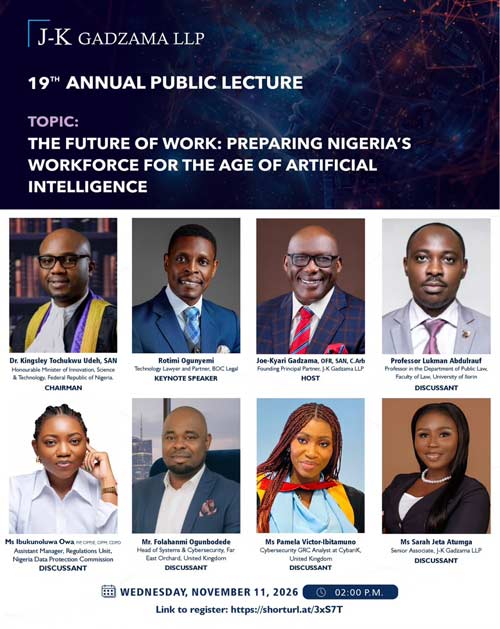
J-K Gadzama LLP has announced that its 19th Annual Public Lecture will take place in Nigeria on Wednesday, November 11, 2026, focusing on the profound impact of artificial intelligence (AI) on the future of employment, with Minister Udeh chairing the event and Rotimi Ogunyemi delivering the keynote address.
This upcoming lecture holds significant legal implications for practitioners, businesses, and employees across Nigeria. It underscores the growing recognition within the legal community that AI is not merely a technological advancement but a transformative force that will reshape labour laws, employment contracts, workplace policies, and intellectual property rights. The discussions are expected to delve into critical issues such as job displacement, the need for reskilling, ethical considerations in AI deployment, data privacy in automated workplaces, and the legal status of AI-generated content or inventions. For businesses, understanding these shifts is crucial for strategic workforce planning, risk management, and ensuring compliance with evolving regulatory landscapes.
The legal context for this discourse spans various existing statutes, including the Nigerian Labour Act, the Factories Act, and the Employees' Compensation Act, which may prove inadequate in addressing the complexities introduced by AI. Discussions will likely explore the need for new legislation or amendments to cover areas such as algorithmic management, discrimination in AI-driven hiring, and the protection of intellectual property created by or with the assistance of AI. The event brings together key parties such as J-K Gadzama LLP, Minister Udeh, Rotimi Ogunyemi, leading legal practitioners, technology experts, academics, and policymakers, fostering a multi-stakeholder dialogue on these pressing issues.
Attorneys should proactively engage with the insights generated from such forums, advising corporate clients on adapting employment contracts, developing AI-specific workplace policies, and navigating potential legal challenges related to AI integration. This includes counsel on data protection, intellectual property ownership, and compliance with anti-discrimination laws in an AI-driven environment. Businesses should consider establishing internal AI ethics committees and investing in legal audits to assess their readiness for the future of work, ensuring they remain compliant and competitive in an increasingly automated economy.
How does this affect you?
Get an AI analysis of this article grounded in your jurisdictions, practice areas, and any policy documents you've uploaded to Wansom.
Wansom is AI and can make mistakes.