
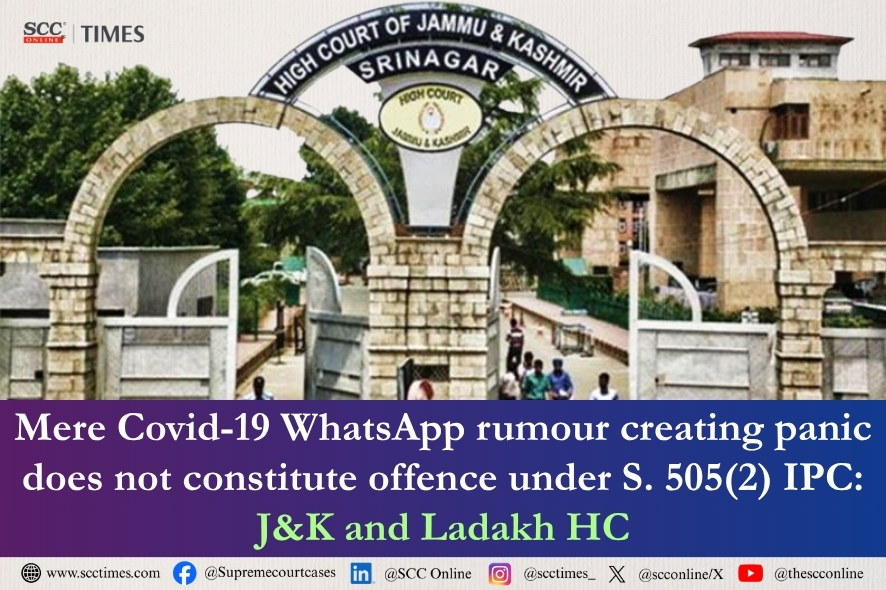
JK High Court: No Panic Offence for COVID-19 WhatsApp Rumours Under IPC
Summary
- The J&K and Ladakh High Court ruled that mere creation of panic through COVID-19-related WhatsApp rumors does not constitute an offence under Section 353(2) of the Bharatiya Nyaya Sanhita (BNS).
- The court held that the intent behind online statements is now a crucial factor in determining whether they constitute an offence under this section.
- This ruling sets a precedent for Indian courts to consider the intent behind online statements rather than just their potential to cause panic.
- The decision has significant implications for cases related to online harassment, cybercrime, and hate speech.
What Happened
The court held that fear or panic alone does not satisfy the provision unless the statement is intended, or likely, to promote enmity, hatred or ill-will between different groups.
The Jammu and Kashmir (J&K) and Ladakh High Court has made a significant ruling regarding the interpretation of Section 353(2) of the Bharatiya Nyaya Sanhita (BNS). In a recent judgment, the court held that mere creation of panic through COVID-19-related WhatsApp rumors does not constitute an offence under this section. This decision marks a shift in the approach of Indian courts towards online statements and their potential to cause harm.
Legal Context
Section 353(2) BNS is a provision that deals with the promotion of enmity, hatred, or ill-will between different groups. The section has been used in various cases to prosecute individuals for spreading rumors and creating panic through online statements. However, the J&K and Ladakh High Court's ruling suggests that the intent behind such statements is now a crucial factor in determining whether they constitute an offence under this section.
Why It Matters
This ruling has significant implications for Indian courts and lawyers handling cases related to online harassment, cybercrime, and hate speech. The decision sets a precedent that courts should consider the intent behind online statements rather than just their potential to cause panic. This shift in approach will likely lead to more nuanced and context-specific judgments in future cases. As such, lawyers should take note of this development and its potential impact on their practice.
Practical Implications
Lawyers should note that this ruling sets a precedent for Indian courts to consider the intent behind online statements, rather than just their potential to cause panic, when determining whether they constitute an offence under Section 505(2) IPC.
Source
Source: Original reporting via SCC Times
How does this affect you?
Get an AI analysis of this article grounded in your jurisdictions, practice areas, and any policy documents you've uploaded to Wansom.
Wansom is AI and can make mistakes.