
Murkomen: No Samburu Livestock Compensation Framework
Summary
- Interior Cabinet Secretary Kipchumba Murkomen stated there is no legal or policy framework for the National Police Service to compensate livestock owners for animals killed during security operations.
- This declaration came in response to demands for compensation following the deaths of hundreds of livestock during a recent security operation in Samburu.
- Murkomen emphasized the need for the Directorate of Criminal Investigations to verify the exact number of animals killed and the circumstances before any action.
- He linked persistent insecurity in northern Kenya to historical marginalisation and underdevelopment, advocating for significant infrastructure investment as a long-term solution.
- The government official suggested that reallocating funds from repeated security operations to development projects could more effectively address banditry.
Government Stance on Livestock Compensation
Murkomen clarified that the National Police Service currently operates without a legal or policy framework that would permit it to compensate individuals whose property, such as livestock, is destroyed or killed during security interventions.
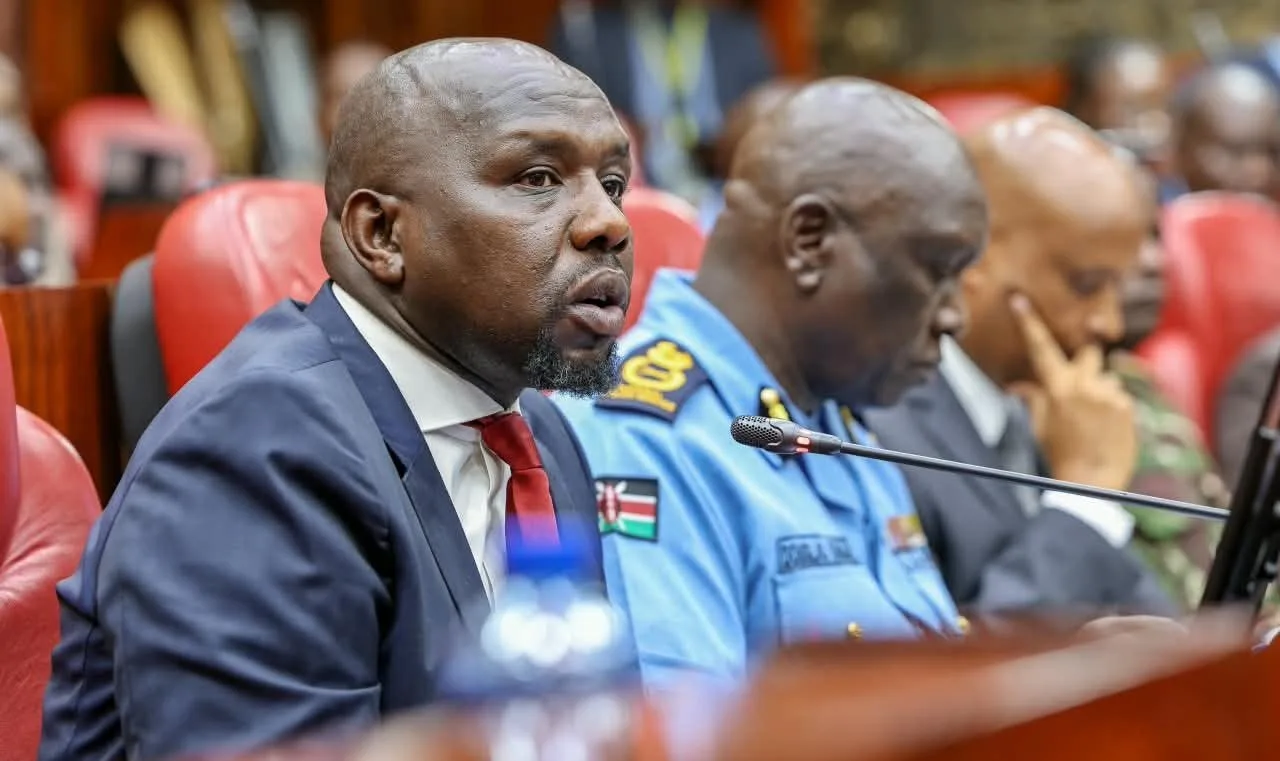
Interior Cabinet Secretary Kipchumba Murkomen recently informed the National Assembly Departmental Committee on Administration and Internal Security that the government would not provide compensation for livestock lost during a recent security operation in Samburu. Speaking on Wednesday, Murkomen clarified that the National Police Service currently operates without a legal or policy framework that would permit it to compensate individuals whose property, such as livestock, is destroyed or killed during security interventions. This position underscores a significant gap in the existing criminal justice system regarding restitution for victims of crime or collateral damage from state operations.
The issue of compensation arose following a security operation in Samburu, which reportedly resulted in the deaths of hundreds of animals. Local leaders and affected families have vociferously demanded recompense for their losses, generating considerable public anger. The National Assembly had specifically summoned both Cabinet Secretary Murkomen and Inspector-General of Police Douglas Kanja to provide an explanation for the events and address the calls for compensation. However, Murkomen maintained that, from the perspective of the criminal justice system, the necessary legal and policy mechanisms for such payments are simply not in place.
Unverified Losses and Investigative Imperatives
Amidst the calls for compensation, there remains significant uncertainty regarding the exact number of livestock killed. Cabinet Secretary Murkomen cautioned against accepting any definitive figures before thorough investigations are concluded. He noted that an initial police report indicated 237 livestock fatalities, while other public estimates have ranged widely from 700 to over 1,000. Murkomen expressed skepticism about the authenticity of circulating photographs purportedly showing dead animals, emphasizing the critical need for the Directorate of Criminal Investigations (DCI) to establish the precise count, identify those responsible for the shootings, and determine the circumstances surrounding each incident.
Murkomen affirmed the government's fundamental duty to safeguard property, including livestock, but stressed that the specific conditions leading to the animals' deaths must first be definitively established. He assured the committee that any officers found to have acted unlawfully would face disciplinary action, and civilians proven culpable would also be subjected to the full force of the law. This stance highlights a commitment to accountability, even as the immediate question of compensation remains unresolved due to the absence of a clear Murkomen Samburu livestock compensation framework.
Addressing Root Causes of Insecurity
Beyond the immediate issue of compensation, Cabinet Secretary Murkomen offered a broader perspective on the persistent insecurity plaguing regions like Samburu, Isiolo, and Turkana, and other parts of northern Kenya. He attributed the root causes of banditry and conflict to historical marginalisation and a pervasive lack of development in these areas. Murkomen argued that security operations alone, while necessary, are insufficient to resolve these deep-seated problems.
Instead, Murkomen advocated for substantial government investment in critical infrastructure, particularly roads, to open up remote areas and integrate these communities more fully into the national economy. He specifically proposed developing routes such as Jemalingot-Kapedo-Lokichar, Tangulbei-Churo-Amaya, Maralal-Baragoi-North Horr, and the Isiolo-Wamba corridor extending to Baragoi and Parsaloi. Such improvements, he contended, would not only enhance access for security services but also facilitate trade, access to water, and greater interaction among communities. Furthermore, he suggested constructing dams and other water infrastructure to alleviate competition over pasture and water, which often fuels conflict among pastoralist groups. Murkomen posited that a strategic allocation of resources, for instance, Sh20 billion spread over five years for infrastructure development, could significantly reduce the need for costly, repeated security operations, drawing a contrast with developed towns like Eldoret and Kitale where banditry is not a comparable issue due to economic advancement.
Practical Implications
Lawyers advising clients whose property (livestock) is damaged or killed during security operations in Kenya should note that the government, through the National Police Service, currently asserts there is no legal or policy framework for compensation. This position significantly impacts the viability of claims for such losses against the state and highlights a gap in existing legal provisions.
Source
How does this affect you?
Get an AI analysis of this article grounded in your jurisdictions, practice areas, and any policy documents you've uploaded to Wansom.
Finish Reading the Full Story and the Expert Analysis.
Get the latest legal & regulatory intelligence in Kenya
Wansom is AI and can make mistakes.