
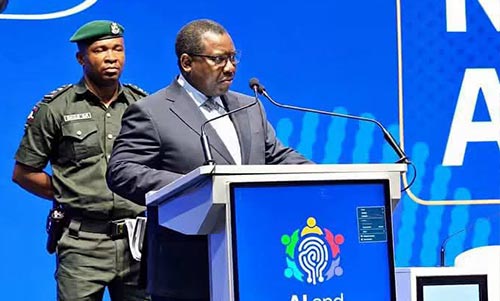
INEC Chairman Warns Against AI-Driven Election Manipulation
On Wednesday, at the Artificial Intelligence and Democracy Forum 2026 in Abuja, the Chairman of the Independent National Electoral Commission (INEC), Prof. Joash Amupitan, SAN, warned against AI-driven election manipulation, asserting that algorithms would not determine the outcome of Nigeria's 2027 general elections.
Prof. Amupitan's statement, delivered at a significant forum, underscores INEC's proactive stance on safeguarding the integrity of Nigeria's electoral process against emerging technological threats. By emphasizing that the decision rests solely with voters, INEC is signaling its commitment to human agency in democratic outcomes, directly addressing concerns about the potential for artificial intelligence to influence or distort public opinion and election results. This public declaration by the head of the electoral body serves as a crucial policy statement, setting the tone for future regulatory approaches to technology in elections and highlighting a critical area of focus for the upcoming general elections.
The legal significance of this development for practitioners lies in the anticipated evolution of electoral law and policy to address AI-related challenges. While current Nigerian electoral laws, primarily the Electoral Act 2022 and the 1999 Constitution (as amended), do not explicitly mention AI, provisions related to electoral offenses, voter inducement, misinformation, and the general conduct of free and fair elections would be relevant. This warning suggests that INEC may introduce guidelines or regulations to curb AI misuse, potentially leading to new grounds for electoral petitions or criminal charges related to technology-assisted manipulation. The statement also reinforces the constitutional mandate of INEC to organize and supervise elections, implying a duty to protect the process from novel forms of interference.
The key parties involved are the Independent National Electoral Commission (INEC), represented by its Chairman, Prof. Joash Amupitan, SAN, and the broader Nigerian electorate. The Artificial Intelligence and Democracy Forum 2026 in Abuja served as the platform for this important pronouncement. While no specific legal action is reported, the statement itself is a significant regulatory and policy development from the nation's chief electoral umpire.
Practitioners advising political parties, candidates, civil society organizations, or technology companies involved in the electoral space should closely monitor INEC's subsequent actions, guidelines, and pronouncements regarding AI. They should prepare for potential amendments to electoral laws or the introduction of new regulations aimed at preventing AI-driven manipulation, including deepfakes, targeted misinformation, and algorithmic bias in voter profiling. Understanding how existing laws on electoral offenses and fair campaigning will be interpreted in the context of AI is crucial, as is advising clients on ethical and legal compliance in their use of technology during the 2027 election cycle.
How does this affect you?
Get an AI analysis of this article grounded in your jurisdictions, practice areas, and any policy documents you've uploaded to Wansom.
Finish Reading the Full Story and the Expert Analysis.
Get the latest legal & regulatory intelligence in Nigeria
Wansom is AI and can make mistakes.