
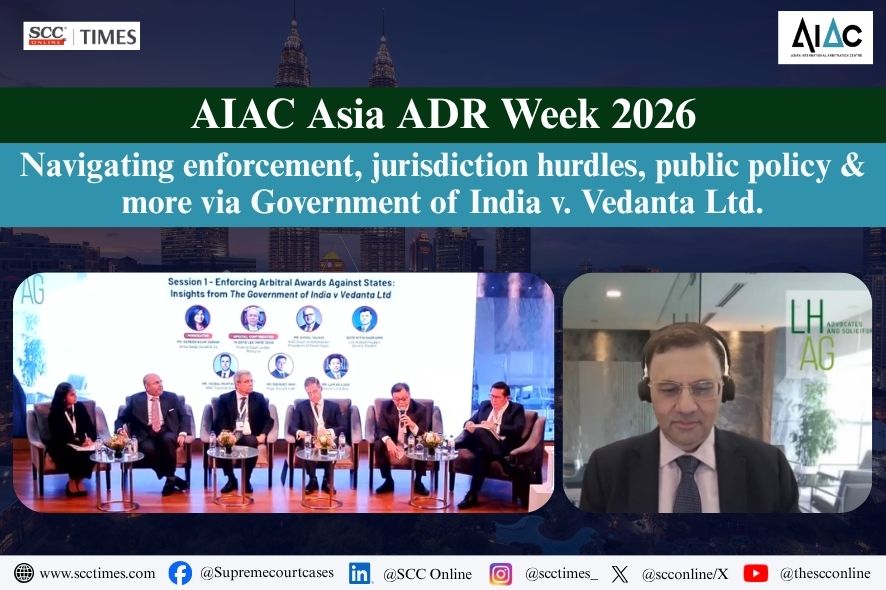
Government of India: Vedanta Arbitral Award Enforcement Challenges Explored
Summary
- The AIAC Asia ADR Week 2026 featured a panel discussing the enforcement of arbitral awards against states.
- The discussion used the case of *Government of India v. Vedanta Ltd* as a key example.
- Panelists examined issues including jurisdictional challenges, public policy, and sovereign immunity.
- The session also covered the supervisory role of courts and the enforcement of annulled awards.
- Complexities related to non-signatories in arbitration were also addressed during the event.
Key Discussions at AIAC Asia ADR Week 2026
Lawyers advising clients on international arbitration involving state parties must closely monitor the evolving legal landscape surrounding the enforcement of arbitral awards, particularly concerning challenges based on sovereign immunity, public policy, and jurisdictional issues, as these discussions at AIAC Asia ADR Week 2026 indicate ongoing complexities and potential pitfalls.
The AIAC Asia ADR Week 2026 featured a significant panel discussion titled "Enforcing Arbitral Awards Against States: Insights from The Government of India v. Vedanta Ltd." This session brought together experts to delve into the intricate challenges associated with the enforcement of international arbitral awards, particularly when a sovereign state is involved.
Panelists at the event meticulously examined a range of critical issues that frequently arise in such disputes. Their discussions encompassed the fundamental principles of enforcing international arbitral awards, the crucial supervisory role played by courts in these processes, and the common jurisdictional hurdles that can impede enforcement. The specific case of *Government of India v. Vedanta Ltd* served as a central reference point for these complex deliberations, highlighting real-world applications of the legal principles discussed.
Navigating Sovereign Immunity and Public Policy
A significant portion of the panel's focus was dedicated to the doctrines of public policy and sovereign immunity, which often present formidable obstacles to the enforcement of arbitral awards against states. These concepts allow states to invoke certain protections, potentially complicating or even preventing the recognition and execution of an award rendered against them. The discussions underscored the delicate balance between upholding international arbitration principles and respecting national sovereignty.
Further complexities explored included the enforcement of awards that have been annulled in their seat of arbitration, a scenario that raises profound questions about finality and international comity. The panel also addressed the challenges posed by non-signatories to arbitration agreements, examining how awards might be enforced against entities that were not direct parties to the original contract but are nonetheless implicated in the dispute. These detailed considerations are vital for understanding the landscape of Government of India Vedanta arbitral award enforcement.
Implications for International Arbitration in India
The insights shared during the AIAC Asia ADR Week 2026 are particularly pertinent for the field of international arbitration in India, given the country's increasing engagement in cross-border commercial and investment disputes. The *Government of India v. Vedanta Ltd* case exemplifies the types of enforcement challenges that can arise when dealing with state entities, making it a crucial reference for practitioners.
Lawyers advising clients on international arbitration involving state parties must closely monitor the evolving legal landscape surrounding the enforcement of arbitral awards, particularly concerning challenges based on sovereign immunity, public policy, and jurisdictional issues, as these discussions at AIAC Asia ADR Week 2026 indicate ongoing complexities and potential pitfalls. The ongoing dialogue around these issues underscores the need for robust legal strategies and a deep understanding of both national and international legal frameworks to successfully navigate the enforcement of arbitral awards against states.
Practical Implications
Lawyers advising clients on international arbitration involving state parties must closely monitor the evolving legal landscape surrounding the enforcement of arbitral awards, particularly concerning challenges based on sovereign immunity, public policy, and jurisdictional issues, as these discussions at AIAC Asia ADR Week 2026 indicate ongoing complexities and potential pitfalls.
Source
Source: Original reporting via SCC Times
How does this affect you?
Get an AI analysis of this article grounded in your jurisdictions, practice areas, and any policy documents you've uploaded to Wansom.
Finish Reading the Full Story and the Expert Analysis.
Get the latest legal & regulatory intelligence in India
Wansom is AI and can make mistakes.