
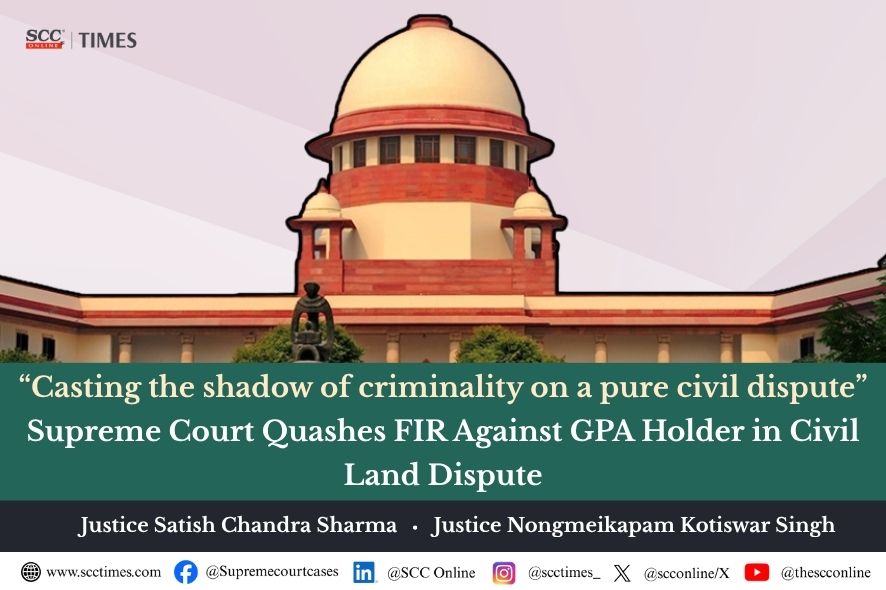
India Supreme Court: Quashes FIR Against GPA Holder in Civil Land Dispute
Summary
- The India Supreme Court recently quashed an FIR filed against a General Power of Attorney (GPA) holder in a land dispute.
- The Court determined that the allegations lacked the essential ingredients of cheating, a prerequisite for criminal charges.
- The dispute was explicitly categorized by the Supreme Court as purely civil in nature, not warranting criminal prosecution.
- This ruling reinforces the critical distinction between civil and criminal matters in property disputes.
- It provides a precedent against the criminalization of civil disputes, particularly those involving GPA holders, by emphasizing the necessity of criminal intent.
What Happened
This intervention by the India Supreme Court to quash an FIR against a GPA holder in a civil land dispute serves as a powerful reminder against the overreach of criminal law into areas traditionally governed by civil jurisprudence.
The Supreme Court of India recently intervened in a land dispute, taking a significant step by quashing a First Information Report (FIR) that had been lodged against a General Power of Attorney (GPA) holder. This decision by the apex court underscores a critical distinction between civil and criminal matters, particularly concerning property disagreements. The ruling effectively halted criminal proceedings that had been initiated in what the Court determined was fundamentally a civil issue.
The Court's rationale for quashing the FIR was twofold. Firstly, it found that the essential "ingredients of cheating," as defined under Indian criminal law, were conspicuously absent in the allegations made against the GPA holder. This determination is crucial, as the presence of deceptive intent from the outset is a prerequisite for establishing a charge of cheating. Secondly, the Supreme Court explicitly characterized the entire disagreement as "purely civil in nature," thereby reinforcing the principle that not every dispute, even one involving alleged wrongdoing, warrants criminal prosecution.
This intervention by the India Supreme Court to quash an FIR against a GPA holder in a civil land dispute serves as a powerful reminder against the overreach of criminal law into areas traditionally governed by civil jurisprudence. It provides clarity on the boundaries between civil grievances and criminal offenses, especially in complex property transactions where agents like GPA holders are involved.
Legal Context and Distinction
In Indian legal practice, a clear demarcation exists between civil and criminal proceedings, though this line is often blurred in property disputes. Civil cases typically involve disputes between individuals or organizations seeking remedies like compensation or specific performance, whereas criminal cases involve offenses against the state, punishable by imprisonment or fines. The charge of cheating, often invoked in land disputes, falls under Section 318(4) of the Bharatiya Nyaya Sanhita (BNS), 2023 (formerly Section 420 of the Indian Penal Code), which requires proof of dishonest inducement and fraudulent intent from the very inception of the transaction. Without this element of *mens rea* (guilty mind), a criminal charge cannot be sustained, even if a breach of contract or financial loss has occurred.
A General Power of Attorney (GPA) holder acts on behalf of another individual, often in property dealings, and their actions are typically governed by the terms of the power of attorney and civil contract law. The Supreme Court's decision highlights that disagreements arising from the performance or non-performance of a GPA holder's duties, or disputes over the validity of a land transaction, are primarily civil in character. Merely because a transaction goes awry or a party feels aggrieved does not automatically transform a civil wrong into a criminal offense, particularly if the initial intent was not dishonest. This distinction is vital for understanding GPA holder criminal liability India.
The apex court's ruling reinforces that a civil land dispute FIR cannot be sustained simply by alleging a loss or a failure to fulfill a contractual obligation. The absence of the specific criminal intent required for offenses like cheating means that such matters must be resolved through civil courts, which are equipped to handle contractual breaches, property rights, and specific performance claims. This judicial stance helps prevent the misuse of criminal provisions to settle what are fundamentally contractual or property-related disagreements.
Why It Matters
This judgment by the Supreme Court holds significant implications for the legal landscape, particularly in addressing the growing concern of the criminalization of civil disputes India. It provides a crucial precedent for challenging criminal proceedings that are initiated solely to exert pressure in civil matters, often seen in property and contractual disagreements. Lawyers can now cite this ruling to argue for the quashing of FIRs where the underlying dispute is purely civil, emphasizing the absence of criminal intent, especially when a GPA holder is involved.
The decision serves as a vital safeguard against the misuse of the criminal justice system as a tool for debt recovery or to gain an unfair advantage in civil negotiations. By unequivocally stating that a dispute was "purely civil in nature" and that the "ingredients of cheating were absent," the Supreme Court has provided a clear directive. This helps to protect individuals, including GPA holders, from unwarranted criminal prosecution when their actions, even if leading to a dispute, do not meet the stringent criteria for criminal offenses.
Ultimately, this ruling strengthens the foundational principle that criminal law should be reserved for genuine criminal acts, characterized by malicious intent, and not be allowed to cast a shadow over purely civil disagreements. It offers a robust defense against the practice of lodging a cheating FIR quashed civil dispute, ensuring that the legal system maintains its integrity by distinguishing between legitimate criminal conduct and civil grievances that require different legal remedies.
Practical Implications
Lawyers can cite this Supreme Court precedent to challenge criminal proceedings (FIRs) initiated in purely civil land disputes, especially when a GPA holder is involved, emphasizing the absence of criminal intent. This ruling reinforces the distinction between civil and criminal matters, offering a defense against the misuse of criminal law for civil grievances.
Source
How does this affect you?
Get an AI analysis of this article grounded in your jurisdictions, practice areas, and any policy documents you've uploaded to Wansom.
Finish Reading the Full Story and the Expert Analysis.
Get the latest legal & regulatory intelligence in India
Wansom is AI and can make mistakes.