
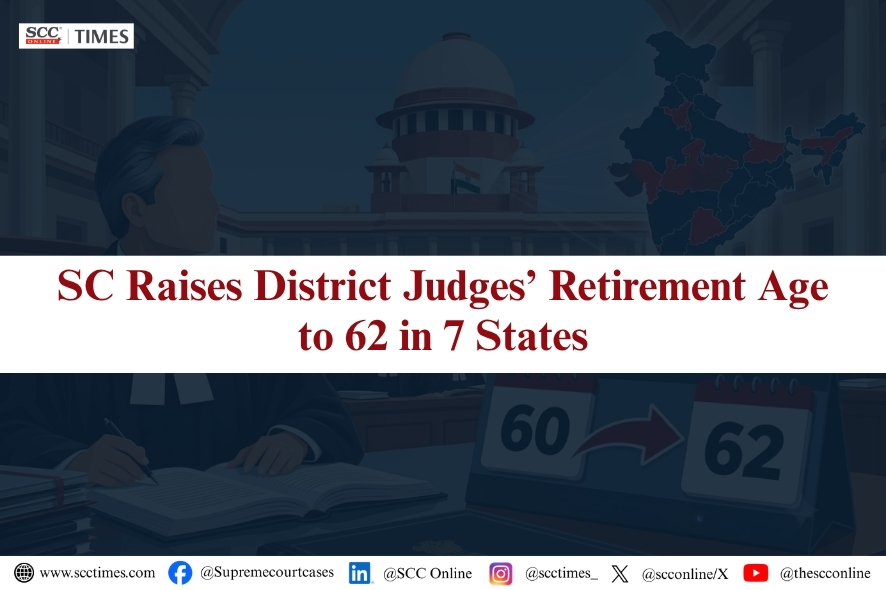
India SC: Mandates District Judges Retirement Age 62 in 7 States
Summary
- The Supreme Court of India has directed seven states to raise the retirement age for district judges.
- The directive mandates increasing the superannuation age from 60 to 62 years for these judicial officers.
- The order was issued in the context of the ongoing case, All India Judges Association v. Union of India.
- States explicitly named in the directive include Chhattisgarh, Karnataka, Madhya Pradesh, Maharashtra, Sikkim, Tamil Nadu, and West Bengal.
Supreme Court Mandate on Retirement Age
Under the new mandate, the superannuation age for district judges in these specified states will be raised from the current 60 years to 62 years.
The Supreme Court of India has issued a significant directive concerning the service conditions of district judges across several states. In a ruling stemming from the long-running case of All India Judges Association v. Union of India, the apex court mandated an increase in the retirement age for these judicial officers. This decision specifically targets district judges, aiming to standardize and enhance their tenure.
The directive instructs seven states to implement this change. The states explicitly named in the court's order include Chhattisgarh, Karnataka, Madhya Pradesh, Maharashtra, Sikkim, Tamil Nadu, and West Bengal. These state administrations are now required to adjust their respective service rules to align with the Supreme Court's pronouncement.
Under the new mandate, the superannuation age for district judges in these specified states will be raised from the current 60 years to 62 years. This adjustment reflects a broader judicial oversight into the conditions of service for the Indian judiciary, ensuring a more uniform approach to judicial administration across different regions of the country.
Legal Precedent and Context
The Supreme Court's authority to issue such a directive is rooted in its constitutional role as the guardian of justice and its long-standing involvement in the All India Judges Association v. Union of India case. This particular litigation has historically served as a crucial vehicle for addressing various aspects of judicial service, including pay scales, allowances, and other conditions of employment for judges at different levels of the Indian judicial system. The present order builds upon a series of judgments aimed at improving the welfare and operational efficiency of the judiciary.
Through this ongoing legal battle, the Supreme Court has consistently sought to ensure that judicial officers are provided with appropriate service conditions, which are vital for maintaining the independence and integrity of the judiciary. The decision to increase the retirement age for district judges falls squarely within this established legal framework, demonstrating the court's proactive stance in shaping judicial policy. It underscores the Supreme Court's power to issue binding directions to state governments on matters pertaining to the judiciary, especially when uniformity and national standards are deemed necessary.
This specific directive highlights the Supreme Court's continued engagement with the practical realities faced by judicial officers. By intervening in matters such as the retirement age, the court not only addresses the immediate concerns of the All India Judges Association but also reinforces its role in ensuring a robust and well-supported judicial infrastructure across the nation. The case serves as a testament to the judiciary's capacity for self-reform and its commitment to upholding the highest standards of judicial service.
Implications of the Age Increase
The elevation of the retirement age for district judges from 60 to 62 years carries several important implications for the judicial system in the affected states. Primarily, it allows for the retention of experienced judicial officers for an additional two years. District judges often possess extensive knowledge of local laws, customs, and procedural intricacies, and their continued service can contribute significantly to the efficiency and quality of justice delivery.
Retaining seasoned judges for a longer period can help mitigate the challenges associated with judicial vacancies and the time required to train new appointees. The experience accumulated over decades on the bench is invaluable, and extending the service period ensures that this expertise remains available to the judicial system and the public for a longer duration. This move could also lead to greater consistency in judgments and a more stable judicial environment within the district courts.
Furthermore, the directive contributes to a greater degree of uniformity in the retirement ages of judicial officers across different states, particularly for Chhattisgarh, Karnataka, Madhya Pradesh, Maharashtra, Sikkim, Tamil Nadu, and West Bengal. While the All India Judges Association v. Union of India case has sought to establish national standards, variations still exist. This specific order helps to harmonize one critical aspect of judicial service, potentially setting a precedent for other states or future directives to ensure a more cohesive national judicial framework regarding judges' superannuation.
Source
Source: Original reporting via SCC Times
How does this affect you?
Get an AI analysis of this article grounded in your jurisdictions, practice areas, and any policy documents you've uploaded to Wansom.
Finish Reading the Full Story and the Expert Analysis.
Wansom is AI and can make mistakes.