
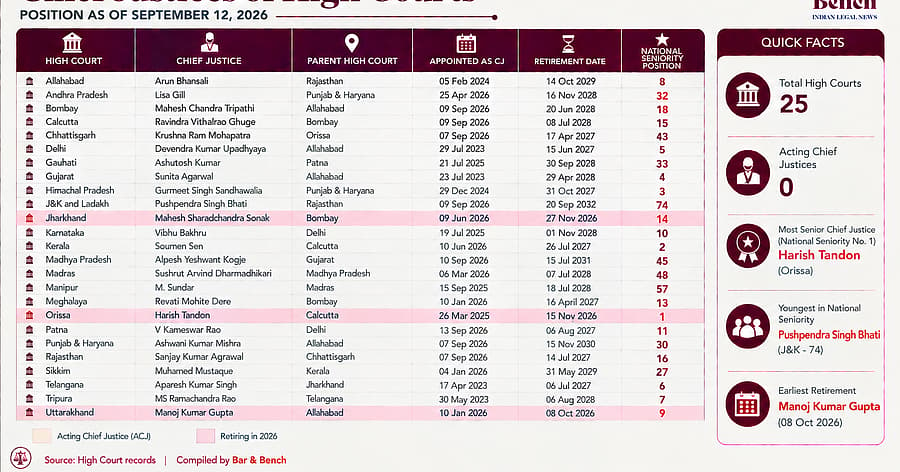
India: All High Courts Now Have Permanent Chief Justices
Summary
- All 25 High Courts in India now have permanent Chief Justices, resolving a period where seven courts were led by acting Chief Justices as of July 2026.
- The vacancies arose from routine transfers, retirements, and the elevation of four High Court Chief Justices to the Supreme Court following the Supreme Court (Number of Judges) Amendment Act, 2026.
- This Act expanded the Supreme Court's strength from 33 to 37 judges, excluding the Chief Justice of India.
- The Collegium made five recommendations after an August 6 meeting, contributing to the full complement of permanent Chief Justices.
- This ensures full administrative leadership and stability across all High Courts, potentially leading to more consistent judicial policy and improved case management.
Full Leadership Restored Across India's High Courts
All 25 High Courts across India are now operating under the leadership of permanent Chief Justices, marking a significant shift from the situation just a few weeks prior.
All 25 High Courts across India are now operating under the leadership of permanent Chief Justices, marking a significant shift from the situation just a few weeks prior. As of July 2026, a notable seven of these crucial judicial institutions were being managed by acting Chief Justices, raising questions about administrative continuity and judicial stability. This recent development ensures that every High Court has a full-time, appointed head, bringing an end to a period characterized by temporary leadership.
The transition to full-time leadership follows a series of judicial appointments and clearances. The presence of numerous acting Chief Justices was an unusual circumstance, largely stemming from a combination of routine transfers, scheduled retirements, and a major legislative change impacting the Supreme Court's composition. The resolution of these vacancies underscores a concerted effort to solidify the administrative framework of the Indian judiciary, particularly at the High Court level, which plays a pivotal role in the nation's legal system.
Understanding the Preceding Vacancies
The temporary leadership across several High Courts was primarily a direct consequence of the government's decision to increase the sanctioned strength of the Supreme Court. Through the Supreme Court (Number of Judges) Amendment Ordinance, 2026, and subsequently the Supreme Court (Number of Judges) Amendment Act, 2026, the number of Supreme Court judges, excluding the Chief Justice of India, was expanded from 33 to 37. This legislative action led to the simultaneous elevation of four High Court Chief Justices to the Supreme Court, creating immediate and significant judicial vacancies in their respective High Courts.
Beyond these elevations, three other High Courts were also being led by acting Chief Justices due to the regular retirement of their incumbent heads. The High Courts operating with acting Chief Justices as of July 20, 2026, included the Bombay High Court, then led by Justice RV Ghuge; the Punjab & Haryana High Court, under Justice Ashwani Kumar Mishra; and the Madhya Pradesh High Court, with Justice Vivek Rusia at its helm. Additionally, the Jammu & Kashmir and Ladakh High Court was led by Justice Sanjeev Kumar, the Patna High Court by Justice Sudhir Singh, the Rajasthan High Court by Justice Sanjeev Prakash Sharma, and the Calcutta High Court by Justice Tapabrata Chakraborty. These numerous temporary appointments highlighted a period of significant flux within the Indian High Court Chief Justice appointments.
Implications for Judicial Stability and Administration
The current state, where all India High Courts have permanent Chief Justices, signifies a crucial step towards enhancing the stability and administrative efficiency of the Indian judiciary. The Collegium, playing a central role in judicial appointments, made five recommendations following a meeting held on August 6, contributing significantly to filling these critical posts. This comprehensive filling of judicial vacancies India High Courts ensures that all courts are now helmed by full-time leaders, a situation that was not present just months ago.
This development is expected to foster more consistent judicial policy and improved case management across the High Courts. With permanent leadership, there is a greater potential for strategic planning, long-term administrative initiatives, and a more predictable judicial environment. Such stability is vital for the effective functioning of the courts and can contribute to faster resolution of matters, ultimately benefiting litigants and strengthening public confidence in the judicial system. The presence of permanent Chief Justices is a cornerstone for robust Indian judiciary stability.
Practical Implications
This development ensures full administrative leadership and stability across all Indian High Courts, which may lead to more consistent judicial policy, improved case management, and potentially faster resolution of matters. Lawyers should note this shift as it could influence court efficiency and the predictability of judicial administration in their respective High Courts.
Source
How does this affect you?
Get an AI analysis of this article grounded in your jurisdictions, practice areas, and any policy documents you've uploaded to Wansom.
Finish Reading the Full Story and the Expert Analysis.
Get the latest legal & regulatory intelligence in India
Wansom is AI and can make mistakes.