
Hona Lia AI Personal Injury: New Agent Streamlines Client Communication
Summary
- Hona, a personal injury case management platform, launched Lia, an AI agent, on September 3, 2026.
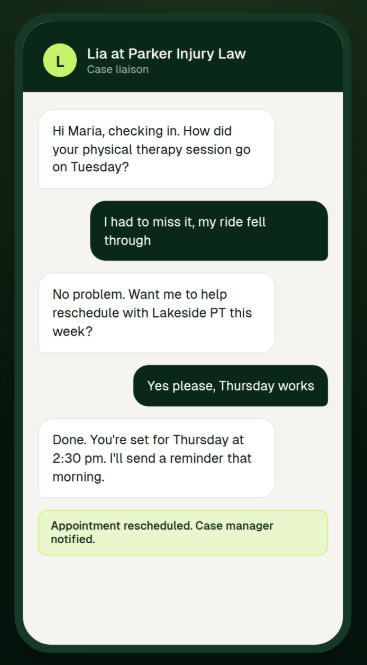
- Lia facilitates client communication, answers case-specific questions, and manages engagement through reminders and follow-ups.
- The AI agent helps clients adhere to medical appointments and treatment plans, addressing a common challenge where 30-50% of patients don't complete treatment.
- Hona's CEO Matthew McClellan notes Lia handles routine client inquiries, freeing up legal staff for complex tasks.
- Lia enters a growing market for agentic AI in legal tech, following similar launches like Eve Legal's Eve 2.0 and Supio's Supio Agent.
Introducing Lia: AI for Personal Injury Firms
Lia is engineered to streamline interactions between personal injury firms and their clients, providing immediate answers to common inquiries by drawing directly from actual case files.
Hona, a prominent case management platform tailored for personal injury law firms, has officially launched Lia, its advanced artificial intelligence agent. This significant development, reported on September 3, 2026, follows a press release issued the previous day. Lia is engineered to streamline interactions between personal injury firms and their clients, providing immediate answers to common inquiries by drawing directly from actual case files.
The core functionality of this Hona case management AI extends beyond simple Q&A. Lia is designed to maintain high levels of client engagement through automated, consistent reminders, follow-ups, and check-ins. Crucially, the system possesses the capability to discern when a client's situation requires direct human intervention, ensuring that complex or sensitive matters are escalated appropriately to legal professionals. This integration of the Hona Lia AI personal injury agent aims to enhance operational efficiency for firms.
Enhancing Client Engagement and Treatment Adherence
According to Matthew McClellan, CEO of Hona, Lia addresses a significant pain point for personal injury firms: the repetitive nature of client questions. While attorneys may encounter the same set of 10 questions daily, for the average personal injury plaintiff, navigating the legal process is often a first-time, unfamiliar experience. Lia is designed to manage this routine and redundant workload, freeing up human staff for more complex tasks and providing clients with timely, consistent information.
Beyond communication, Lia also plays a critical role in improving client adherence to medical appointments and prescribed treatment plans. McClellan highlighted concerning statistics from patient-adherence studies, which consistently show that between 30% and 50% of patients fail to complete their full treatment plans, and typical appointment attendance hovers around 70%. He emphasized that simple one-way automated texts are insufficient to tackle this issue. Instead, cases demand a system that is responsive, capable of follow-up, can detect changes in a client's status, and react effectively when a client becomes unresponsive, a capability central to this personal injury client communication AI.
The Evolving AI Legal Tech Market
The introduction of Lia by Hona positions the company within a rapidly expanding sector of legal technology focused on agentic AI capabilities. Prior to Lia's public release, Hona conducted beta testing with 20 firms, gathering valuable insights to refine the AI agent's performance. The company's commitment to innovation in this space is further underscored by its successful Series A funding round last year, which secured $9.5 million.
Lia AI legal tech joins a competitive and dynamic market. Other notable developments include Eve Legal's launch of Eve 2.0 in January, which incorporates a suite of AI agents, auditors, and analysts designed to support legal operations. Similarly, Supio unveiled its Supio Agent in May, further illustrating the growing trend of AI for personal injury firms leveraging sophisticated AI agents to automate tasks and improve client outcomes. These advancements signal a transformative period for legal practice, particularly within the personal injury domain.
Practical Implications
Personal injury lawyers should evaluate AI agents like Hona's Lia to automate client communication, improve treatment plan adherence, and manage routine case tasks, potentially enhancing efficiency and client outcomes. This development signals a growing trend in legal technology that firms should monitor for competitive advantage and operational improvement.
Source
Source: Original reporting via Law.com
How does this affect you?
Get an AI analysis of this article grounded in your jurisdictions, practice areas, and any policy documents you've uploaded to Wansom.
Finish Reading the Full Story and the Expert Analysis.
Wansom is AI and can make mistakes.