
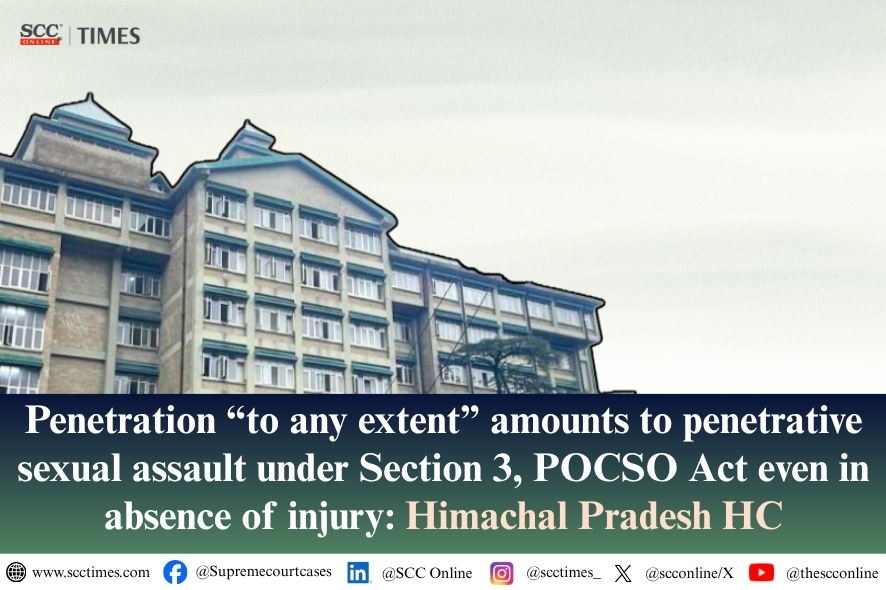
Himachal Pradesh HC: POCSO Penetration Extent Defined, Injury Not Required
Summary
- The Himachal Pradesh High Court affirmed a conviction for aggravated penetrative sexual assault under the POCSO Act.
- The court ruled that "penetration to any extent" constitutes penetrative sexual assault under Section 3, even without injury.
- This interpretation clarifies the scope of the offense, making the presence of physical harm irrelevant for conviction.
- The offense carries a minimum sentence of 20 years' imprisonment under Section 6 of the POCSO Act.
What Happened
By unequivocally stating that "penetration to any extent" constitutes penetrative sexual assault, even in the absence of injury, the court has provided a clear and authoritative interpretation of Section 3.
The Himachal Pradesh High Court recently issued a pivotal judgment, affirming a lower Trial Court's decision that an appellant was correctly found guilty of aggravated penetrative sexual assault under the Protection of Children from Sexual Offences (POCSO) Act, 2012. This significant ruling from the High Court reinforces the judicial commitment to upholding the stringent protections afforded to minors under Indian law. The case centered on a crucial interpretation of what constitutes penetrative sexual assault within the framework of the Act.
A key aspect of the High Court's determination involved clarifying the definition of penetrative sexual assault as stipulated in Section 3 of the POCSO Act. The court explicitly held that "penetration to any extent" is sufficient to establish the commission of this offense. Importantly, this interpretation applies even in situations where there is an "absence of injury" to the victim, thereby expanding the understanding of the act and ensuring that the lack of visible physical harm does not diminish the gravity of the crime. This clarification by the Himachal Pradesh High Court on the POCSO penetration extent is set to have far-reaching implications.
Legal Context
The recent ruling by the Himachal Pradesh High Court offers crucial guidance on the application and interpretation of specific provisions within the POCSO Act, particularly focusing on Section 3 and Section 6. Section 3 of the Act is dedicated to defining penetrative sexual assault, and the court's pronouncement now firmly establishes that neither the depth of penetration nor the presence of any discernible physical injury is a prerequisite for the offense to be legally recognized. This precise interpretation of POCSO Act Section 3 ensures that legal proceedings can focus on the act itself, rather than being sidetracked by the extent of physical harm.
Moreover, the offense of aggravated penetrative sexual assault, for which the appellant in this case was convicted, carries severe statutory penalties under Section 6 of the POCSO Act. This section mandates a minimum sentence of 20 years' imprisonment, underscoring the legislative intent to impose harsh punishments for crimes against children. The High Court's decision to uphold the Trial Court's conviction, therefore, not only clarifies the definitional aspects of the crime but also reaffirms the robust punitive framework designed to deter and punish such heinous acts.
Why It Matters
This definitive pronouncement from the Himachal Pradesh High Court holds substantial weight for legal professionals, including lawyers prosecuting or defending cases under the POCSO Act in India. By unequivocally stating that "penetration to any extent" constitutes penetrative sexual assault, even in the absence of injury, the court has provided a clear and authoritative interpretation of Section 3. This clarity is vital for ensuring consistency in judicial decisions and for guiding legal strategy in matters involving child sexual abuse, particularly regarding the definition of aggravated penetrative sexual assault.
The ruling has significant practical implications, especially for understanding the Himachal Pradesh HC POCSO penetration extent. It underscores that the legal focus in such cases must remain on the act of penetration itself, irrespective of its superficiality or whether it resulted in any physical trauma. This interpretation strengthens the protective legal framework for children, ensuring that the law is applied broadly to safeguard minors from all forms of sexual assault and reinforcing the severe consequences outlined in Section 6 POCSO punishment provisions.
Practical Implications
Lawyers prosecuting or defending cases under the POCSO Act in India, particularly those involving Sections 3 and 6, must be aware of this Himachal Pradesh High Court interpretation which clarifies that 'penetration to any extent' constitutes penetrative sexual assault, even without injury, thereby broadening the scope of the offense and potential liability.
Source
How does this affect you?
Get an AI analysis of this article grounded in your jurisdictions, practice areas, and any policy documents you've uploaded to Wansom.
Finish Reading the Full Story and the Expert Analysis.
Get the latest legal & regulatory intelligence in India
Wansom is AI and can make mistakes.