
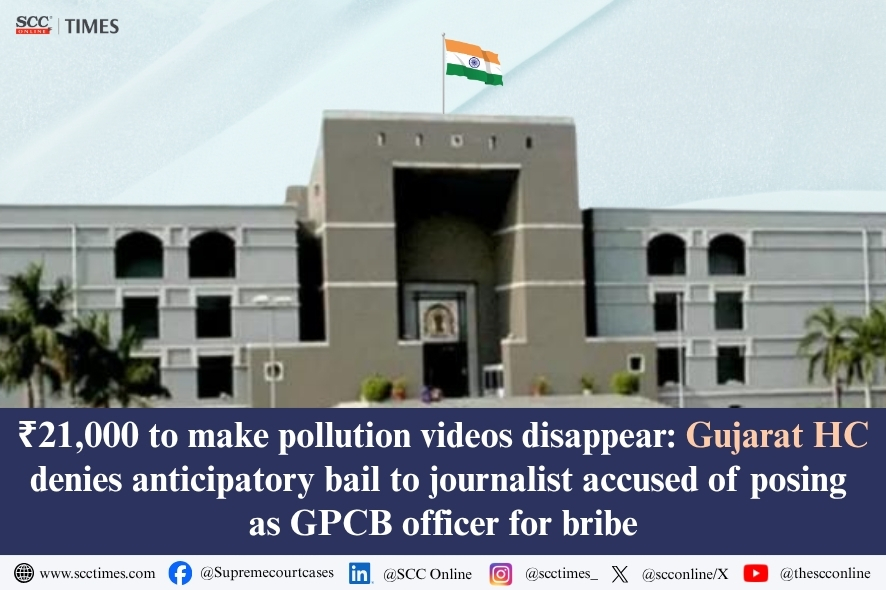
Gujarat High Court: Co-Accused Statement Anticipatory Bail Denied, Role Clarified
Summary
- The Gujarat High Court denied anticipatory bail to a journalist accused of impersonation and bribery.
- The journalist allegedly posed as a GPCB officer and demanded ₹21,000.
- The bribe was purportedly for making 'pollution videos' disappear.
- A co-accused's statement to police is not admissible as evidence in court.
- However, such statements can be considered during investigation as clues to guide officers in collecting evidence and determining further inquiry.
Judicial Ruling on Anticipatory Bail
The High Court underscored that a co-accused's statement, even if it cannot be directly used to prove guilt in court, serves as an invaluable "clue."
The Gujarat High Court has recently delivered a significant verdict, rejecting the anticipatory bail application filed by a journalist implicated in a case of alleged impersonation and bribery. This judicial action stems from accusations that the individual falsely presented themselves as an official of the Gujarat Pollution Control Board (GPCB), a regulatory body responsible for environmental oversight. The denial of pre-arrest bail underscores the judiciary's serious view of offenses that undermine public trust and involve attempts to manipulate regulatory processes for personal gain.
According to the allegations, the journalist sought a specific sum of ₹21,000. This monetary demand was reportedly made with the explicit intention of suppressing or "making disappear" certain videos related to pollution. Such an act, if proven, would not only constitute bribery but also an attempt to obstruct justice by concealing evidence pertinent to environmental infractions. The court's decision to deny anticipatory bail suggests that the nature of these charges, coupled with the ongoing investigation, requires a thorough inquiry without the applicant being shielded by pre-arrest protection.
Legal Framework for Co-Accused Statements
A pivotal aspect of the Gujarat High Court's reasoning in this anticipatory bail matter involved a detailed articulation of the legal standing of statements made by a co-accused to law enforcement. The court meticulously clarified that while such statements are generally deemed inadmissible as substantive evidence during a trial, their role and value within the investigative phase are distinctly different and critically important. This distinction is fundamental to understanding the court's approach to criminal proceedings.
The High Court underscored that a co-accused's statement, even if it cannot be directly used to prove guilt in court, serves as an invaluable "clue." This guidance is essential for the investigating officer, providing crucial direction for the subsequent steps of the inquiry. It aids in identifying potential avenues for evidence collection, helping to unearth corroborating facts and shape the overall trajectory of the investigation. Therefore, the Gujarat HC ruling affirms that these statements, despite their evidentiary limitations, are legitimate tools for guiding police efforts to gather concrete proof and determine the full scope of an alleged crime.
Broader Implications for Justice and Investigation
The decision by the Gujarat High Court to deny anticipatory bail in this case carries significant implications for the broader landscape of criminal justice, particularly concerning the delicate balance between an individual's right to liberty and the imperative for comprehensive investigations. By allowing the investigative process to proceed unhindered, potentially leveraging insights gleaned from a co-accused statement, the court reinforces the principle that thoroughness is paramount, especially in cases involving allegations of corruption and impersonation.
This ruling serves as a crucial precedent, highlighting how courts weigh the need for custodial interrogation or unconstrained investigation against claims for pre-arrest protection. It emphasizes that leads, even those derived from sources with limited direct evidentiary value, are vital for uncovering the truth and ensuring that justice is served. The court's nuanced stance on the utility of a co-accused's statement in guiding an investigation, while maintaining its inadmissibility in trial, provides clarity for law enforcement and reinforces public confidence in the integrity of the legal system's pursuit of accountability.
Source
Source: Original reporting via SCC Times
How does this affect you?
Get an AI analysis of this article grounded in your jurisdictions, practice areas, and any policy documents you've uploaded to Wansom.
Finish Reading the Full Story and the Expert Analysis.
Get the latest legal & regulatory intelligence in India
Wansom is AI and can make mistakes.