
Green Light for Dangote’s KSh 2.2 Trillion Lamu Refinery, For Now
Kenya’s planned KSh 2.2 trillion Dangote East Africa Refinery has received a temporary opening from the courts. On 14 October, the High Court in Malindi declined to extend interim orders that had required parties to maintain the status quo over disputed land earmarked for the project. The immediate obstacle to construction was therefore eased, but not because the court had established that the land acquisition was lawful, that residents had no valid claims, or that every environmental requirement had been met.
Instead, the ruling turned on procedure. A group of 133 residents had failed to serve the respondents as directed, and their petition contained an incorrect land reference that needed amendment. Justice Jane Onyango declined to grant further interim protection, gave the petitioners an opportunity to correct their filing and serve the parties, and left the underlying dispute unresolved. The matter is scheduled for mention on 24 November.
For a project promoted as a major investment in Kenya’s industrial future, the distinction is consequential. The refinery can move forward for now, but the legal questions surrounding the land, the people who say they depend on it, and the public obligations attached to the investment have not disappeared.
What the court decided and what it did not
The 14 October decision is best understood as a ruling on interim protection, not a final judgment on the merits of the residents’ claims.
The proceedings began with an application filed on 23 September by 133 residents from the Mvinjeni/Magogoni area of Lamu County. They sought orders preventing the government, Dangote-related entities and other parties from proceeding with activities on disputed land while the court considered their claims. They argued that they and their families had occupied and cultivated parts of the area for years, and that the development risked prejudicing their interests before questions of acquisition, compensation and resettlement had been resolved.
On 25 September, the court directed that the prevailing status quo on the identified parcel, LR No. 13061, be maintained until the scheduled hearing. The court did not certify the application as urgent, and the order did not expressly prevent the refinery’s 30 September groundbreaking ceremony. It was a temporary arrangement intended to preserve the position on the specified land pending further consideration of the application.
By 14 October, however, the petitioners had not complied with the court’s directions on service. The respondents argued that they had not been properly notified and opposed the extension of interim orders. The court also identified an error in the land reference and allowed the petitioners time to amend the filing. Justice Onyango declined to issue fresh orders preserving the status quo.
That distinction matters for three reasons:
First, the court did not determine who ultimately has the superior legal interest in the disputed land. Second, it did not decide whether the residents are entitled to compensation or resettlement. Third, it did not make a final determination of the environmental allegations raised by the applicants.
The absence of a continuing interim order is not the same as a finding that the project has satisfied every legal obligation. Nor does the ruling establish that the residents’ claims are invalid. It means that the applicants did not secure the temporary protection they sought at that stage of the proceedings.
The project has gained room to proceed. Its legal position on the underlying issues remains to be tested.
Procedure became the immediate turning point
The most important feature of the ruling is that procedural compliance determined whether the court would continue to preserve the position on the ground.
Service of court papers is not a technicality that can simply be ignored. A respondent must be properly notified of proceedings so that they have a fair opportunity to understand the case and respond. The government and other respondents told the court that they had not been served in accordance with the directions. Lawyers representing state agencies and a drilling contractor also challenged the request for further orders on that basis.
The petitioners’ lawyer reportedly explained that he had difficulty obtaining company registration information containing an address for serving Dangote-related entities. But the respondents disputed the adequacy of the steps taken, and the court insisted on proper service before the applications could proceed.
There was also a land-identification problem. Reporting on the proceedings indicates that the petition contained a parcel reference associated with Watamu rather than the intended site in Lamu, alongside an incorrect village reference. The respondents argued that the interim orders could not appropriately be extended when the property described in the filing was disputed. The judge allowed an amendment, while requiring the petitioners to serve the parties properly.
These issues show how procedural errors can have practical consequences in urgent land disputes. Where construction activity is advancing, the timing of an application and the accuracy of the documents may determine whether a court intervenes before the physical situation changes.
But procedural discipline cuts both ways. It protects respondents from orders made without proper notice and gives courts a reliable description of the property in dispute. It also places a real burden on communities seeking urgent relief, particularly when they are challenging a large project involving multiple corporate and public-sector respondents.
The broader lesson is not that procedure should yield to investment, or that development should automatically be halted whenever a petition is filed. It is that the legal process must be accessible and properly followed if the competing rights are to be assessed before events on the ground make the dispute harder to resolve.
The residents’ case is about more than a boundary line
The 133 residents say they have occupied, cultivated or developed portions of the affected area over many years. Their claims concern the way the land is being made available for the refinery and whether the interests of people living and working there have been identified and addressed. They allege that some residents were excluded from the acquisition, compensation and resettlement process. These are allegations advanced by the petitioners, not findings established by the court.
Their requested relief extends beyond stopping construction. According to reporting on the original application, they sought a survey and inspection to identify the portions used by individual residents and document homes, crops, trees and other developments. They also sought disclosure of acquisition notices, survey plans, valuation reports, compensation schedules and records identifying people recognised as having interests in the land. Their claims include compensation, possible resettlement and protection of property and community sites.
This matters because a public-land designation does not, by itself, answer every question raised by long-term occupation. The legal status of a parcel and the interests of people who use it are related, but distinct, questions. The existence of government ownership would not automatically settle whether particular occupants have rights that must be recognised or addressed under applicable law.
The government’s position, as reported, is that most of the land earmarked for the refinery is public property. Lands Cabinet Secretary Alice Wahome has argued that occupation of parts of the site does not in itself establish private ownership.
That is a relevant position, but it does not resolve the case. The question is not simply whether every resident holds a registered title. It is what legal interests, if any, the residents can establish; what procedures were followed in assembling the site; and what obligations arise if people with legally protected interests are affected by the project.
Those questions require evidence and legal determination. They cannot be answered merely by the scale of the proposed investment or by the government’s description of the land.
The investment case is enormous but scale is not a legal defence

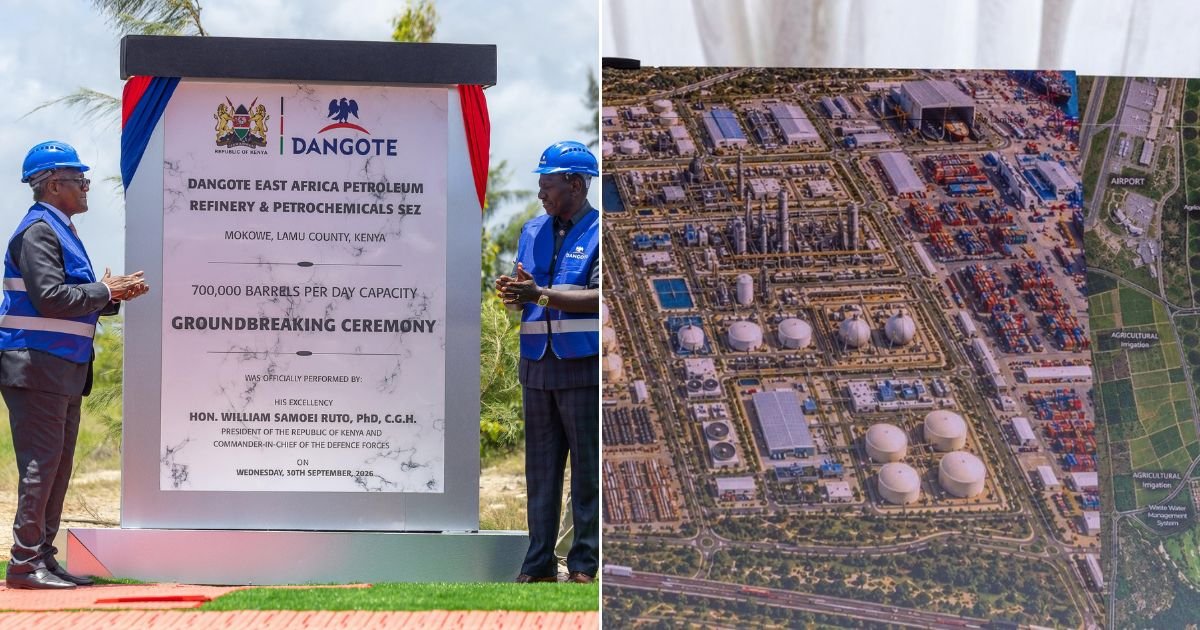
The proposed refinery is estimated to cost approximately KSh 2.2 trillion and is designed to process up to 700,000 barrels of crude oil per day. It is planned as a major industrial development associated with the Lamu Port–South Sudan–Ethiopia Transport (LAPSSET) Corridor. The project’s groundbreaking ceremony took place on 30 September 2026, attended by President William Ruto and Dangote Group president Aliko Dangote.
The government has presented the project as part of a wider industrialisation and energy-security ambition. A refinery of the proposed scale could reshape petroleum processing and related industrial activity in the region if it is completed and operates as planned. Its significance also explains why the government and investor are keen to move from announcements to construction.
But the project’s size makes careful legal preparation more important, not less.
A large investment can create jobs, infrastructure demand and industrial opportunities. It can also concentrate the consequences of poor planning: disputed land acquisition, unclear compensation arrangements, environmental harm or uncertainty about public commitments may affect communities while exposing investors and government agencies to prolonged litigation.
The question is therefore not whether Kenya should pursue major industrial development. It is whether the development is being delivered through legally sound land arrangements, credible environmental safeguards and transparent decision-making.
A project’s economic promise does not replace those requirements. Nor does a land petition, on its own, prove that a project should be stopped. The courts’ task is to determine the applicable rights and obligations on the evidence and under the law.
Environmental compliance remains a separate question
The residents have also raised environmental concerns and questioned whether all required assessment procedures were followed. The available reporting does not establish that the court resolved those allegations on 14 October.
That limitation is important. A decision not to extend interim orders cannot be presented as judicial confirmation that environmental approvals are complete or that every potential impact has been adequately addressed.
For an industrial project of this scale, environmental scrutiny is not merely an obstacle to construction. It is part of the process through which risks should be identified, assessed and managed. The precise obligations depend on the project’s approvals and the applicable legal framework, which must be examined through the relevant records rather than assumed from the fact that construction has begun.
The distinction between an allegation and a verified breach must also be maintained. The residents’ concerns deserve consideration, but the available reports do not establish that the project has violated environmental law. Equally, the 14 October ruling does not establish that it has complied with every environmental requirement.
The next phase of the dispute will need to clarify what claims remain before the court and what evidence is available to support them. Until then, neither categorical accusation nor categorical exoneration is justified.
The public-accountability question extends beyond the land case
The land dispute is not the only legal challenge surrounding the refinery.
On 6 October, the Daily Nation reported that the High Court had certified as urgent a separate petition seeking disclosure of agreements, approvals and public commitments connected to Kenya’s proposed participation in the project. The petitioner questioned the transparency of arrangements involving potential public funds, public land, equity participation, guarantees, tax concessions and related support. Those concerns were the petitioner’s case, not findings of wrongdoing by the government or the investor.
This is a separate proceeding from the Malindi residents’ land case. The two should not be conflated: one concerns claimed interests in the land and the adequacy of related processes; the other concerns disclosure and scrutiny of the government’s proposed financial and other commitments.
Taken together, however, they illustrate the range of questions raised by an investment of this scale. The public interest is not limited to whether the refinery will be built. It also includes how land is made available, how public resources are committed, which risks the State may assume, what approvals govern the project and how affected people can challenge decisions.
Where public money or public assets are involved, transparent disclosure is important to allow citizens to assess the rationale, cost, risks and expected public benefit. That is especially true when a project is promoted as a national strategic investment.
The existence of a petition seeking disclosure does not establish that the transaction is unlawful or that the State has failed in its obligations. Those issues depend on the relevant documents, legal requirements and the court’s eventual assessment. But the questions are legitimate subjects of public scrutiny, distinct from the immediate procedural ruling in Malindi.
What happens next?
The Malindi matter is scheduled for mention on 24 November 2026. Before the residents’ applications can be considered further, reporting indicates that they were required to amend the petition’s land details and serve the respondents in accordance with the court’s directions.
The significance of the next date will depend on what has happened in the intervening period: whether the amendments and service have been completed, how the respondents answer the claims, and what directions the court gives for hearing the underlying dispute.
Three issues will be particularly important.
First, the accuracy of the land record. The court needs to be satisfied that the property identified in the petition is the land actually affected by the challenged activities. Clear parcel identification is essential to any order regulating access, construction or the preservation of property.
Second, the residents’ claimed interests and remedies. The case will need to establish the legal and factual basis for the residents’ claims, including the nature of their occupation, the acquisition process and any compensation or resettlement obligations that may arise.
Third, the scope of any further interim relief. If the petitioners renew their request for temporary orders, the court will have to consider the application in the procedural and evidential position then before it. The 14 October ruling does not predetermine how a properly presented application must be decided.
Meanwhile, the separate petition concerning disclosure of the government’s proposed participation will proceed on its own track. Developments in that case may affect public understanding of the project’s financial and governance arrangements, but they should not be treated as determinations of the land dispute.
As of 27 October, the available reporting does not establish a final judicial determination of the residents’ underlying land claims or of the environmental allegations. Any later orders, amended pleadings or operational changes should be checked before publication.
Conclusion: Construction can proceed; the questions remain
The Malindi High Court’s 14 October decision gives the Dangote Lamu refinery room to proceed without the extension of the interim orders sought by 133 residents. But describing it as a definitive judicial clearance would go too far.
The court’s immediate concern was procedural: the respondents had not been served as directed, and the land reference required correction. The ruling did not determine the merits of the residents’ claims, confirm that compensation and resettlement obligations had been satisfied, or settle the environmental questions raised in the petition.
That is the central distinction for investors, policymakers and communities alike. Large infrastructure projects need predictable processes and the ability to move forward when legal requirements are met. Communities, in turn, need a meaningful opportunity to establish their rights and obtain remedies where the law supports them. Neither objective is served by confusing a procedural ruling with a final judgment.
The refinery’s immediate path is clearer. Its wider legal and public-accountability questions are not. The next stage will test whether the parties can bring those questions before the court in a form that allows them to be decided on their merits.
Citations
- 1.The Kenya Times, “Court Clears Path for Dangote’s Lamu Oil Refinery,” 14 October 2026. Read the report.
- 2.The Standard, “Lamu residents ordered to serve Dangote as court declines to issue temporary orders stopping construction,” 14 October 2026. Read the report.
- 3.The Star, “Why Malindi court declined to stop Dangote refinery groundbreaking,” 30 September 2026. Read the report.
- 4.The Standard, “Land row, public participation concerns cloud refinery project,” 1 October 2026. Read the report.
- 5.Daily Nation, “Court orders urgent hearing of case seeking Dangote refinery deal disclosure,” 6 October 2026. Read the report.
Finish Reading the Full Story and Expert Analysis.
Get the latest legal & regulatory intelligence in Kenya
Wansom is AI and can make mistakes.