
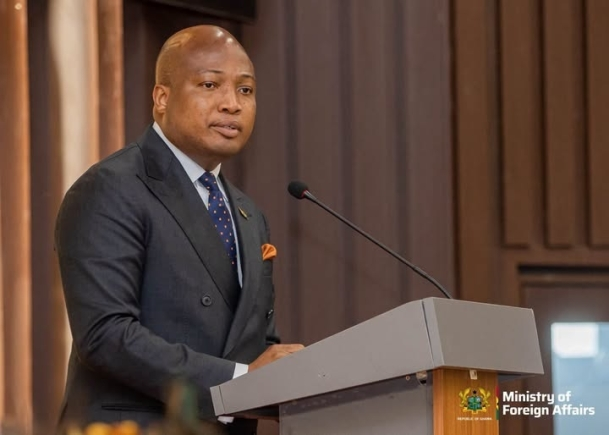
Ghana: Ablakwa Confirms BRICS Partner Country Application
Summary
- Ghana is pursuing a BRICS Partner Country application, not full membership, as clarified by Foreign Affairs Minister Samuel Okudzeto Ablakwa.
- The decision is driven by Ghana's national interest, aligning with Article 40 of the 1992 Constitution, and aims to diversify strategic development options.
- This move reaffirms Ghana's non-alignment policy, a historical foreign policy stance that has facilitated diverse international collaborations.
- Ghana engaged with European Union member states to communicate its rationale prior to the public announcement.
- If successful, Ghana will join other nations like Nigeria and Vietnam on the BRICS Partner Countries list, which expanded in 2025.
Ghana's Strategic BRICS Engagement
The Minister highlighted Ghana's existing strong relationships with current BRICS member states, viewing the potential partnership as a natural alignment with a significant global trading bloc.
Ghana's Minister for Foreign Affairs, Samuel Okudzeto Ablakwa, recently clarified the nation's strategic approach to the BRICS alliance, confirming that Accra is pursuing a BRICS Partner Country application rather than full membership. Speaking on TV3's Key Points on a Saturday, October 10, Mr. Ablakwa emphasized that this decision is firmly rooted in Ghana's national interest, a principle enshrined in Article 40 of the 1992 Constitution of Ghana. The Minister highlighted Ghana's existing strong relationships with current BRICS member states, viewing the potential partnership as a natural alignment with a significant global trading bloc.
The BRICS group, which currently encompasses eleven major emerging markets and developing countries—Brazil, China, Egypt, Ethiopia, India, Indonesia, Iran, Russia, Saudi Arabia, South Africa, and the United Arab Emirates—is recognized as a crucial platform for international consultation and cooperation. Ghana's engagement is intended to leverage this platform for discussions on contemporary issues of global and regional significance. This move underscores a broader strategy to diversify Ghana's international engagements and economic opportunities.
Reaffirming Non-Alignment and Global Positioning
Mr. Ablakwa also addressed concerns regarding the potential impact of this decision on Ghana's long-standing relationships with traditional international partners. He explicitly stated that the pursuit of a BRICS Partner Country status does not jeopardize these existing ties. Instead, he framed the initiative as a reaffirmation of Ghana's enduring non-alignment policy, a foreign policy stance that has historically allowed the nation to forge diverse international collaborations. This policy, famously championed by President Kwame Nkrumah during the Cold War, enabled Ghana to secure support from the United States for the construction of the Akosombo Dam while simultaneously engaging the Soviet Union for Africa's pioneering atomic energy program.
Prior to the public announcement of its intentions, Ghana engaged in discussions with member states of the European Union. During these consultations, Ghanaian officials clearly articulated the rationale behind their decision, emphasizing the nation's sovereign right to explore and diversify its strategic options for national development. This proactive communication aimed to ensure transparency and mitigate any potential misunderstandings among its established allies, reinforcing the principle of Ghana non-alignment policy in its foreign relations.
The Evolving Landscape of BRICS
The BRICS alliance has undergone significant expansion since its inception. Initially formalized as BRIC in 2006 during a meeting of Foreign Ministers on the sidelines of the United Nations General Assembly in New York, the group held its inaugural summit in Yekaterinburg, Russia, in 2009. The inclusion of South Africa in 2010 marked its transformation into BRICS. More recently, the alliance welcomed new full members, with Egypt, Ethiopia, Iran, Saudi Arabia, and the UAE joining from January 2024, and Indonesia set to become a full member in January 2025.
Beyond full membership, BRICS has also established a category for Partner Countries. In 2025, a diverse group of nations—including Belarus, Bolivia, Kazakhstan, Cuba, Malaysia, Nigeria, Thailand, Uganda, Uzbekistan, and Vietnam—joined the BRICS Partner Countries list. Should Ghana's application prove successful, it will join this expanding cohort, aligning itself with countries seeking closer collaboration with the BRICS bloc without necessarily committing to full membership. This development highlights the growing influence and evolving structure of BRICS on the global stage, offering various levels of engagement for interested nations.
Practical Implications
Lawyers advising on international trade, investment, or compliance in Ghana should monitor the evolving implications of Ghana's BRICS Partner Country status for potential shifts in trade agreements, investment incentives, and regulatory alignment with BRICS member states, especially in light of Ghana's reaffirmed non-alignment policy.
Source
How does this affect you?
Get an AI analysis of this article grounded in your jurisdictions, practice areas, and any policy documents you've uploaded to Wansom.
Finish Reading the Full Story and the Expert Analysis.
Get the latest legal & regulatory intelligence in Ghana
Wansom is AI and can make mistakes.