
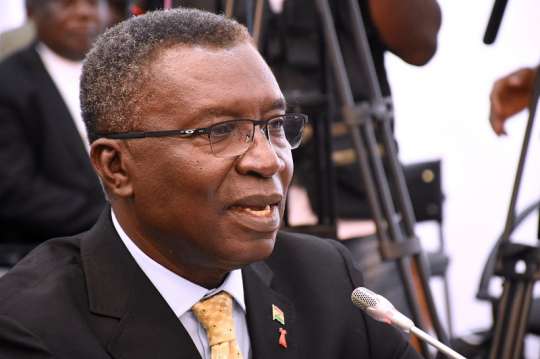
Ghana: Frimpong-Boateng Unveils Environmental Restoration Fund Proposal
Summary
- Professor Kwabena Frimpong-Boateng has proposed a statutory Environmental Restoration Fund for Ghana.
- The fund would be financed by a defined proportion of mineral royalties, dedicated to land reclamation and water body restoration.
- It is designed to operate outside the national budget cycle with independent oversight and public disclosure to prevent fund diversion.
- Ghana faces significant environmental degradation, with 10% of its surface area affected and an estimated $21 billion needed for restoration.
- An annual State of the Environment audit, providing independently verified data, was also proposed to Parliament.
A New Proposal for Environmental Funding
A core tenet of the proposed statutory Environmental Restoration Fund Ghana is its operational independence from the national budget cycle.
Professor Kwabena Frimpong-Boateng, who previously served as Ghana's Minister for Environment, Science, Technology and Innovation, has put forward a significant Ghana Environmental Restoration Fund proposal. This initiative calls for the establishment of a statutory Environmental Restoration Fund Ghana, designed to operate independently of the nation's standard budgetary processes. The primary objective of this fund would be to secure dedicated financing for the extensive mining land reclamation Ghana funding efforts and the vital restoration of water bodies that have suffered pollution.
Under the proposal, a specific percentage of Ghana mineral royalties restoration revenue would be channeled directly into this fund. Professor Frimpong-Boateng emphasized that these funds should be exclusively allocated for environmental restoration activities. A crucial aspect of his vision includes independent oversight for the fund's management and expenditure, coupled with a commitment to public disclosure. This framework aims to ensure transparency and accountability in how resources are utilized for environmental remediation across the country. The proposal was formally presented during a keynote address at the Fourth Annual Colloquium, hosted by the Department of Political Science Education at the University of Education, Winneba, on Wednesday, September 2, 2026. The colloquium's theme, "Politics, the Environment, and Our Future: Ghana at Crossroads?", provided the backdrop for this critical discussion.
Addressing Ghana's Environmental Crisis
The urgency behind the Kwabena Frimpong-Boateng environmental fund proposal is underscored by the alarming scale of environmental degradation in Ghana. According to Professor Frimpong-Boateng, approximately 10% of Ghana's total surface area, which translates to an estimated 23,853 square kilometers, has already been degraded. The financial burden associated with reversing this damage is substantial, with restoration efforts projected to cost around $21 billion.
This immense figure highlights the need for a robust and sustained funding mechanism. For instance, the rehabilitation of the Ankobra River alone is estimated to require $400 million. This cost does not even encompass the restoration needs of numerous other significantly polluted water bodies across the nation, including the Pra, Offin, Birim, Anum, and Oda rivers, as well as the Black, White, and Red Volta rivers. Professor Frimpong-Boateng stressed that addressing environmental damage of this magnitude demands predictable and protected financing, rather than relying on temporary allocations that could be withdrawn or redirected by subsequent governments.
Ensuring Transparency and Accountability
A core tenet of the proposed statutory Environmental Restoration Fund Ghana is its operational independence from the national budget cycle. Professor Frimpong-Boateng articulated that placing the fund within the regular budget framework would expose it to potential diversion, particularly during periods of fiscal strain when governments might be tempted to reallocate funds. To counteract this risk, he advocates for its independent governance, with a mandate to publish annual accounts detailing expenditures at each specific restoration site. This level of granular reporting aims to foster public trust and ensure funds are used as intended for mining land reclamation Ghana funding.
Beyond the fund itself, Professor Frimpong-Boateng also called for the implementation of an annual State of the Environment audit proposal to be presented to Parliament concurrently with the national budget. This audit would provide independently verified data on critical environmental indicators, including water quality across various river basins, changes in forest cover, the extent of degraded and reclaimed land, waste management practices, and wetland loss. He argued that public measurement of these environmental metrics is essential for effective governance, ensuring that a portion of the revenue generated from Ghana's mineral resources is consistently reinvested into repairing the environmental damage caused by their extraction.
Practical Implications
Lawyers and compliance officers in Ghana's mining sector should monitor the legislative progress of this proposed Environmental Restoration Fund. Its potential establishment could introduce new financial obligations via mineral royalties and stricter compliance requirements for environmental remediation and public disclosure, impacting operational costs and reporting for mining companies.
Source
How does this affect you?
Get an AI analysis of this article grounded in your jurisdictions, practice areas, and any policy documents you've uploaded to Wansom.
Finish Reading the Full Story and the Expert Analysis.
Wansom is AI and can make mistakes.