
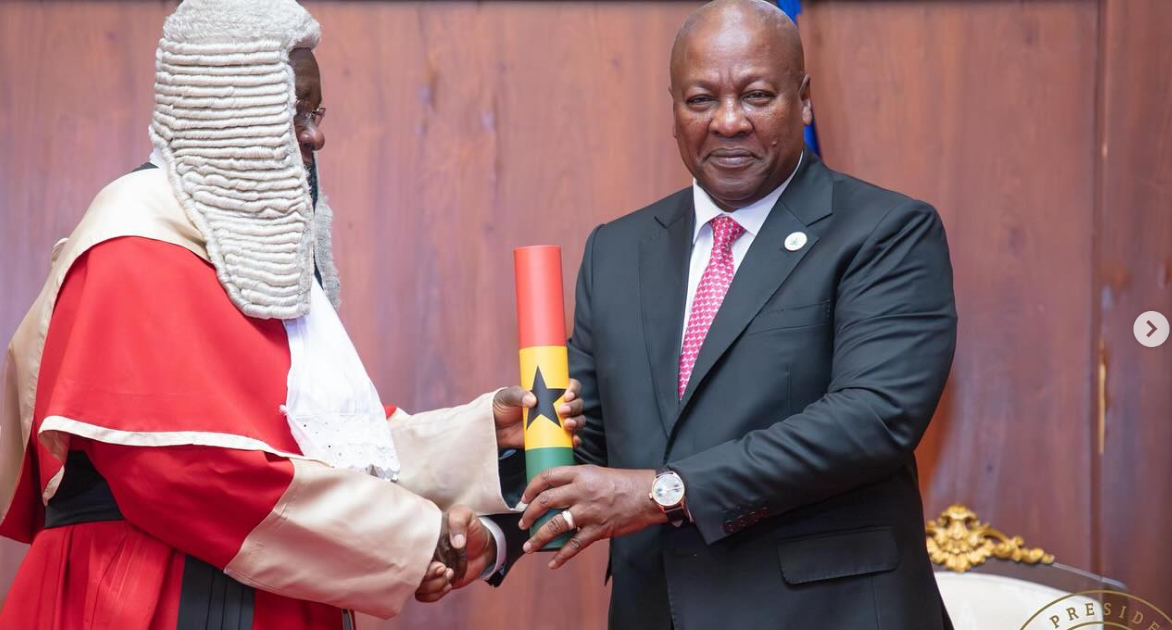
Ghana Chief Justice Paul Baffoe-Bonnie: 'Eight Years' Comment Sparks Debate
Summary
- Ghana's Chief Justice, Paul Baffoe-Bonnie, made controversial remarks during visits to the Minerals Income Investment Fund (MIIF) and the Social Security and National Insurance Trust (SSNIT).
- His comments included questioning Ghana's activities "in the past eight years" (referring to the Akufo-Addo administration) and urging MIIF to support President John Mahama’s agenda.
- The New Patriotic Party (NPP) called for his retraction or resignation, while CDD-Ghana warned of a perception of political bias.
- The Judicial Service defended the Chief Justice, stating his observations were made in good faith and not intended to undermine judicial independence.
- The incident highlights the critical importance of not only actual judicial impartiality but also the public perception of it to maintain trust in the legal system.
Controversial Remarks by Chief Justice
It is not enough for justice to be impartial in practice; it must also *appear* impartial to the public.
Ghana's Chief Justice, Paul Baffoe-Bonnie, recently sparked significant political debate following public comments made during official visits to two state institutions. During an engagement with the Minerals Income Investment Fund (MIIF), Justice Baffoe-Bonnie commended the management on their reported performance. He then remarked that observing the current activities of some state organizations led him to question what Ghana had "really been doing 'in the past eight years.'" This specific timeframe immediately resonated politically, as "eight years" in the current context refers to the 2017-2024 tenure of the Akufo-Addo administration.
Further escalating the political temperature, the Chief Justice also encouraged MIIF management to ensure the success of President John Mahama’s agenda. Earlier, during a visit to the Social Security and National Insurance Trust (SSNIT), Justice Baffoe-Bonnie drew a comparison between the institution's current performance and a previous attempt to divest certain assets, including the Labadi Beach Hotel. He expressed concern, questioning how the nation had "sunk so low" in that prior period. These statements, delivered during what were ostensibly routine institutional tours, quickly became central to a national discussion on judicial impartiality in Ghana.
Political Fallout and Official Responses
The Chief Justice's remarks swiftly drew sharp criticism from political factions, particularly the New Patriotic Party (NPP). Interpreting his "eight years" comment as a public assessment of their administration's record, the NPP called for Justice Baffoe-Bonnie to either retract his statements or resign from his judicial post and align himself with the opposition National Democratic Congress (NDC). Beyond the immediate political fray, the Center for Democratic Development (CDD-Ghana) also weighed in, urging greater restraint from judicial figures. CDD-Ghana specifically warned that such public pronouncements risk fostering a perception of political bias, which could undermine public trust in the judiciary.
In response to the growing controversy, the Judicial Service issued a statement defending the Chief Justice. The Service clarified that Justice Baffoe-Bonnie's observations were made in good faith and were not intended to compromise or undermine the independence of the judiciary. This official explanation aimed to mitigate concerns about the Chief Justice's political remarks and reassure the public of the judiciary's commitment to impartiality, despite the public outcry and calls for accountability.
The Imperative of Perceived Impartiality
The incident involving Ghana Chief Justice Paul Baffoe-Bonnie underscores a fundamental principle of judicial independence: it is not enough for justice to be impartial in practice; it must also *appear* impartial to the public. While judges, like all citizens, possess their own intelligence, patriotism, and capacity for observation, their professional role demands a higher standard of circumspection in public commentary. Even if Justice Baffoe-Bonnie's intentions were entirely benign and his remarks genuinely made in good faith, as asserted by the Judicial Service, the political interpretation of phrases like "eight years" or calls to support a specific presidential agenda can erode public confidence.
The challenge lies in the inherent difficulty of separating a judge's personal observations from their official capacity, especially when those observations touch upon sensitive political periods or government policies. The perception of bias, once created, can be difficult to dispel, regardless of the actual merits or impartiality of judicial decisions. This situation highlights why organizations like CDD-Ghana emphasize restraint, recognizing that the integrity of the legal system hinges not just on the absence of actual bias, but crucially, on the unwavering public belief in its neutrality. The Ghana judicial independence controversy serves as a potent reminder of the delicate balance required to maintain trust in the rule of law.
Practical Implications
This incident highlights the critical importance of maintaining both actual and perceived judicial impartiality in Ghana. Lawyers and compliance officers should be acutely aware of how public statements by judicial figures can impact the integrity and public trust in the legal system, potentially influencing case perceptions and the broader legal environment.
Source
How does this affect you?
Get an AI analysis of this article grounded in your jurisdictions, practice areas, and any policy documents you've uploaded to Wansom.
Finish Reading the Full Story and the Expert Analysis.
Wansom is AI and can make mistakes.