
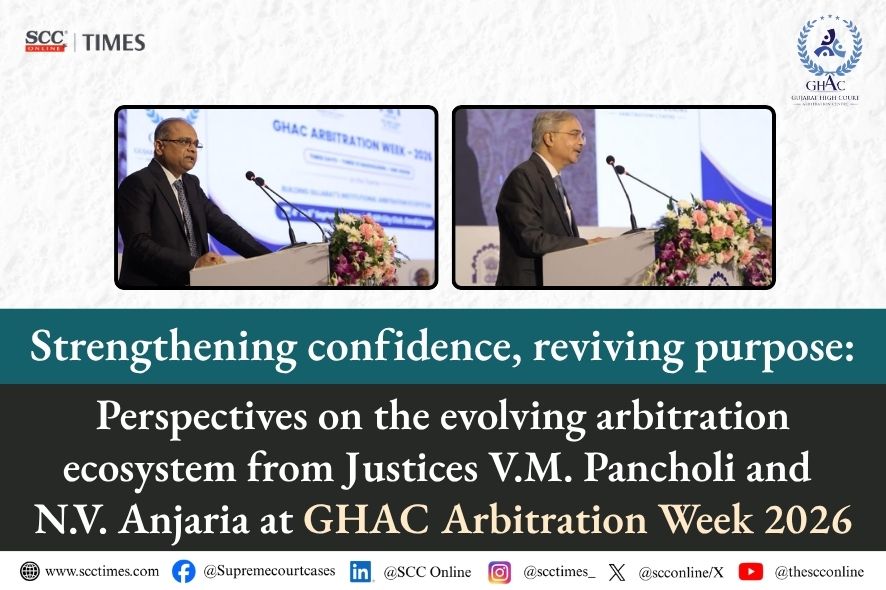
GHAC Arbitration Week 2026 Pancholi Anjaria: Justices Urge Stronger India Arbitration
Summary
- Supreme Court Justices V.M. Pancholi and N.V. Anjaria addressed the inaugural GHAC Arbitration Week 2026 ceremony.
- Their discussions focused on strengthening India's arbitration ecosystem.
- Key themes included building institutional confidence and upholding core arbitration values.
- The core values highlighted were independence, efficiency, accessibility, party autonomy, and settlement.
Judicial Perspectives on India's Arbitration Future
The judicial perspectives presented by Supreme Court Justice V.M. Pancholi arbitration views and Supreme Court Justice N.V. Anjaria arbitration perspectives are crucial for understanding the trajectory of arbitration policy and practice in the country.
The inaugural ceremony of GHAC Arbitration Week 2026 served as a significant platform for judicial leaders to articulate their vision for the future of dispute resolution in India. Judges of the Supreme Court of India V.M. Pancholi and N.V. Anjaria, prominent figures in the Indian judiciary, delivered key addresses that underscored a collective commitment to enhancing the nation's arbitration framework. Their remarks at the GHAC Arbitration Week 2026 Pancholi Anjaria session focused squarely on the imperative of strengthening India's arbitration ecosystem, signaling a clear judicial direction for practitioners and institutions alike.
The core message from both Justices revolved around two fundamental pillars: cultivating robust institutional confidence and meticulously returning the arbitration process to its foundational values. This emphasis highlights a strategic approach to not only improve the operational aspects of arbitration but also to reinforce its legitimacy and effectiveness within the broader legal landscape. The judicial perspectives presented by Supreme Court Justice V.M. Pancholi arbitration views and Supreme Court Justice N.V. Anjaria arbitration perspectives are crucial for understanding the trajectory of arbitration policy and practice in the country.
Reaffirming Core Principles for a Robust Ecosystem
Central to the Justices' discourse was a reaffirmation of the intrinsic values that underpin effective arbitration. They specifically highlighted independence, efficiency, accessibility, party autonomy, and the ultimate goal of settlement as non-negotiable principles. The emphasis on independence ensures that arbitral tribunals operate free from undue influence, fostering impartiality and trust in the process. Efficiency, another key value, speaks to the need for timely and cost-effective resolution of disputes, a critical factor for businesses and individuals seeking alternatives to traditional litigation.
Accessibility aims to make arbitration a viable option for a wider range of parties, reducing barriers to entry and promoting its use across various sectors. Furthermore, the Justices underscored the importance of arbitration party autonomy India, recognizing the parties' right to shape the arbitral process to suit their specific needs, thereby enhancing satisfaction and compliance with awards. Finally, the focus on settlement reinforces arbitration's primary objective: to resolve disputes amicably and definitively, providing closure and avoiding protracted legal battles. These principles are seen as vital for the continued India arbitration ecosystem strengthening.
Building Trust and Institutional Confidence
A significant portion of the judicial commentary at the GHAC Arbitration Week 2026 focused on the critical need to build and sustain institutional confidence within India's arbitration framework. This confidence is not merely about the efficiency of individual arbitrations but encompasses the broader perception of the entire system's fairness, reliability, and enforceability. When institutions and practitioners operate with a high degree of confidence, it encourages greater adoption of arbitration as a preferred dispute resolution mechanism, both domestically and internationally.
The judiciary's vocal support for these foundational values directly contributes to fostering Indian arbitration institutional confidence. By advocating for independence, efficiency, accessibility, party autonomy, and settlement, Supreme Court Justices Pancholi and Anjaria are signaling a judicial commitment to upholding the integrity and efficacy of arbitration. This judicial endorsement is instrumental in assuring stakeholders that the arbitration process is not only legally sound but also supported by the highest echelons of the legal system, thereby encouraging its growth and wider acceptance.
Practical Implications
Lawyers practicing arbitration in India should note these judicial perspectives as they signal the judiciary's commitment to strengthening the arbitration ecosystem through principles like independence and efficiency. This understanding can inform strategic advice to clients regarding dispute resolution mechanisms and help anticipate future policy developments or judicial interpretations in arbitration.
Source
How does this affect you?
Get an AI analysis of this article grounded in your jurisdictions, practice areas, and any policy documents you've uploaded to Wansom.
Finish Reading the Full Story and the Expert Analysis.
Wansom is AI and can make mistakes.