
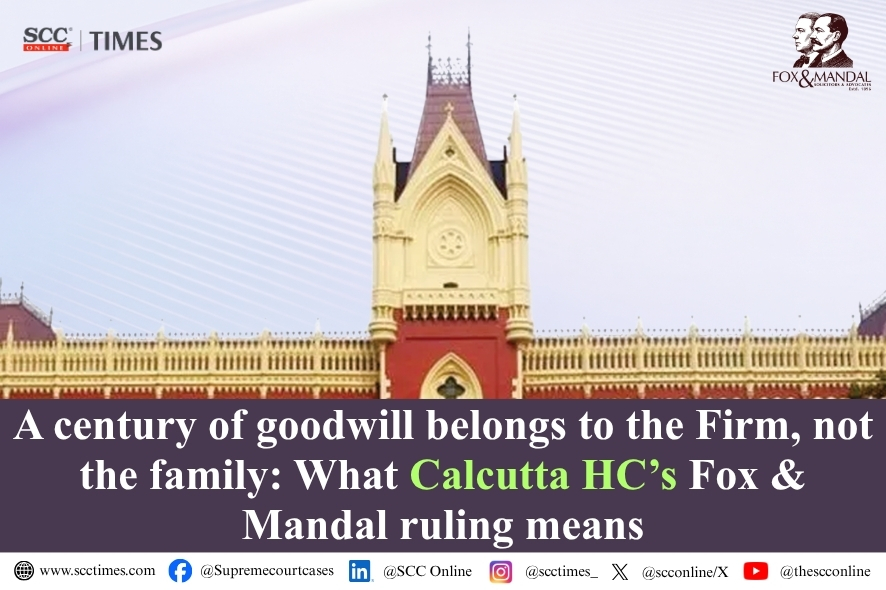
Calcutta High Court: Fox & Mandal Goodwill Ruling Grants Injunction
Summary
- The Calcutta High Court granted summary judgment to Fox & Mandal in a passing-off dispute, permanently restraining defendants from claiming association with the firm.
- The court affirmed Fox & Mandal's prior use, reputation, and goodwill dating from its 1896 establishment, finding defendants had no legal entitlement to these assets.
- Defendants argued their right to use the name based on family lineage and shared goodwill, claiming it was a "family mark," but these arguments were rejected.
- The ruling clarifies that a professional firm's goodwill belongs to the entity, not to individual partners or their descendants, even after reconstitutions over a century.
- The court stated that likelihood of injury or damage is sufficient for a passing-off claim to succeed, and deliberate violation of restraint orders constitutes public deception.
What Happened
This ruling clarifies that even if prominent members of a family, such as the Mandal family, were partners at various times during the firm's century-long history, this does not confer ownership of the firm's goodwill upon their heirs.
The Calcutta High Court recently delivered a significant ruling, granting summary judgment in favor of the historic legal firm Fox & Mandal in a passing-off dispute. The court issued a permanent injunction, preventing the defendants from asserting any connection with Fox & Mandal, after determining they had no legal right to the firm's established goodwill or trademarks. This decisive action underscores the court's finding that the plaintiff firm had unequivocally demonstrated prior use, reputation, and goodwill originating from its establishment in 1896.
The dispute centered on allegations by Fox & Mandal that the defendants were misrepresenting their association with the venerable institution. Founded in 1896 by English attorney John Kerr Fox and Indian attorney Gokul Chandra Mandal, the firm has continuously provided legal and professional services under its distinctive name for over a century. Plaintiff 2, a limited liability partnership, was subsequently formed by the firm and its partners. The defendants, also engaged in the legal profession, included Defendant 2, a partnership established in 1984 with some former partners of the plaintiff firm, and Defendant 1, who had never been a partner or employee of the plaintiff firm but was associated with Defendant 2.
The Legal Battle and Key Arguments
Fox & Mandal contended that the defendants were actively using various materials, including publications, advertisements, brochures, online articles, and websites, to falsely trace their history and reputation back to the plaintiff firm. A primary point of contention was the defendants' representations suggesting a link to the firm's 1896 founding and its enduring historical legacy. The plaintiff firm, which holds trademark registration in Class 42 and owns several other marks, argued that these actions constituted passing off, creating a misleading impression of connection to the public.
In their defense, the defendants primarily argued that Defendant 1, as a legal heir of a former partner, possessed rights to the firm's shared goodwill. They asserted that "Fox & Mandal" functioned as a family mark, implying that members of the Mandal family should not be barred from using it. The defendants also pointed to their own mark's registration predating the plaintiff firm's and claimed a no-objection certificate had been granted. However, the court found these arguments to be a "camouflage" designed to delay proceedings. The plaintiffs highlighted that the defendants had failed to file a written statement despite proper service and the expiry of the prescribed period, indicating no genuine or triable issues for a full trial.
Significance of the Ruling
The Calcutta High Court's decision carries substantial weight for professional service firms, particularly regarding the ownership of goodwill and brand identity. The court explicitly stated that the defendants lacked any legal entitlement to the firm's goodwill or marks, reinforcing the principle that a firm's reputation and brand belong to the entity itself, not to individual partners or their descendants. This ruling clarifies that even if prominent members of a family, such as the Mandal family, were partners at various times during the firm's century-long history, this does not confer ownership of the firm's goodwill upon their heirs.
Furthermore, the court emphasized that an action for passing off can succeed based merely on the likelihood of injury or damage, rather than requiring proof of actual harm. It also noted that deliberate violations of prior restraint orders constitute misrepresentation and deception to the general public. This judgment, which followed a series of legal victories for Fox & Mandal, including the dismissal of appeals against interim protection orders (first granted on November 15, 2022, and confirmed on September 27, 2023, with a subsequent appeal also dismissed and a Supreme Court special leave petition withdrawn), firmly establishes the firm's intellectual property rights against claims based on family lineage.
Practical Implications
This ruling sets a significant precedent for professional service firms in India, clarifying that a firm's goodwill and brand identity belong to the entity, not individual partners' families. Lawyers advising on partnership agreements, succession planning, or intellectual property for long-standing firms should note this decision to ensure robust protection against passing-off claims by former partners' descendants.
Source
How does this affect you?
Get an AI analysis of this article grounded in your jurisdictions, practice areas, and any policy documents you've uploaded to Wansom.
Finish Reading the Full Story and the Expert Analysis.
Wansom is AI and can make mistakes.