
Federal Judge Blocks Trump Administration's DEI Grant Cuts
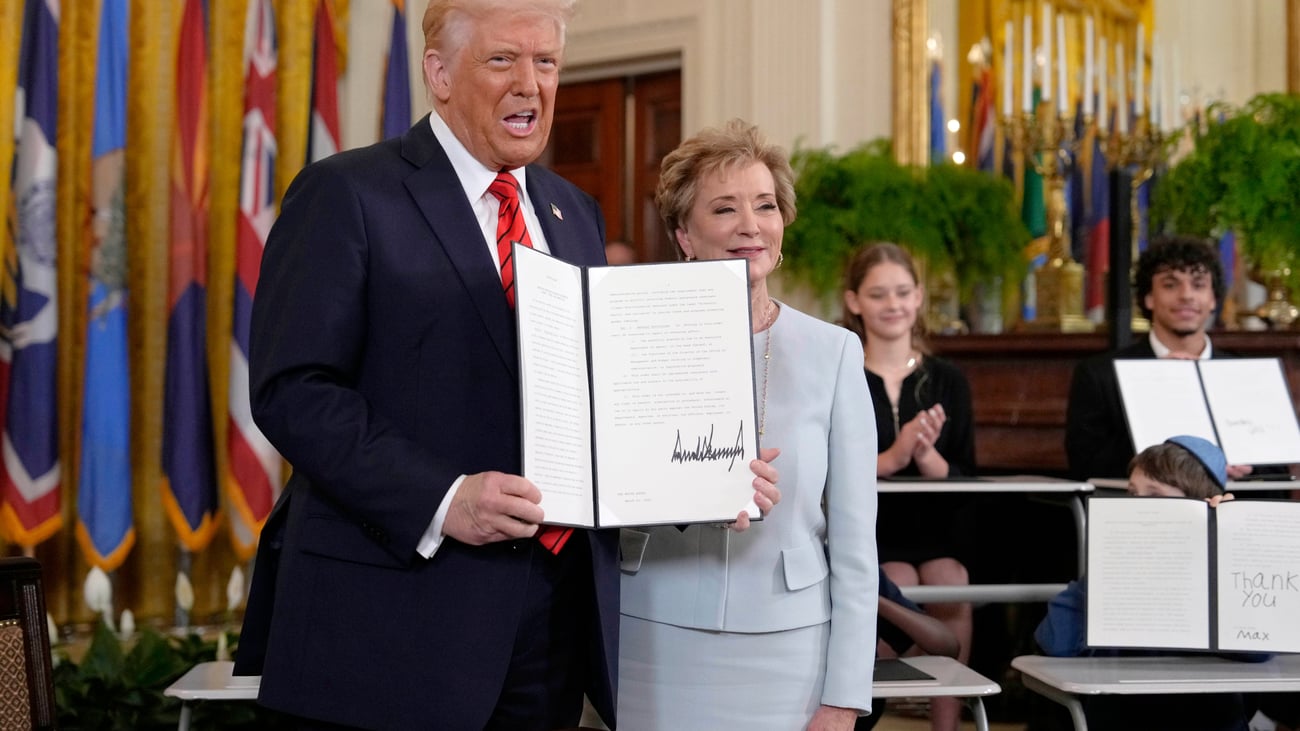
A federal judge in Boston found the administration couldn’t even define what diversity, equity and inclusion is. President Donald Trump holds up a signed executive order alongside Secretary of Education Linda McMahon in the East Room of the White House in Washington, Thursday, March 20, 2025. (AP Photo/Ben Curtis) (CN) — A federal judge has struck down a Department of Education directive to slash $600 million in teacher training grants that the Trump administration claims are related to “divisive ideologies” like diversity, equity and inclusion. In a 70-page ruling issued Thursday, U.S. District Judge Angel Kelley, a Joe Biden appointee in the District of Massachusetts, found the government’s decision was arbitrary and capricious in part because it couldn’t define what DEI is or state why the slashed programs were discriminatory. “It is difficult to see how topics can be ‘anti-racis[t]’ yet simultaneously fall within the directive’s category of ‘discriminatory’ activities,” Kelley wrote. “The record likewise shows that the directive swept in topics as broad and amorphous as ‘family and community in the classroom’ and ‘social-emotional learning.’ These topics do not, on their face, have any apparent connection to discrimination.” Kelley added the term DEI is not self-defining, and that the government said nothing on the record that it has a widely understood definition that could realistically be applied to this kind of directive. “Under these circumstances, it is difficult to see how subordinate officials are expected to implement the directive consistently or how grantees are expected to understand what programs it prohibits,” Kelley wrote. Her ruling blocks an Education Department directive from February 2025 that guts around $600 million in grants dedicated to training educators. The Trump administration claimed this was part of a broader effort to eradicate government funding that it associated with DEI practices. Eight Democratic-led states sued the following month, claiming the executive branch unlawfully pulled the funding that Congress approved to address nationwide teacher shortages. Taking that cash off the table, the states argued, would “destabilize local school systems” and thrust public schools into chaos as they rework budgets that are set years in advance. A federal judge agreed, siding with the states in temporarily blocking the grant cuts in a ruling that was upheld by the First Circuit . But the issue later rose to the conservative Supreme Court, which granted the Trump administration’s petition to ignore the lower courts’ orders and resume with the funding cuts while a final decision was pending. More than a year later, Kelley’s final ruling once again puts the funding cuts on ice. The summary judgement order permanently declares that the scrutinized directive is a violation of the Administrative Procedure Act and bars the government from acting on it. “In sum, because the directive provides no discernible criteria for ‘DEI,’ and thus for determining the type of programs and activities it disfavors, it fails to provide the explanation necessary to guide implementation,” Kelley wrote. “Accordingly, the directive is arbitrary and capricious.” In a statement Friday, an Education Department spokesperson stuck by the government’s claims that the contested grants were divisive. “Taxpayer dollars should support preparing teachers for meaningful student learning, expanding the pipeline of high-quality teachers, and retaining top talent — not funding divisive ideology or racial preferences,” said the department’s press secretary Savannah Newhouse. New York Attorney General Letitia James — part of the suing coalition alongside California, Massachusetts, New Jersey, Colorado, Illinois, Maryland and Wisconsin — called the ruling a “major victory.” “Kids in rural and underserved communities deserve access to qualified teachers and a quality education,” she said in a statement posted to social media Friday. The two grant
How does this affect you?
Get an AI analysis of this article grounded in your jurisdictions, practice areas, and any policy documents you've uploaded to Wansom.
Finish Reading the Full Story and the Expert Analysis.
Get the latest legal & regulatory intelligence in United States
Wansom is AI and can make mistakes.