
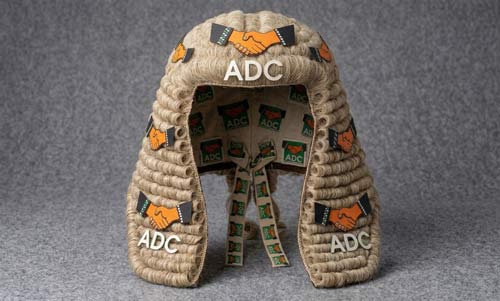
Federal High Court Abuja: Voids ADC Leadership Mark Aregbesola
Summary
- The Federal High Court in Abuja voided the leadership of Mark and Aregbesola in the African Democratic Congress (ADC).
- The court ruled that Nafiu Gombe never resigned from the ADC, contradicting previous assumptions.
- A key piece of evidence, Exhibit ADC 1, was declared "fictitious or fabricated" by the court.
- The judgment clarified that INEC monitoring of party activities does not constitute an election.
- This ruling raises fundamental questions about the reliance on National Executive Committee resolutions and INEC recognition for political party leadership legitimacy.
Court Voids ADC Leadership
This judicial intervention serves as a potent reminder to all political entities that their internal operations must withstand rigorous scrutiny, ensuring that leadership is genuinely reflective of democratic principles and not merely a product of committee resolutions or external recognition.
The Federal High Court in Abuja recently issued a significant ruling that invalidated the leadership of Mark and Aregbesola within the African Democratic Congress (ADC). This decision stems from a judicial review that scrutinized the legitimacy of their ascent to party leadership, ultimately finding procedural irregularities and factual misrepresentations. The court's pronouncement effectively nullifies their tenure, necessitating a re-evaluation of the party's internal governance.
A core finding of the court was its declaration that Nafiu Gombe, a key figure in the party, had never officially resigned from the ADC. This determination directly contradicted claims or assumptions that may have underpinned the leadership changes. Furthermore, the court explicitly labeled a crucial piece of evidence, identified as Exhibit ADC 1, as either "fictitious or fabricated," casting serious doubt on the veracity of documents presented to justify the leadership structure. These specific findings were instrumental in the court's decision to void the leadership.
Legal Scrutiny of Party Processes
Central to the Federal High Court Abuja ADC judgment was a clarification regarding the role and implications of Independent National Electoral Commission (INEC) monitoring. The court unequivocally stated that INEC's oversight activities do not constitute an election in themselves. This distinction is crucial, as it implies that the mere presence or observation by INEC during party processes does not automatically confer legitimacy or validate outcomes if underlying procedures are flawed.
The ruling also prompted fundamental inquiries into the operational mechanics of internal democracy Nigerian political parties. Specifically, the court's decision raised questions about the extent to which a political party can legitimately rely on resolutions passed by its National Executive Committee (NEC) to establish leadership, particularly when those resolutions might be based on questionable facts or processes. It further challenged the notion that recognition by INEC alone is sufficient to validate a party's leadership structure, emphasizing the need for robust internal democratic adherence.
Implications for Internal Party Democracy
This judgment from the Federal High Court in Abuja carries substantial weight for the future conduct and governance of political parties across Nigeria. By voiding the ADC leadership of Mark and Aregbesola based on findings of Nafiu Gombe ADC resignation not occurring and fabricated evidence, the court has sent a clear message about the imperative of transparency and adherence to established rules within party structures. It reinforces the principle that internal democracy is not merely a rhetorical concept but a fundamental legal requirement.
The ruling underscores the critical importance of meticulous record-keeping and verifiable processes for all leadership transitions and party decisions. It highlights that reliance on potentially fabricated documents or misinterpretations of member status can lead to severe legal repercussions, including the nullification of leadership. This judicial intervention serves as a potent reminder to all political entities that their internal operations must withstand rigorous scrutiny, ensuring that leadership is genuinely reflective of democratic principles and not merely a product of committee resolutions or external recognition.
Practical Implications
This judgment clarifies the legal requirements for internal democracy within Nigerian political parties, particularly concerning the validity of NEC resolutions and the role of INEC monitoring. Lawyers advising political parties must ensure strict adherence to constitutional and electoral guidelines to prevent leadership challenges based on procedural irregularities.
Source
How does this affect you?
Get an AI analysis of this article grounded in your jurisdictions, practice areas, and any policy documents you've uploaded to Wansom.
Finish Reading the Full Story and the Expert Analysis.
Get the latest legal & regulatory intelligence in Nigeria
Wansom is AI and can make mistakes.