
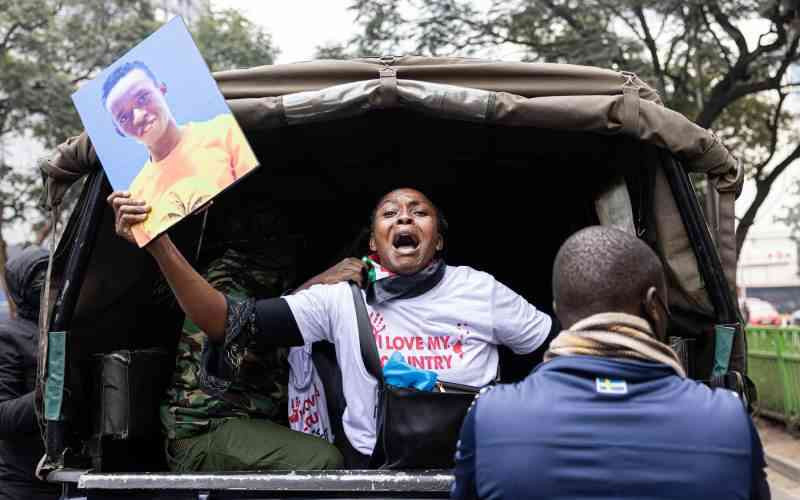
Nairobi Court: Evans Kiratu Unlawful Death Ruling Kenya Protest
Summary
- A Nairobi court ruled that 21-year-old Evans Kiratu Karobi died from unlawful blunt-force trauma during June 2024 Finance Bill protests.
- Milimani Senior Principal Magistrate Eric Wambo Otieno found Kiratu sustained catastrophic internal injuries on June 20, 2024, during police crowd-control operations.
- Despite extensive medical evidence and witness testimony, the court could not identify the specific perpetrator responsible for inflicting the fatal injuries.
- Investigations were hampered by non-operational public surveillance cameras and CCTV footage that did not capture the moment of injury.
- The ruling highlights significant challenges in establishing individual accountability for deaths during public order enforcement in Kenya.
Court Rules Protester's Death Unlawful, Perpetrator Unidentified
This ruling, despite acknowledging unlawful force, underscores the significant challenges in establishing individual culpability for deaths during public order enforcement, even when unlawful force is acknowledged by the court.
A Nairobi court has concluded an inquest into the death of Evans Kiratu Karobi, ruling that the 21-year-old protester died from unlawful blunt-force trauma sustained during the June 2024 Finance Bill demonstrations. Despite this finding, the Milimani Senior Principal Magistrate Eric Wambo Otieno stated that investigations failed to produce sufficient evidence to identify the individual or individuals responsible for inflicting the fatal injuries.
The ruling by Magistrate Otieno explicitly stated that Kiratu's death was caused by unlawful blunt force trauma from unknown persons during public demonstrations on June 20, 2024. These events unfolded along Kenyatta Avenue and Kimathi Street within Nairobi's Central Business District. The court acknowledged that Kiratu suffered catastrophic internal injuries during these protests, which were part of widespread opposition to the Kenya Finance Bill 2024.
Evans Kiratu was among numerous young Kenyans who took to the streets to voice their dissent against the proposed Finance Bill. The demonstrations were met with police action to disperse crowds in the city center, creating chaotic scenes where Kiratu ultimately sustained his fatal injuries. The court's inability to pinpoint a perpetrator leaves a significant question mark over individual accountability in this high-profile case.
Gruesome Injuries and Witness Account Emerge
Postmortem examinations presented during the Evans Kiratu Karobi death inquest revealed the severity of his injuries. Medical experts unanimously concluded that Kiratu died from multiple system organ injuries affecting his thorax, abdomen, and pelvis, all consistent with blunt force trauma. These extensive injuries included internal bruising to his fourth through seventh ribs, a ruptured diaphragm, a ruptured pericardial membrane, and the herniation of his intestines and stomach into the thoracic cavity. Additionally, he suffered a collapsed left lung, pelvic fractures, and a ruptured urinary bladder.
The court heard compelling testimony from Christopher Munene, a witness who described the chaotic scene near Naivas Supermarket, Kenyatta Avenue, and Kimathi Street. Munene recounted a heavy police presence and the deployment of tear gas, which triggered pandemonium as officers moved to disperse demonstrators. Amidst the chaos and clouds of tear gas, Munene heard a loud bang, followed by shouts from the public that someone had been hit. He found Kiratu lying on the road, writhing in pain.
According to Munene's account, Kiratu complained of severe pain in his pelvic and private areas. Members of the public attempted to administer first aid before flagging down an Uber driver, whose vehicle was then commandeered to transport Kiratu to Kenyatta National Hospital. During the journey, Kiratu reportedly continued to complain in his mother tongue about pain in his private parts and later vomited blood while awaiting treatment. Munene also observed a hole around Kiratu's pelvic region, and doctors informed him that the young protester was going into shock before he ultimately succumbed to his injuries.
Accountability Challenges in Public Order Operations
Despite clear evidence that Evans Kiratu sustained his fatal injuries during police crowd-control operations, the Milimani court explicitly stated it could not determine who inflicted the blunt-force trauma. Magistrate Wambo classified the manner of death as “one resulting from blunt force trauma sustained during public order enforcement operations,” underscoring the context of the incident without assigning individual blame. This Milimani court protest death ruling highlights the persistent difficulties in establishing direct culpability in such volatile environments.
Investigations faced significant hurdles in identifying a perpetrator. CCTV footage retrieved from H.H. Towers showed protesters fleeing from visible tear gas smoke but failed to capture the precise moment Kiratu was struck or identify the person responsible. Furthermore, public street surveillance cameras in the area were not operational at the critical time. Investigating officer Ibrahim Shumu confirmed that Kiratu was among protesters dispersed by police using tear gas, but his inquiry yielded no direct evidence to identify the specific object or individual that caused the injuries.
This ruling, despite acknowledging unlawful force, underscores the significant challenges in establishing individual culpability for deaths during public order enforcement, even when unlawful force is acknowledged by the court. The outcome of the Evans Kiratu unlawful death ruling Kenya case raises critical questions about police accountability Kenya and the mechanisms for justice when victims suffer blunt force trauma protest death, yet specific perpetrators remain unknown.
Practical Implications
This ruling highlights the significant challenges in establishing accountability for deaths occurring during public order enforcement, even when unlawful force is acknowledged by the court. Lawyers advising clients on human rights, public interest litigation, or potential claims against the state should note the precedent regarding the difficulty of perpetrator identification in such chaotic circumstances, which may impact future litigation strategies.
Source
How does this affect you?
Get an AI analysis of this article grounded in your jurisdictions, practice areas, and any policy documents you've uploaded to Wansom.
Finish Reading the Full Story and the Expert Analysis.
Wansom is AI and can make mistakes.