
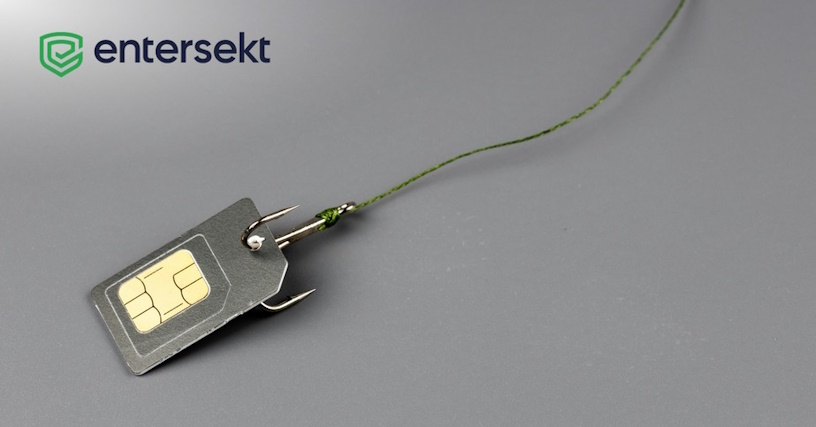
Entersekt: South Africa SIM-Swap Protection Fights Mobile Fraud
Summary
- SIM-swap fraud accounts for approximately 60% of mobile-banking fraud in South Africa, with digital-banking fraud losses projected to reach R2.4 billion in 2025.
- Entersekt provides real-time SIM-swap protection through MNO authentication, cryptographic device binding, and Context Aware Authentication, a solution refined over a decade.
- Capitec Bank utilizes Entersekt's SIM check for high-risk transactions, including adding cards to digital wallets and account recovery.
- The Reserve Bank's upcoming authorization framework for non-bank payment providers offers an opportunity to mandate real-time SIM-change checks and device-bound authentication as baseline security requirements.
- Relying solely on text messages for identity verification is a critical vulnerability that criminals actively exploit, necessitating advanced fraud prevention strategies.
The Escalating Threat of SIM-Swap Fraud in South Africa
For lawyers and compliance officers advising financial institutions and payment providers, it is imperative to recognize that real-time SIM-change checks and device-bound authentication should become baseline requirements for any entity, whether a bank or a fintech, initiating instant payments.
South Africa's financial sector faces a significant challenge with the rise of SIM-swap fraud, a vulnerability highlighted by Michael Avery in a November Financial Mail article. He cautioned that as instant payment systems expand, the mobile number, a critical identity credential, remains susceptible to hijacking. This raises a crucial question for financial institutions and payment providers: why should they not possess real-time awareness of a SIM card replacement?
The scale of this problem is substantial. Data from the Communications Risk Information Centre (COMRiC) indicates that approximately 60% of all mobile-banking fraud is directly attributable to SIM-swap attacks. Furthermore, the South African Banking Risk Information Centre (SABRIC) projects digital-banking fraud losses to reach R2.4 billion in 2025, a notable increase from the R1.9 billion recorded in the preceding year. The advent of instant payments dramatically shrinks the window available to detect and prevent fraudulent transactions, reducing it from days to mere seconds.
For institutions that only discover a SIM swap when a customer reports an issue, the financial loss has often already occurred. A primary weakness contributing to this vulnerability is the continued reliance on text messages as a definitive proof of identity. Entersekt's long-standing principle, established from its inception, asserts that mere possession of a phone number should never be sufficient to compromise a bank account.
Entersekt's Proven SIM-Swap Protection Strategies
Entersekt offers a robust solution to this pervasive issue, providing real-time intelligence on SIM card changes. The company has been empowering its clients with advanced Entersekt SIM-swap protection South Africa for over a decade, continuously refining its approach even before the emergence of instant payment systems like PayShap. Their technology is designed to immediately inform institutions when a SIM card has recently been replaced.
Key to this defense is Entersekt MNO authentication, which verifies the SIM's age and status directly with mobile network operators in real-time. This allows financial entities to ascertain if a SIM has undergone a recent change before transmitting verification codes or entrusting sensitive information to that number. This capability delivers the immediate warning system that experts like Avery have advocated for, and it is already operational in various deployments.
Beyond SIM-swap detection, Entersekt enhances security through cryptographic device binding ZA, which securely links authentication and transaction signing processes to a customer's trusted device. Additionally, Context Aware Authentication evaluates factors such as the device, user behavior, and location to determine when an action warrants heightened scrutiny. This multi-layered approach ensures that even if a criminal successfully hijacks a mobile number, they lack the necessary access to a customer's device to illicitly transfer funds.
Regulatory Imperatives for Robust Digital Security
The efficacy of Entersekt's solutions is demonstrated by practical applications, such as Capitec Bank's integration of Entersekt's SIM check when launching Samsung Pay in June 2022. This allowed the bank to confirm that a customer's SIM had not been recently swapped before authorizing the addition of a card to their digital wallet. This same rigorous check now safeguards various high-risk customer journeys, including account recovery, new-device registration, and payment approvals.
While some argue for delaying the expansion of payment systems until SIM security is fully reformed, Entersekt contends that South Africa does not need to postpone action. The necessary tools to move beyond treating a phone number as sole proof of identity are currently available and have a proven track record. The impending Reserve Bank's authorisation framework for non-bank payment providers, expected by the end of November, presents a critical opportunity to establish these advanced security measures as standard requirements.
For lawyers and compliance officers advising financial institutions and payment providers, it is imperative to recognize that real-time SIM-change checks and device-bound authentication should become baseline requirements for any entity, whether a bank or a fintech, initiating instant payments. This aligns with the principle of 'same activity, same risk, same safeguards.' Institutions that continue to rely on text messages for customer verification are inadvertently depending on a channel that criminals have already mastered how to exploit, underscoring the urgent need for enhanced fraud prevention strategies to mitigate significant financial losses from South Africa mobile banking fraud.
Practical Implications
Lawyers and compliance officers advising financial institutions and payment providers in South Africa should assess their current fraud prevention strategies, particularly regarding SIM-swap attacks, to ensure they meet evolving regulatory expectations, such as the Reserve Bank's authorisation framework for non-bank payment providers, and mitigate significant financial losses from digital banking fraud.
Source
Source: Original reporting via Entersekt
How does this affect you?
Get an AI analysis of this article grounded in your jurisdictions, practice areas, and any policy documents you've uploaded to Wansom.
Finish Reading the Full Story and the Expert Analysis.
Get the latest legal & regulatory intelligence in South Africa
Wansom is AI and can make mistakes.