
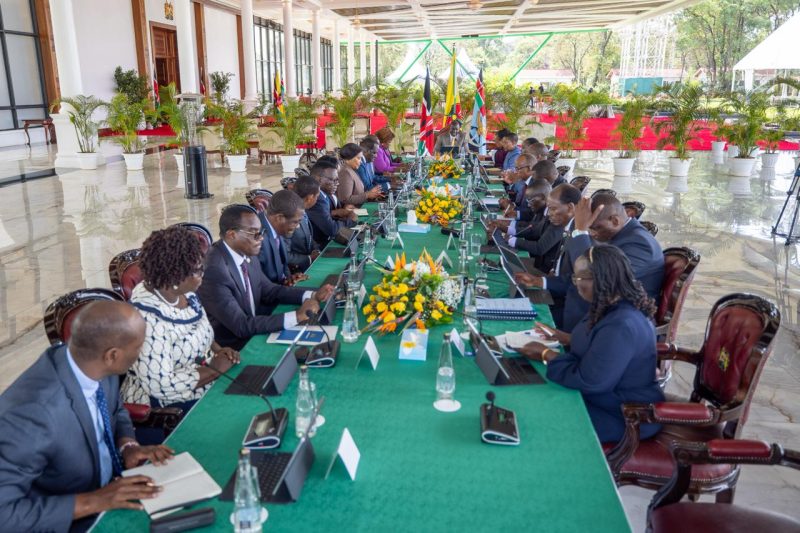
High Court: Declines Urgent Listing for Eliud Matindi Challenge to Ruto Cabinet
Summary
- The High Court declined to urgently hear Eliud Matindi's petition challenging the legitimacy of Kenya's Cabinet.
- Matindi's petition argues that President William Ruto failed to reconstitute a gender-compliant Cabinet by the October 28 deadline set by a previous court ruling.
- A June 30, 2026, court decision found the Cabinet fell short of the two-thirds gender rule under Article 27(8) of the Constitution.
- Matindi seeks orders to stop Cabinet Secretaries from exercising executive powers and to halt their salaries, arguing the current Cabinet is unconstitutional.
- The case is now set for procedural steps, with a mention scheduled for February 10.
Recent Court Developments
Matindi warns that permitting these officials to continue making decisions and exercising executive authority under a Cabinet he considers illegitimate poses a serious threat to Kenya's constitutional order.
The High Court in Nairobi recently declined to grant urgent status to a petition challenging the legitimacy of Kenya's Cabinet Secretaries. Justice Patricia Nyaundi, presiding over the matter, instead issued procedural directives, instructing petitioner Eliud Matindi to serve his petition and an accompanying application to all named respondents and interested parties by November 9. The respondents have been given until November 24, or 14 days following service, to submit their responses to the court.
Matindi, in turn, has a seven-day window after service, but no later than December 2, to file any further affidavits. The case is scheduled for a mention on February 10 of the following year. This decision means the challenge to the Ruto Cabinet will not be heard on an expedited basis, despite the petitioner's request for immediate consideration.
Constitutional Gender Mandate
This legal challenge stems from a significant ruling issued on June 30, 2026, by a three-judge bench, which found the composition of the national Cabinet to be in violation of the two-thirds gender rule stipulated under Article 27(8) of the Constitution. In a split decision, Justices Eric Ogola and Stephen Githinji formed the majority, mandating the appointing authority, President William Ruto, to reconstitute the Cabinet within 120 days to achieve constitutional gender compliance. Justice Jairus Ngaah delivered a dissenting opinion in that prior judgment.
At the time of the initial ruling, the Cabinet consisted of 25 members, including the President, Deputy President, Attorney General, and 22 Cabinet Secretaries. Of these, only seven were women, representing approximately 28 percent, while 18 were men, making up 72 percent. The majority concluded that the Cabinet was deficient by two women to meet the constitutional threshold, setting October 28 as the deadline for the Ruto Cabinet reconstitution.
Petitioner's Core Arguments
Eliud Matindi's petition asserts that President Ruto failed to adhere to the court's directive within the specified period, despite the absence of any orders staying the previous judgment. Matindi accuses the President and other respondents of deliberately disregarding the judicial decision, allowing government operations to continue under a Cabinet he deems unconstitutional. He contends that the President "chose to do nothing," characterizing this alleged non-compliance as a direct challenge by the President to the Constitution itself.
To substantiate his claims, Matindi points to Gazette Notices published on October 30 by several Cabinet Secretaries, including John Mbadi Ngongo, Hanna Wendot Cheptumo, Aden Duale, Julius Migos Ogamba, Mutahi Kagwe, and Beatrice Askul Moe. These notices, he argues, demonstrate that these officials persist in exercising powers and fulfilling responsibilities reserved for members of the national executive. Matindi's legal position is that, following the expiry of the court-granted compliance period, the national executive and Cabinet of Kenya, as defined by Articles 130 and 152(1) of the Constitution, effectively ceased to exist.
Implications for Executive Authority
The petitioner is seeking several significant remedies, including conservatory orders to prevent the affected Cabinet Secretaries from presenting themselves as members of the national executive or performing any Cabinet functions while the case is pending. Furthermore, the petition requests the suspension of Executive Order No. 1 of 2025, specifically where it assigns statutory responsibilities to Cabinet Secretaries in their executive capacity. Matindi also aims to restrain the Controller of Budget from authorizing any withdrawals from the Consolidated Fund or other public funds for the payment of salaries, remuneration, or benefits to these officials.
Substantively, he seeks judicial declarations that the President failed to comply with the June 30 judgment and that the continued exercise of executive authority by the challenged officials is unconstitutional. Matindi warns that permitting these officials to continue making decisions and exercising executive authority under a Cabinet he considers illegitimate poses a serious threat to Kenya's constitutional order. The Eliud Matindi petition thus raises fundamental questions about the rule of law and the separation of powers within the Kenyan government.
Practical Implications
Lawyers and compliance officers should monitor this case closely as a successful challenge could invalidate decisions made by current Cabinet Secretaries or halt their operations, creating significant legal uncertainty and potential risks for clients engaging with the Kenyan government through these officials. Advise clients on potential legal exposures related to ongoing or future transactions involving the challenged Cabinet until the legitimacy of the Cabinet is resolved.
Source
How does this affect you?
Get an AI analysis of this article grounded in your jurisdictions, practice areas, and any policy documents you've uploaded to Wansom.
Wansom is AI and can make mistakes.