
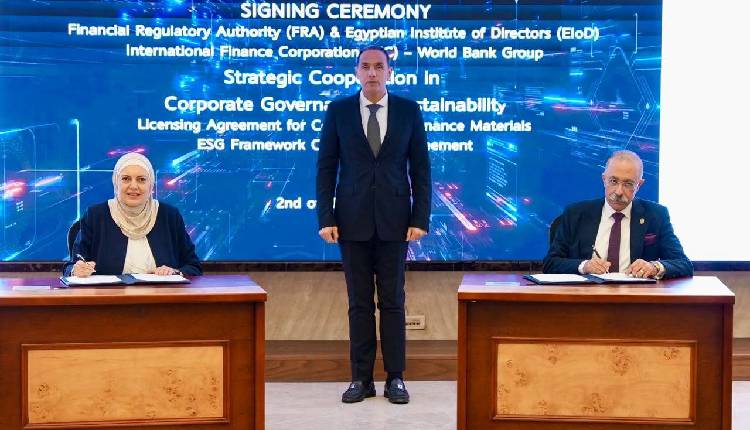
Egypt's FRA: IFC Agreements Bolster Non-Banking Sustainability Governance
Summary
- Egypt's Financial Regulatory Authority (FRA) and the International Finance Corporation (IFC) signed two cooperation agreements.
- The agreements aim to develop sustainability assessment tools and strengthen corporate governance.
- These initiatives will apply across Egypt's non-banking financial sector.
- The IFC is a member of the World Bank Group, contributing global expertise to the partnership.
Recent Developments
The comprehensive FRA IFC agreements Egypt sustainability governance initiatives are poised to generate significant and far-reaching implications for the country's non-banking financial sector.
Egypt's Financial Regulatory Authority (FRA) recently formalized a significant collaboration with the International Finance Corporation (IFC), an integral member of the World Bank Group. These two entities signed a pair of distinct cooperation agreements on Wednesday, marking a pivotal step in the ongoing development of the nation's financial landscape.
The primary objectives underpinning these accords are the creation of advanced sustainability assessment tools and the reinforcement of corporate governance frameworks, specifically targeting the non-banking financial sector across Egypt.
Strategic Partnership and Objectives
The Financial Regulatory Authority (FRA), which serves as Egypt's principal regulator for non-banking financial institutions, has strategically aligned with the International Finance Corporation (IFC) to bolster the sector's operational and ethical standards. This crucial Financial Regulatory Authority IFC cooperation leverages the IFC's extensive global experience in fostering private sector growth and implementing robust governance structures in developing economies.
As a prominent member of the World Bank Group IFC FRA, the IFC's involvement signals a commitment to integrating internationally recognized best practices into Egypt's regulatory environment. This partnership is designed to introduce new methodologies and benchmarks that will directly influence how non-banking financial entities are structured, managed, and evaluated, promoting a more resilient and responsible financial ecosystem.
Enhancing Governance and Sustainability Frameworks
A central pillar of the recently concluded agreements is the dedicated effort to develop sophisticated sustainability assessment tools for Egypt's non-banking financial sector. This initiative aims to provide both regulators and financial institutions with comprehensive mechanisms to effectively measure, report on, and ultimately enhance their environmental, social, and governance (ESG) performance.
Simultaneously, the agreements place a substantial emphasis on strengthening corporate governance NBFIs Egypt. This encompasses a thorough review and potential revision of existing guidelines pertaining to board composition, internal control systems, transparency protocols, and accountability mechanisms, all of which are fundamental for cultivating investor confidence and ensuring market stability. The implementation of these new sustainability assessment tools Egypt will be a key outcome, driving a more integrated approach where financial viability is increasingly intertwined with responsible business conduct.
Implications for Egypt's Financial Sector
The comprehensive FRA IFC agreements Egypt sustainability governance initiatives are poised to generate significant and far-reaching implications for the country's non-banking financial sector. By elevating the standards in both corporate governance and sustainability practices, Egypt aims to enhance its appeal for foreign direct investment and solidify its reputation as a responsible and forward-thinking financial hub.
Improved governance within Egypt's non-banking financial sector governance is absolutely critical for mitigating systemic risks, safeguarding the interests of investors and consumers, and ensuring the long-term health and viability of financial institutions operating within the sector. The collaborative efforts stemming from the World Bank Group IFC FRA partnership provide a robust foundation for achieving these ambitious goals, ultimately contributing to a more resilient, transparent, and sustainably oriented financial ecosystem across Egypt, aligning it closely with global benchmarks for responsible finance.
Practical Implications
Lawyers and compliance officers in Egypt's non-banking financial sector should monitor upcoming regulations and guidelines stemming from these FRA-IFC agreements, particularly concerning new sustainability assessment tools and strengthened corporate governance requirements, to ensure client compliance and mitigate potential exposures.
Source
How does this affect you?
Get an AI analysis of this article grounded in your jurisdictions, practice areas, and any policy documents you've uploaded to Wansom.
Wansom is AI and can make mistakes.