
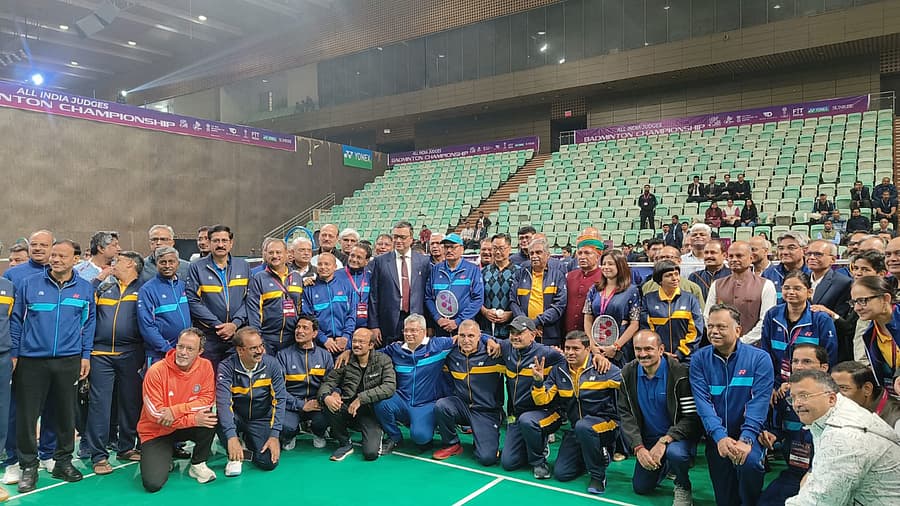
Effort to malign CJI and judiciary: Delhi HC orders removal of reports claiming 75 judges went to London Badminton event
Abstract
The Delhi High Court recently issued a significant order directing the immediate removal and de-indexing of false and malicious reports circulating online, which claimed that the Chief Justice of India (CJI) and numerous other judges, along with Union Ministers, had travelled to London at public expense to attend a badminton tournament. Justice Tejas Karia observed that this content constituted a systematic misinformation campaign designed to malign the reputation of the judiciary and undermine public confidence in the justice delivery system. The court mandated social media platforms, search engines, and digital publishers to comply with the takedown directive within 24 hours and further restrained the public from disseminating such impugned content. This ruling underscores the judiciary's firm stance against disinformation and highlights the evolving responsibilities of online intermediaries in maintaining the integrity of public discourse.
Introduction
In a decisive move to safeguard the integrity and public perception of the Indian judiciary, the Delhi High Court on Friday ordered the swift removal of a barrage of fake news and social media content. These reports falsely alleged that Chief Justice of India Surya Kant, along with dozens of Supreme Court and High Court judges and Union Ministers, had undertaken a government-sponsored trip to London to participate in a badminton tournament. Justice Tejas Karia, presiding over the matter, unequivocally labelled the content as "false, malicious and derogatory," noting its potential to severely undermine public confidence in the judiciary.
The court's directive extends to social media platforms, search engines, digital publishers, and other online intermediaries, requiring them to remove, disable, and de-index the impugned content within a stringent 24-hour timeframe. This order also explicitly restrains members of the public from further uploading, publishing, circulating, or sharing the false information. The ruling comes in response to a petition filed by the Badminton Association of India (BAI), which clarified that the viral photographs were from a domestic tournament held in Delhi in 2025, and the CJI's visit to London was for official state business. This article will delve into the legal framework underpinning this order, analysing its implications for freedom of speech, defamation, contempt of court, and the evolving landscape of intermediary liability in India's digital age.
Background
The legal landscape governing online content in India is shaped by a confluence of constitutional rights, statutory provisions, and judicial precedents. At its core lies Article 19(1)(a) of the Constitution of India, which guarantees the fundamental right to freedom of speech and expression. However, this right is not absolute and is subject to 'reasonable restrictions' under Article 19(2), which includes grounds such as defamation and contempt of court. The right to reputation is also recognised as an integral part of the right to life and personal liberty under Article 21 of the Constitution.
Defamation in India is addressed under Sections 499 and 500 of the Indian Penal Code, 1860 (IPC), which criminalise the making or publishing of imputations intended to harm or knowing they will harm a person's reputation. Beyond individual reputation, the integrity of public institutions, particularly the judiciary, is protected by the Contempt of Courts Act, 1971. This Act defines 'criminal contempt' to include the publication of any matter that 'scandalises or tends to scandalise, or lowers or tends to lower the authority of, any court' or interferes with the administration of justice. Such provisions aim to uphold the sanctity of the judicial system and ensure public trust.
In the digital realm, the Information Technology Act, 2000 (IT Act), and the Information Technology (Intermediary Guidelines and Digital Media Ethics Code) Rules, 2021 (IT Rules, 2021), govern the responsibilities of online intermediaries. A landmark judgment, *Shreya Singhal v. Union of India*, AIR 2015 SC 1523, significantly clarified intermediary liability under Section 79 of the IT Act. The Supreme Court held that intermediaries would only be obligated to take down content upon receiving 'actual knowledge' through a court order or a notification from the appropriate government or its agency, rather than merely a private party request. The IT Rules, 2021, further detail due diligence requirements for intermediaries, including provisions for content takedown within specific timeframes upon such notifications, particularly for unlawful content like defamation or contempt of court.
Analysis
The Delhi High Court's order in this matter is a robust assertion of the judiciary's authority to protect its institutional integrity against deliberate misinformation. Justice Karia's observation that the impugned content was "founded on demonstrably incorrect factual assertions" and constituted a "systematic misinformation campaign" is critical. The Solicitor General, Tushar Mehta, confirmed that the viral photographs were from a domestic badminton event in Delhi in November 2025, and the claims about the CJI and Union Ministers attending a corporate-sponsored event in London were "completely false and misleading." This factual clarity was essential in distinguishing the content from legitimate criticism or fair reportage, placing it squarely within the ambit of actionable defamation and potential criminal contempt.
The court's emphasis on the content's capacity to "undermine public confidence in the judiciary" highlights the broader societal impact of such disinformation. Unlike individual defamation, attacks on the judiciary's reputation can erode the foundational trust necessary for the rule of law. The 24-hour takedown directive to intermediaries is particularly noteworthy. While *Shreya Singhal v. Union of India* established the 'actual knowledge' standard for takedowns, requiring a court order or government notification, this Delhi High Court order provides precisely that judicial mandate, compelling swift action from platforms.
Furthermore, the court's direction for intermediaries to preserve and surrender digital footprints, including IP logs, contact details, and banking records of anonymous uploaders, signifies a proactive approach to identify the originators of the fake news. This aligns with the spirit of the IT Rules, 2021, which aim to enhance accountability for unlawful content online. The ruling reinforces the delicate balance between the fundamental right to freedom of speech and the equally important need to protect the reputation of individuals and institutions, especially when faced with demonstrably false and malicious narratives. It underscores that Article 19(1)(a) cannot be invoked to shield deliberate falsehoods that threaten public order or the administration of justice.
Conclusion
The Delhi High Court's decisive order to remove reports maligning the Chief Justice of India and the judiciary marks a significant development in India's battle against digital misinformation. It serves as a stark reminder to digital publishers, social media platforms, and individuals alike that the constitutional guarantee of freedom of speech is not a license for reckless or malicious dissemination of falsehoods, particularly when such content targets the foundational pillars of democracy. The swift 24-hour takedown mandate, coupled with the direction to preserve user data for investigation, signals a robust judicial intent to hold both content creators and intermediaries accountable.
For legal practitioners, this judgment reinforces the critical importance of due diligence in content creation and publication. Clients operating in the digital space, whether as news outlets, social media influencers, or platform providers, must be acutely aware of their enhanced responsibilities under the IT Act and Rules, especially concerning content that could be deemed defamatory or contemptuous. The judiciary's proactive stance indicates a low tolerance for attempts to erode public trust through fabricated narratives. Practitioners should advise a cautious approach, emphasizing verification and adherence to ethical journalistic standards, to navigate the evolving legal landscape where the protection of institutional integrity is increasingly being prioritised against the backdrop of pervasive online disinformation.
How does this affect your business?
Get an AI analysis of this article grounded in your jurisdictions, practice areas, and any policy documents you've uploaded to Wansom.
Wansom is AI and can make mistakes.