
Thiès Building Collapse: Order to Stop Work Ignored, R+5 Exceeded R+3 Permit
Summary
- A building in Thiès collapsed, resulting in one fatality and two individuals rescued alive.
- The structure had two unauthorized levels, exceeding its R+3 permit to reach R+5.
- The Regional Urbanism Division issued a stop-work order on June 9, 2026, which was not respected.
- The Ministry of Urbanism, Territorial Communities and Spatial Planning confirmed these regulatory breaches.
- The exact causes of the `effondrement immeuble Thiès` are still under investigation.
The Collapse and Immediate Aftermath
The tragic `effondrement immeuble Thiès` highlights severe consequences stemming from the `non-respect ordre arrêt travaux Sénégal` and the `dépassement autorisation construction Thiès`, directly preceding the catastrophic failure.
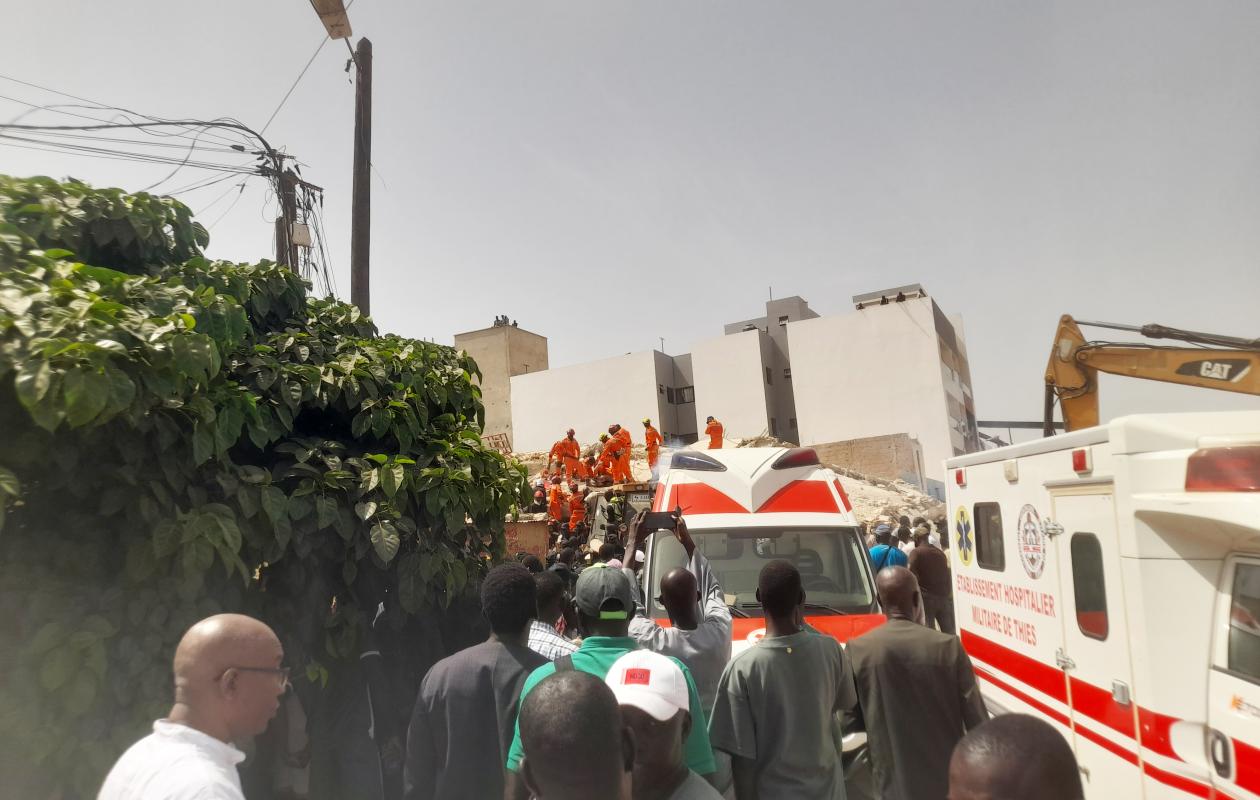
A building collapse in Thiès, situated near the Brioche Dorée and the Lat-Dior stadium, has resulted in casualties and an ongoing rescue operation. Initial reports from the ministry indicate that three individuals were trapped beneath the debris following the structural failure. Emergency services successfully extracted two of these individuals alive, who were subsequently transported to a medical facility for treatment. Tragically, one person has been confirmed deceased as a direct consequence of the incident.
During the critical rescue efforts, Assane Ndiongue, a mason who had been working on the site, provided an estimate to responders, suggesting that up to three people might still be buried. His assessment specifically mentioned two masons from Dakar and a vendor. Remarkably, some of those who were trapped managed to establish communication with the rescue teams, providing crucial information. Police and firefighters were heavily mobilized at the scene, working diligently to extricate any remaining victims from the rubble.
Regulatory Breaches and Prior Warnings
Investigations into the `effondrement immeuble Thiès` quickly revealed significant regulatory non-compliance. Administrative documents provided by the `Ministère de l'Urbanisme, des Collectivités territoriales et de l'Aménagement des Territoires` confirmed that the building's permit for elevation was strictly limited to R+3, meaning three floors above the ground level. Despite this clear authorization, construction proceeded well beyond these limits, with the structure ultimately reaching R+5, incorporating two additional levels without the necessary legal approval. This `dépassement autorisation construction Thiès` represents a critical breach of building regulations.
The unauthorized expansion of the building was not an unobserved issue. The Regional Urbanism Division had identified this over-construction on June 9, 2026. Following this discovery, an official `ordre arrêt travaux` was formally issued and affixed to the building, explicitly mandating an immediate halt to all construction activities. The tragic `effondrement immeuble Thiès` highlights severe consequences stemming from the `non-respect ordre arrêt travaux Sénégal` and the `dépassement autorisation construction Thiès`, directly preceding the catastrophic failure.
Unresolved Questions and Accountability
While the immediate cause of the `effondrement immeuble Thiès` has not yet been definitively established by the ministry, the documented regulatory violations raise serious questions regarding the `responsabilité effondrement bâtiment Thiès`. The ministry has publicly communicated these findings, emphasizing the discrepancy between the authorized R+3 structure and the actual `R+5 construction illégale Thiès`, as well as the disregarded stop-work order.
Authorities are continuing their efforts to ascertain the precise factors that led to the building's collapse. The preliminary information points to a clear pattern of non-adherence to established building codes and official directives. The full implications of these breaches, both legally and in terms of public safety, are expected to unfold as the investigation progresses.
Practical Implications
Lawyers and compliance officers should advise clients involved in construction projects in Senegal on the critical importance of adhering strictly to building permits and immediately complying with stop-work orders to avoid severe legal liabilities, including potential criminal charges, and significant reputational damage arising from regulatory non-compliance and structural failures.
Source
How does this affect you?
Get an AI analysis of this article grounded in your jurisdictions, practice areas, and any policy documents you've uploaded to Wansom.
Finish Reading the Full Story and the Expert Analysis.
Wansom is AI and can make mistakes.