
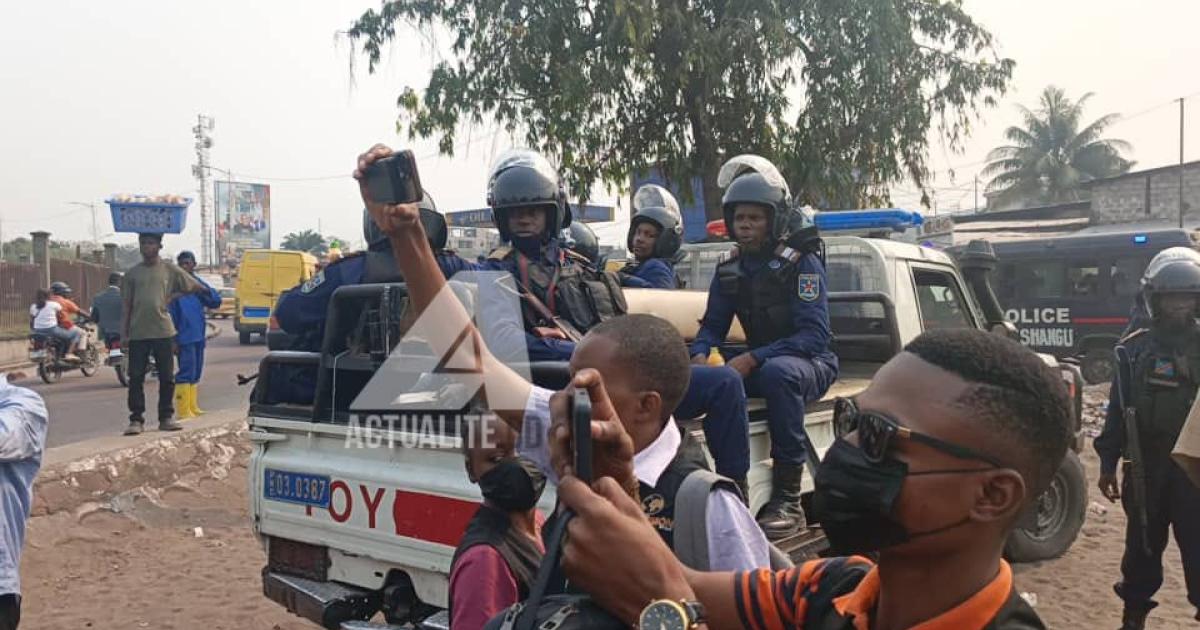
DRC: Opposition March Faces Police Tear Gas Dispersal
Summary
- An opposition march by militants took place on Boulevard Lumumba in Limete commune.
- The march was obstructed by barriers set up by UDPS militants.
- Police forces intervened, using tear gas to disperse the crowds.
- The situation was reported as tense on March 15, 2026, at 13:14.
Opposition March Leads to Confrontation
The deployment of tear gas by police forces during the DRC opposition march signifies a specific approach to crowd control in situations deemed to be escalating beyond peaceful parameters.
A political demonstration organized by militants of an opposition group unfolded on Boulevard Lumumba, situated within the Limete commune. The participants were engaged in a procession, aiming to voice their concerns through public assembly in a key urban thoroughfare. This event, reported on March 15, 2026, at 13:14, quickly escalated into a confrontational scenario.
As the opposition march progressed, its path was obstructed by barriers. These impediments were reportedly erected by militants affiliated with the UDPS, creating a direct confrontation point between the two political factions. The presence of these blockades effectively halted the forward movement of the demonstrators, intensifying the already charged atmosphere.
In response to the escalating situation and the standoff between the groups, law enforcement personnel intervened. Police forces deployed tear gas to disperse the crowds and restore order. This action led to a tense situation, highlighting the volatile nature of political gatherings when opposing factions clash and authorities step in to manage the unrest.
Political Climate and Underlying Tensions
The incident underscores the persistent political tensions within the Democratic Republic of Congo, where public demonstrations often serve as a crucial outlet for opposition voices. The involvement of an opposition collective in a march through a prominent area like Boulevard Lumumba, signals their intent to assert their presence and challenge the prevailing political narrative.
The counter-action by militants of the UDPS, reportedly setting up physical barriers, points to a broader pattern of political rivalry that can spill into direct street-level confrontations. Such actions by party affiliates can be interpreted as attempts to suppress dissenting voices or to assert territorial control over public spaces, further complicating the landscape for peaceful assembly.
This clash between opposition demonstrators and ruling party supporters, culminating in police intervention, reflects the challenges inherent in maintaining civil discourse in a highly polarized political environment. The reported 'tense situation' is indicative of the underlying fragility of political stability when fundamental rights, such as freedom of assembly, encounter resistance from opposing political forces.
Law Enforcement's Role in Public Order
The deployment of tear gas by police forces during the DRC opposition march signifies a specific approach to crowd control in situations deemed to be escalating beyond peaceful parameters. Law enforcement agencies are typically tasked with ensuring public safety and maintaining order, which often involves balancing the right to protest with the need to prevent violence or widespread disruption.
The use of chemical agents like tear gas is a common, albeit controversial, method employed globally for dispersing large gatherings. Its application in this instance suggests that authorities perceived a significant breakdown in order or an imminent threat that necessitated a forceful intervention to separate the clashing groups and clear the thoroughfare.
While the state has a legitimate interest in upholding public order, the manner and necessity of such interventions are frequently scrutinized, particularly in political contexts. The incident on Boulevard Lumumba raises questions about the threshold for police action and the broader implications for the exercise of democratic freedoms when demonstrations are met with such measures.
Implications for Democratic Expression
The confrontation on Boulevard Lumumba, marked by the DRC opposition march police tear gas deployment, carries significant implications for the country's democratic space. Such incidents can deter future participation in peaceful protests, as citizens may fear similar forceful responses or direct clashes with opposing political factions.
The reported tension and the need for police intervention highlight the ongoing struggle for political expression and the challenges faced by opposition movements in exercising their rights. When public spaces become sites of physical confrontation and state-sanctioned dispersal, it can narrow the avenues available for legitimate political dissent and dialogue.
Ultimately, events like this contribute to a climate where political discourse is often characterized by confrontation rather than constructive engagement. The ability of different political groups to coexist and express their views without resorting to obstruction or requiring forceful intervention is a critical indicator of a healthy democratic environment, which this incident suggests is under strain.
Source
How does this affect you?
Get an AI analysis of this article grounded in your jurisdictions, practice areas, and any policy documents you've uploaded to Wansom.
Finish Reading the Full Story and the Expert Analysis.
Get the latest legal & regulatory intelligence in DR Congo
Wansom is AI and can make mistakes.