
Delhi Police Commissioner Anurag Kumar: Contempt Apology Filed in SC
Summary
- Delhi Police Commissioner Anurag Kumar has issued an "unconditional and unqualified apology" to the Supreme Court in a contempt case.
- The case concerns alleged violations of court orders regarding metro services and internet access during a CJP protest on October 10.
- The Supreme Court had directed normal metro operations, unhindered internet, and review of barricades on October 9 and 11.
- Kumar's affidavits claim no willful non-compliance, stating only cellular internet was suspended near Raisina Hill and metro regulations were scaled down.
- The proceedings highlight the judiciary's strict enforcement of directives concerning public services and protest rights.
Commissioner Tenders Apology in Contempt Case
This development underscores the Supreme Court's strict enforcement of its orders, particularly those pertaining to public services and the fundamental right to protest, even amidst challenging law and order scenarios.
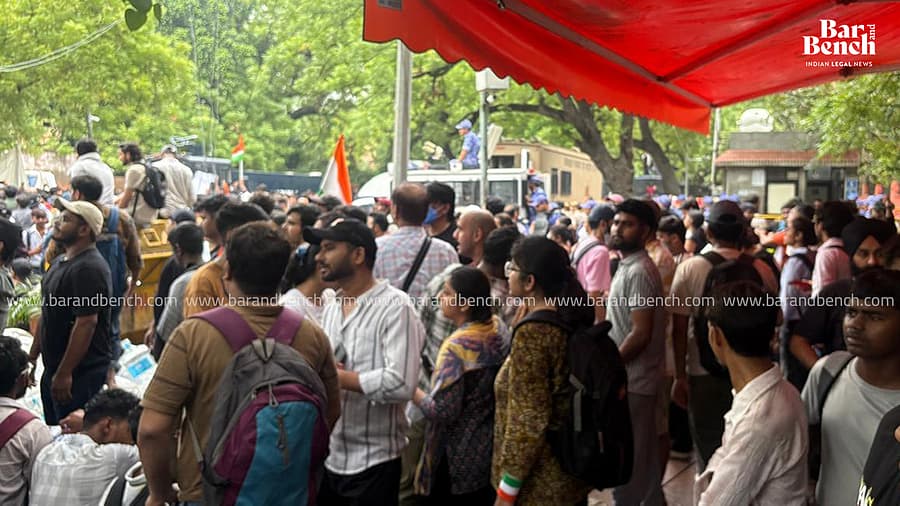
Delhi Police Commissioner Anurag Kumar has formally submitted an "unconditional and unqualified apology" to the Supreme Court of India. This significant development is part of a contempt of court case initiated against him, stemming from alleged restrictions imposed during a protest by the Cockroach Janta Party (CJP) in Delhi on October 10.
Commissioner Kumar presented his defense and apology in two separate affidavits. These documents were filed before a Supreme Court Bench comprising Chief Justice of India Surya Kant and Justice Joymalya Bagchi. In his submissions, Kumar asserted that there was "no non-compliance much less any wilful or deliberate non-compliance" with the Court's prior directives, and he is seeking the discharge of the contempt notice issued against him.
Allegations of Order Violation
The contempt petition specifically accuses the Delhi Police of violating an order issued by the Supreme Court on October 9. Key allegations include the closure of entry and exit points at various metro stations, notably GTB Nagar and Vishwavidyalaya, during the CJP protest.
The Supreme Court, through its orders on October 9 and October 11, had provided explicit instructions to ensure public services and protest rights were maintained. These directives mandated that metro services operate normally and that internet facilities remain "unhindered." Furthermore, the Court ordered a review of barricade placements, prohibited the illegal detention of individuals participating in peaceful assemblies outside areas designated under Section 163 BNSS, and called for the removal of any Section 163 notice board located at the Supreme Court premises.
Police Justification for Actions Taken
In response to the allegations, Commissioner Anurag Kumar's compliance affidavit offered explanations for the actions taken. Regarding internet services, the affidavit claimed that "internet facilities were working unhindered," clarifying that only cellular internet services experienced suspension. This suspension, according to the police, was a measure taken due to the prevailing law and order situation.
The counter affidavit further detailed that this specific action was initiated at the Delhi Police's request to the Central government and was confined to an area within four kilometers of Raisina Hill. Concerning metro operations, the police initially regulated access at 57 stations. However, following the Supreme Court's October 9 order, the number of regulated stations was reduced to 45, meaning approximately 15% of the Delhi Metro's total 303 stations were affected.
Judiciary's Stance on Compliance
This development underscores the Supreme Court's strict enforcement of its orders, particularly those pertaining to public services and the fundamental right to protest, even amidst challenging law and order scenarios. The fact that Delhi Police Commissioner Anurag Kumar has tendered an apology highlights the judiciary's low tolerance for executive non-compliance.
The case serves as a critical reminder for high-ranking officials regarding the potential for contempt proceedings when court directives are perceived to be disregarded. The Supreme Court India's firm stance, as evidenced by the Bench of Chief Justice Surya Kant and Justice Joymalya Bagchi, reinforces the principle that judicial orders must be adhered to, ensuring that public life and civil liberties are not unduly curtailed without proper legal justification.
Practical Implications
This development underscores the Supreme Court's strict enforcement of orders related to public services and protest rights, even in law and order situations. Lawyers advising on public assembly, digital rights, or government compliance should note the judiciary's low tolerance for executive non-compliance and the potential for contempt proceedings against high-ranking officials.
Source
How does this affect you?
Get an AI analysis of this article grounded in your jurisdictions, practice areas, and any policy documents you've uploaded to Wansom.
Finish Reading the Full Story and the Expert Analysis.
Get the latest legal & regulatory intelligence in India
Wansom is AI and can make mistakes.