
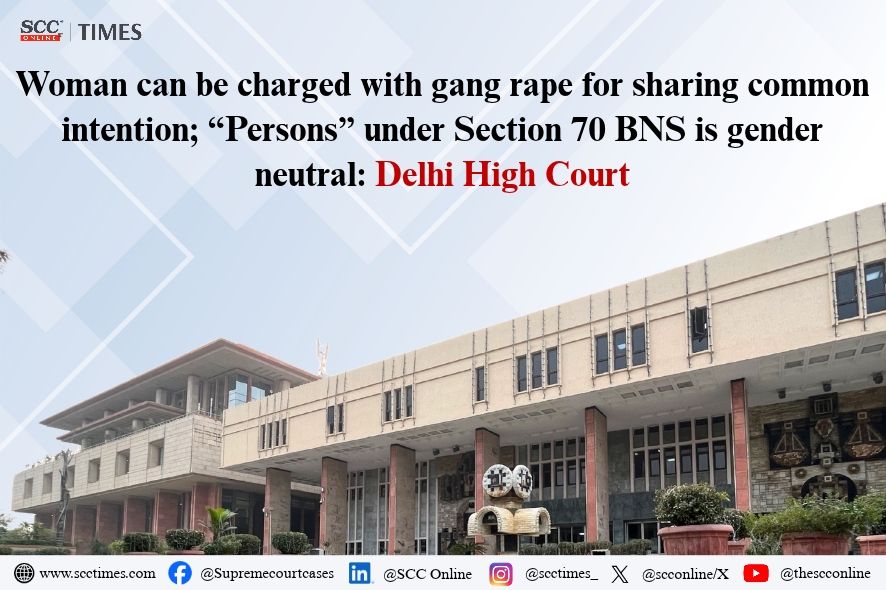
Delhi High Court: Woman Can Be Charged With Gang Rape Under Gender-Neutral BNS Section 70
In India, the Delhi High Court dismissed a petition challenging an order on charge, holding that the term "persons" in the gang rape provision under Section 376-D of the Indian Penal Code (IPC) and its successor, Section 70 of the Bharatiya Nyaya Sanhita (BNS), is gender-neutral, thereby affirming that a woman can be charged with gang rape if she forms part of a group or acts in furtherance of a common intention to have rape committed on a victim.
This ruling holds profound legal significance for criminal law practitioners and the broader understanding of criminal liability in India. It unequivocally clarifies that complicity in gang rape is not limited by gender, expanding the scope of accountability to include women who participate through common intention or group action, even if they do not physically commit the act of rape. This interpretation aligns with modern principles of criminal jurisprudence that focus on intent and participation, rather than solely on the physical act, and ensures a more comprehensive approach to prosecuting sexual offenses. It underscores that the law views all individuals, irrespective of gender, as potentially culpable for their roles in such grave crimes.
The legal context for this decision primarily involves Section 376-D of the Indian Penal Code, which defines gang rape, and its corresponding provision, Section 70 of the recently enacted Bharatiya Nyaya Sanhita. The case also involved offences under the Protection of Children from Sexual Offences (POCSO) Act, suggesting the victim was a minor. The Delhi High Court's dismissal of a petition challenging an "order on charge" means that the court found sufficient prima facie evidence to proceed with the trial against the accused, including the woman, based on the legal interpretation that "persons" is gender-neutral. This decision is a crucial exercise in statutory interpretation within the criminal justice system.
Practitioners in criminal law, both defence and prosecution, must take careful note of this judgment. For defence attorneys, it means that female clients can face gang rape charges if their involvement, even indirect, demonstrates a shared intention or active participation in the group's criminal objective. For prosecutors, it provides a clear legal basis to pursue charges against women who facilitate or are part of a group committing gang rape, requiring thorough investigation into the roles and intentions of all individuals involved. This ruling necessitates a gender-neutral approach to assessing criminal liability in gang rape cases, focusing on the elements of common intention and group action.
How does this affect you?
Get an AI analysis of this article grounded in your jurisdictions, practice areas, and any policy documents you've uploaded to Wansom.
Finish Reading the Full Story and the Expert Analysis.
Get the latest legal & regulatory intelligence in India
Wansom is AI and can make mistakes.