
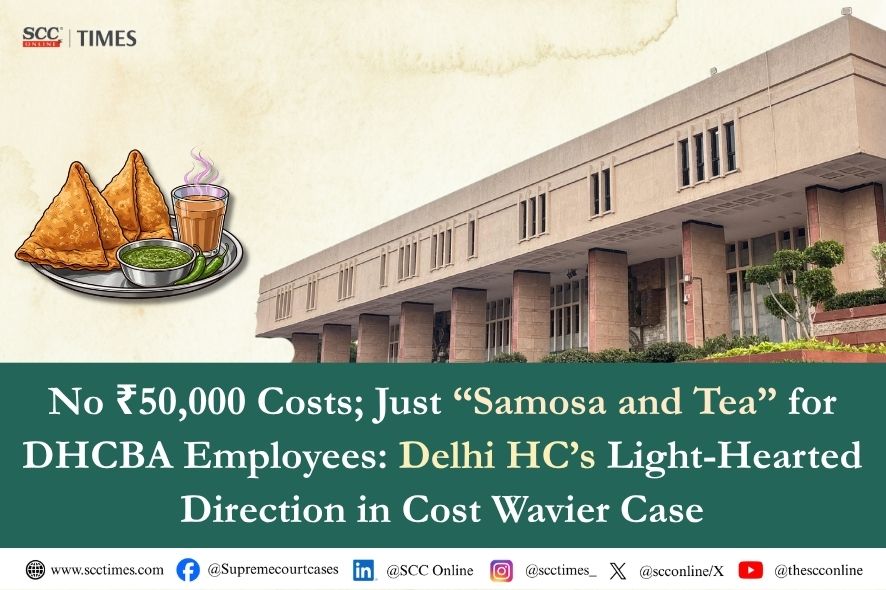
Delhi High Court: Samosa Tea Costs Replace ₹50,000 Fine
Summary
- The Delhi High Court waived ₹50,000 in costs previously imposed on petitioners in the case of `Indus Birra Beverages v. Ishaan Associates`.
- Justice Saurabh Banerjee directed the petitioners' counsel to distribute samosas and tea to all employees of the Delhi High Court Bar Association within one week.
- The waiver was granted after considering the specific factual matrix involved in the application.
- The original costs were imposed on August 20, 2026, and the waiver order was issued on September 17, 2026.
A Unique Cost Waiver from the Delhi High Court
Instead of the original financial imposition, the court stipulated a unique condition for the petitioners' counsel.
The Delhi High Court recently issued a distinctive directive in a case concerning the waiver of previously imposed costs, opting for a non-monetary resolution. Justice Saurabh Banerjee, presiding over the matter, granted an application seeking to set aside a financial penalty of ₹50,000 that had been levied on August 20, 2026. This decision, rendered on September 17, 2026, in the case of `Indus Birra Beverages v. Ishaan Associates` (CRL.M.C. 6010 of 2026), saw the court exercising its discretion to waive the substantial monetary costs.
Instead of the original financial imposition, the court stipulated a unique condition for the petitioners' counsel. They were directed to arrange for the distribution of samosas and tea to all employees of the Delhi High Court Bar Association (DHCBA) within a week of the order. This unconventional approach to resolving a cost dispute highlights a creative application of judicial authority, moving beyond traditional monetary penalties. The ruling effectively replaced a significant financial burden with a gesture of goodwill, impacting the `Delhi HC samosa tea costs` narrative.
Judicial Discretion in Cost Orders
The court's decision to waive the ₹50,000 costs was made after considering the specific "factual matrix involved" in the application. While the precise details of this factual matrix were not elaborated, the ruling underscores the broad `Judicial discretion cost orders India` courts possess when adjudicating such matters. This discretion allows judges to tailor remedies and conditions based on the unique circumstances presented in each case, rather than adhering strictly to pre-defined monetary penalties.
The `Delhi High Court cost waiver` in this instance demonstrates a willingness to explore alternative forms of compliance. By substituting a financial penalty with a community-oriented gesture, Justice Banerjee's order exemplifies how judicial discretion can be employed to achieve a fair and equitable outcome, even if it deviates from conventional practices. This approach can be particularly relevant in situations where the imposition of substantial costs might be disproportionate or counterproductive to the overall interests of justice.
Beyond Monetary Penalties: The Significance of Symbolic Gestures
This particular `Justice Saurabh Banerjee cost order` offers valuable insight into the evolving landscape of judicial remedies, particularly in India. The direction for `DHCBA employees samosa tea` distribution, while seemingly light-hearted, carries a symbolic weight. It suggests that courts may, at times, prioritize gestures that foster community spirit or offer a form of collective benefit over strict financial penalties, especially when the underlying facts warrant such an approach.
For legal practitioners, this ruling serves as a reminder that judicial outcomes are not always confined to monetary judgments. The court's creative solution in `Indus Birra Beverages v. Ishaan Associates` illustrates that alternative, non-monetary conditions can be imposed, reflecting a nuanced understanding of justice. Such innovative directives can have a significant impact on how cost applications are approached and negotiated, encouraging lawyers to consider a broader spectrum of potential resolutions beyond mere financial transactions.
Practical Implications
This light-hearted direction highlights the Delhi High Court's discretion in waiving costs and imposing alternative, non-monetary conditions. Lawyers should be aware of such creative judicial approaches when advising clients on cost applications or negotiating settlements, as courts may consider symbolic remedies.
Source
How does this affect you?
Get an AI analysis of this article grounded in your jurisdictions, practice areas, and any policy documents you've uploaded to Wansom.
Finish Reading the Full Story and the Expert Analysis.
Get the latest legal & regulatory intelligence in India
Wansom is AI and can make mistakes.