
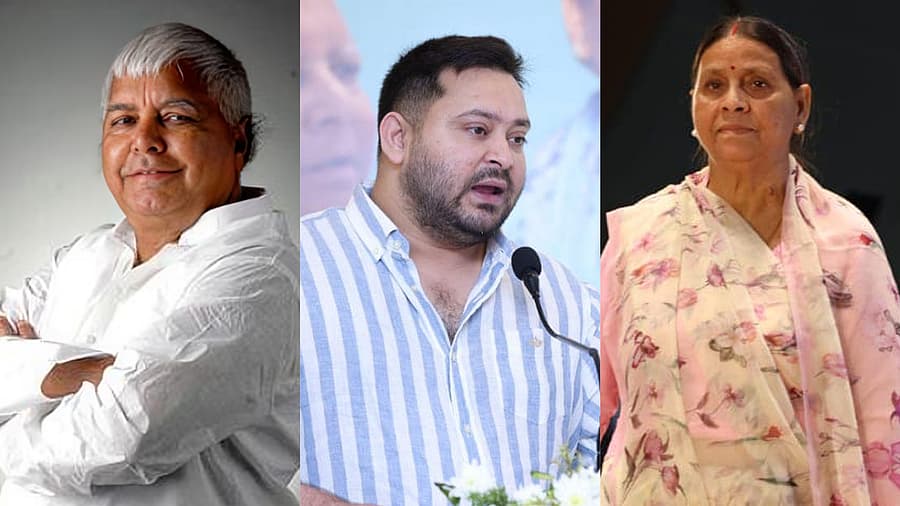
Delhi High Court: Upholds Framing of Lalu Yadav IRCTC Charges
Summary
- The Delhi High Court rejected petitions by Lalu Prasad Yadav, Rabri Devi, and Tejashwi Yadav challenging the framing of charges in the IRCTC scam case.
- Justice Swarana Kanta Sharma issued the order, upholding the trial court's decision from the Rouse Avenue Courts.
- Lalu Yadav faces charges of corruption, criminal conspiracy, and cheating, while Rabri Devi and Tejashwi Yadav are charged with criminal conspiracy and cheating.
- The CBI alleges the family accepted prime land and shares as bribes for awarding railway contracts during Lalu Yadav's tenure as Railway Minister.
- The Yadav family maintains the case is politically motivated and lacks substantive evidence.
High Court Upholds Charges
This ruling reinforces the high bar for challenging the framing of charges in corruption cases at the High Court level, indicating that trial courts' decisions on prima facie evidence are often upheld.
The Delhi High Court recently dismissed petitions filed by former Bihar Chief Minister Lalu Prasad Yadav, his wife Rabri Devi, and son Tejashwi Yadav. These petitions sought to overturn a trial court's decision to frame criminal charges against them in connection with the alleged IRCTC scam case. Justice Swarana Kanta Sharma delivered the order, affirming the lower court's proceedings.
The trial court, specifically Vishal Gogne, who was then Special Judge (PC Act) of the Rouse Avenue Courts and is now Registrar (Vigilance) at the Delhi High Court, had previously framed charges on October 13. Lalu Prasad Yadav faces charges of corruption, criminal conspiracy, and cheating. His wife, Rabri Devi, and son, Tejashwi Yadav, are charged with criminal conspiracy and cheating. Several other individuals were also implicated with charges in the same case, prompting the Yadav family to appeal to the High Court.
Allegations of Corruption
The Central Bureau of Investigation (CBI) initiated the probe, alleging that Lalu Prasad Yadav, during his tenure as Railway Minister from 2004 to 2009, and his family members engaged in a corrupt scheme. The core accusation is that they accepted valuable land and shares as a bribe. This alleged quid pro quo was in exchange for awarding contracts to a private firm while Yadav presided over the Railways.
According to the CBI's claims, a manipulated tender process was orchestrated to lease two IRCTC hotels, located in Ranchi and Puri, to a company named Sujata Hotels. In return for this preferential treatment, land valued at crores of rupees was reportedly transferred to a company with alleged links to Rabri Devi and Tejashwi Yadav. This transfer, the CBI contends, occurred at a significantly reduced price, far below its actual market value. The Yadav family has consistently challenged the investigation, asserting a lack of evidence against them and characterizing the case as politically motivated.
Legal Implications of the Ruling
The Delhi High Court's decision to reject the challenge against the framing of charges in the IRCTC case underscores a critical aspect of legal proceedings in corruption matters. This ruling reinforces the high bar for challenging the framing of charges in corruption cases at the High Court level, indicating that trial courts' decisions on prima facie evidence are often upheld. The order from Justice Swarana Kanta Sharma effectively allows the trial to proceed based on the charges established by the Rouse Avenue Courts.
This outcome highlights the judiciary's approach to preliminary evidence in complex corruption cases. Lawyers advising clients facing similar corruption allegations should note the difficulty in overturning such orders, emphasizing the importance of robust defense during the initial stages of investigation and charge framing. The High Court's affirmation signals that the trial court found sufficient grounds to proceed with a full trial against Lalu Prasad Yadav, Rabri Devi, and Tejashwi Yadav on the alleged IRCTC scam charges.
Practical Implications
This ruling reinforces the high bar for challenging the framing of charges in corruption cases at the High Court level, indicating that trial courts' decisions on prima facie evidence are often upheld. Lawyers advising clients facing similar corruption allegations should note the difficulty in overturning such orders, emphasizing the importance of robust defense during the initial stages of investigation and charge framing.
Source
How does this affect you?
Get an AI analysis of this article grounded in your jurisdictions, practice areas, and any policy documents you've uploaded to Wansom.
Finish Reading the Full Story and the Expert Analysis.
Get the latest legal & regulatory intelligence in India
Wansom is AI and can make mistakes.