
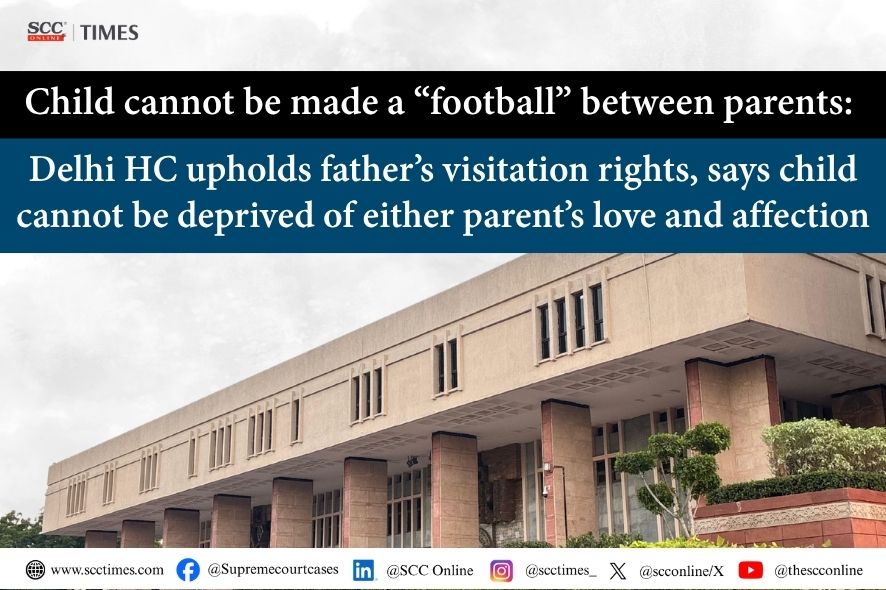
Delhi High Court: Affirms Father Visitation Rights for Child
Summary
- The Delhi High Court recently affirmed a father's visitation rights for his 15-year-old child.
- The court emphasized that children require both a father's guidance and a mother's affection for their fundamental well-being.
- It was highlighted that a child should not be treated as a 'football' in parental disputes, as this is detrimental to their development.
- The ruling underscores the principle that a child must not be deprived of the love and affection of either parent.
Judicial Affirmation of Parental Rights
The court vividly stated that a child cannot be made a 'football' between parents, emphasizing the profound detriment such a situation causes to the minor.
The Delhi High Court recently issued a significant ruling, affirming the visitation rights of a father concerning his 15-year-old child. This decision by the Delhi HC underscores a crucial aspect of family law in India, particularly in cases involving parental separation or divorce. The court’s pronouncement serves as a reminder of the judiciary's role in safeguarding the holistic development of minors amidst domestic disputes.
In its deliberation, the High Court articulated that a child of fifteen years requires the distinct contributions of both parents for proper upbringing. Specifically, the court noted the necessity of a father’s guidance alongside a mother’s love and affection. These elements, according to the court, are not merely desirable but are fundamental components essential for the child's overall well-being and healthy growth. The judgment reinforces the idea that children possess an inherent right to a relationship with both parents, a right that should be protected by the legal system.
Upholding Child Welfare in Parental Disputes
A central tenet of the Delhi High Court's decision was its strong admonition against using a child as a pawn in disputes between parents. The court vividly stated that a child cannot be made a 'football' between parents, emphasizing the profound detriment such a situation causes to the minor. This powerful metaphor highlights the court's concern over instances where children become instruments or battlegrounds for their parents' unresolved conflicts, often leading to emotional and psychological harm. Such scenarios can contribute to what is often termed parental alienation, where one parent's actions negatively impact the child's relationship with the other.
The ruling further clarified that depriving a child of the love and affection of either parent is unacceptable. It stressed that the fundamental right of a child to experience the care, guidance, and emotional support from both their father and mother must be preserved. This judicial stance is critical for lawyers advising on child custody Delhi HC cases, as it provides a clear directive that the child's best interests, including their emotional and developmental needs, must always take precedence over parental disagreements. The court's emphasis on the child's inherent right to both parents' involvement sets a significant precedent for future family law proceedings in India.
Broader Implications for Family Law in India
This judgment from the Delhi High Court carries substantial weight for the landscape of family law and child custody matters across India. It firmly establishes that the child's right to a relationship with both parents is a paramount consideration, even when parents are estranged or divorced. The court's unequivocal declaration that a child cannot be deprived of either parent’s love and affection serves as a guiding principle for courts adjudicating similar disputes concerning visitation rights child India. It encourages a legal approach that seeks to foster, rather than sever, parental bonds wherever possible, always with the child's welfare at its core.
The decision reinforces the judiciary's commitment to ensuring child welfare in parents' disputes in India, moving beyond the traditional adversarial nature of such cases to focus on the child's long-term emotional and psychological health. For legal practitioners, this ruling provides a robust foundation for advocating for or defending visitation rights based on the child's fundamental need for both parental figures. It signals that courts will scrutinize parental actions that seek to isolate a child from one parent, prioritizing the child's comprehensive development over individual parental grievances. This precedent is crucial for shaping future outcomes in cases involving parental separation, ensuring that the child's interests remain at the forefront of judicial consideration.
Practical Implications
Lawyers advising on family law and child custody matters in India should note this Delhi High Court precedent, which reinforces the principle of prioritizing a child's fundamental right to both parents' love and guidance, even amidst parental disputes. It provides a strong basis for arguing for or defending visitation rights based on the child's well-being.
Source
How does this affect you?
Get an AI analysis of this article grounded in your jurisdictions, practice areas, and any policy documents you've uploaded to Wansom.
Finish Reading the Full Story and the Expert Analysis.
Get the latest legal & regulatory intelligence in India
Wansom is AI and can make mistakes.