
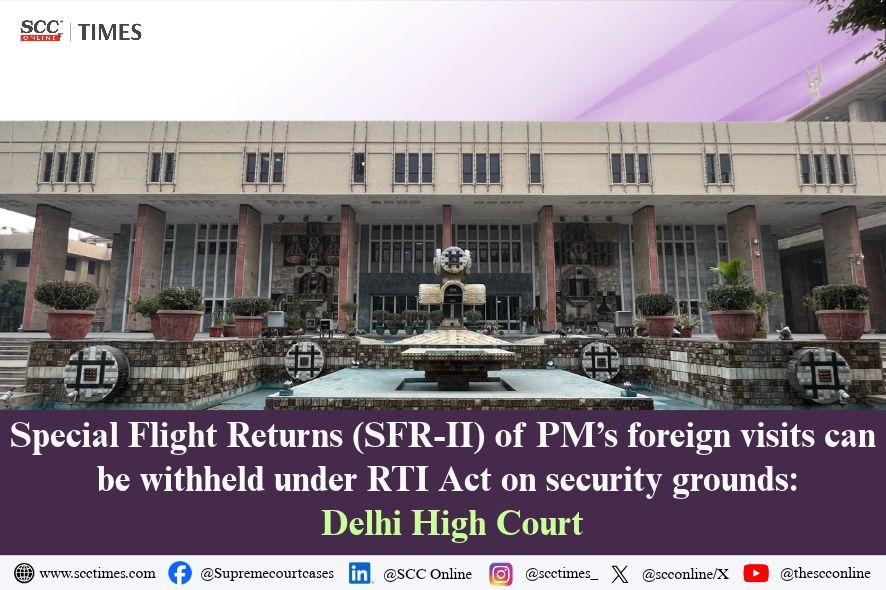
Delhi High Court: PM's Flight Returns Withholdable Under RTI for Security
In India, the Delhi High Court, in a ruling by Justice Amit Mahajan, held that Special Flight Returns (SFRs) containing details of the Prime Minister's foreign air travel can be withheld under Sections 8(1)(a) and (g) of the Right to Information Act, 2005, if disclosure could jeopardise national security or endanger the Prime Minister's life and physical safety, thereby setting aside a Central Information Commission (CIC) order from July 8, 2020, which had directed disclosure.
This ruling carries significant legal weight for practitioners and public authorities in India, as it clarifies the delicate balance between the public's right to information and paramount national security concerns. It reinforces the principle that the security of high constitutional functionaries and sensitive state operations can legitimately be protected from disclosure under the RTI Act, even when public funds are expended. The court's observation that redacting names alone might not mitigate risks provides a crucial guideline for assessing the scope of security exemptions, emphasizing a holistic view of potential threats.
The legal context for this decision is rooted in the Right to Information Act, 2005, specifically Sections 8(1)(a) and 8(1)(g), which provide exemptions for information that could prejudice national security or endanger life or physical safety. The petition was filed under Articles 226 and 227 of the Constitution of India, invoking the Delhi High Court's supervisory and writ jurisdiction over the Central Information Commission, which is the final appellate body under the RTI Act. The key parties involved were the Delhi High Court, the Central Information Commission, the Indian Air Force as the public authority, and the respondent who sought information regarding the foreign visits of former Prime Minister Manmohan Singh and Prime Minister Narendra Modi.
For attorneys advising government departments or public authorities, this judgment serves as a vital precedent for invoking security-related exemptions under the RTI Act, particularly concerning VVIP security and sensitive operational details. It underscores the necessity of articulating clear and demonstrable links between disclosure and potential security compromises. Conversely, practitioners representing information seekers must recognize the high bar set by this ruling for overcoming security exemptions in such sensitive contexts. The takeaway is to meticulously evaluate the nature of the information and the potential for genuine security threats when either seeking or resisting disclosure of similar records.
How does this affect you?
Get an AI analysis of this article grounded in your jurisdictions, practice areas, and any policy documents you've uploaded to Wansom.
Finish Reading the Full Story and the Expert Analysis.
Get the latest legal & regulatory intelligence in India
Wansom is AI and can make mistakes.