
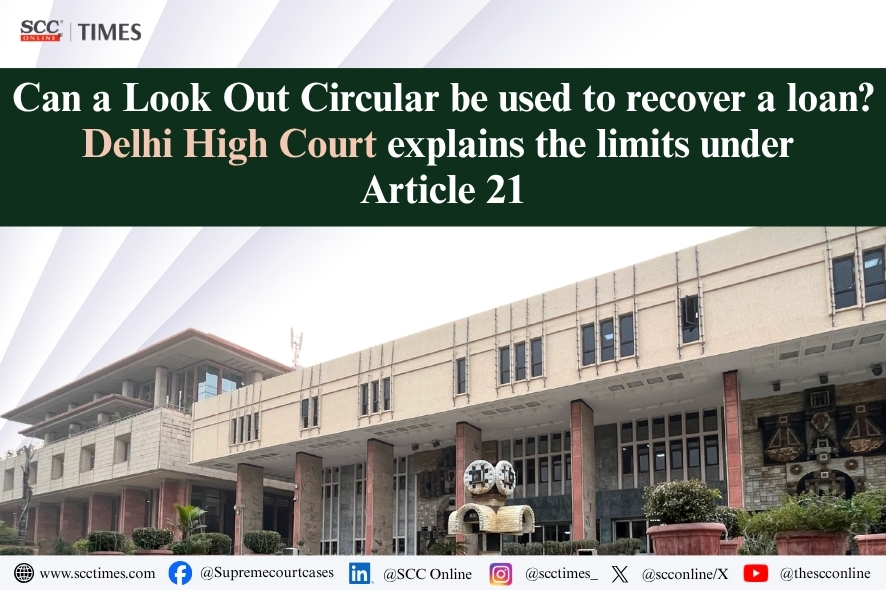
Delhi High Court: Look Out Circular Not For Debt Recovery
Summary
- The Delhi High Court has ruled that Look Out Circulars (LOCs) cannot be used as routine tools for debt recovery.
- Restrictions on foreign travel must be justified by a lawful basis.
- Any such travel restrictions also require credible material to support them.
- This judicial decision reinforces the safeguards provided by Article 21 of the Indian Constitution.
What Happened
Lawyers advising clients on debt recovery or defending against Look Out Circulars must be aware of the Delhi High Court's ruling, which clarifies that LOCs are not routine debt recovery tools and require a lawful basis and credible material, impacting strategies for both creditors and debtors.
The Delhi High Court has issued a significant clarification regarding the application of Look Out Circulars (LOCs), specifically stating that these measures are not to be employed as standard instruments for debt recovery. This ruling underscores a critical distinction, preventing the routine use of LOCs in financial disputes. The court's pronouncement establishes a clear boundary, ensuring that the power to restrict an individual's foreign travel is not indiscriminately applied in cases solely involving outstanding loans.
The judicial directive further stipulated that any imposition of restrictions on an individual's ability to travel internationally must be supported by a legitimate legal foundation. This requirement for a "lawful basis" means that authorities cannot arbitrarily issue an LOC; there must be a specific legal provision or established legal principle that justifies such a severe curtailment of personal liberty. This move by the Delhi High Court aims to prevent the overreach of such powers, ensuring due process is followed.
Furthermore, the court mandated that such travel restrictions must also be substantiated by "credible material." This implies that mere allegations or unsubstantiated claims are insufficient to warrant the issuance of an LOC. There must be concrete, verifiable evidence presented to justify the restriction on an individual's right to travel abroad. This dual requirement of a lawful basis and credible material significantly tightens the criteria for issuing LOCs, particularly in the context of financial liabilities.
Legal Context
The Delhi High Court's recent decision serves to reinforce the fundamental safeguards enshrined within Article 21 of the Indian Constitution. This pivotal article guarantees the right to life and personal liberty, a broad protection that has been interpreted by courts to encompass the right to travel abroad. By emphasizing that Look Out Circulars cannot be used as routine debt-recovery tools, the court is upholding this constitutional right, ensuring that individuals are not unduly deprived of their liberty to move freely across borders without proper justification.
Historically, Look Out Circulars in India have served as a crucial mechanism for law enforcement agencies to prevent individuals involved in serious criminal offenses or those deemed a flight risk from leaving the country. However, their application has sometimes extended into the realm of civil disputes, including debt recovery, leading to concerns about their potential misuse. The court's ruling directly addresses this ambiguity, clarifying the appropriate "Look Out Circular legal basis" and preventing its transformation into a general "Indian debt recovery tool."
This judicial intervention provides much-needed clarity on the scope and limitations of LOCs. It differentiates between their legitimate use in preventing escape from justice for serious offenses and their inappropriate deployment in commercial disagreements. The ruling effectively narrows the circumstances under which an individual's right to travel can be curtailed, aligning the practice more closely with the constitutional protections afforded under Article 21 and ensuring that any restriction is proportionate and legally sound.
Why It Matters
This pronouncement from the Delhi High Court carries substantial implications for both creditors and debtors within India's financial landscape, particularly concerning "Delhi High Court Look Out Circular debt recovery" practices. For creditors, the ruling signals that the issuance of an LOC is not a readily available or routine mechanism for compelling loan repayment. Instead, they must rely on other established "Indian debt recovery tools" and legal processes, which typically involve civil litigation and execution proceedings, rather than leveraging travel restrictions as a primary means of coercion.
The decision effectively means that "Delhi HC limits Look Out Circulars" as a broad-brush approach to recovering outstanding debts. This clarification is particularly significant for debtors, as it offers enhanced protection against arbitrary travel bans. Individuals facing financial difficulties can now be more assured that their fundamental right to travel abroad, protected under Article 21, will not be curtailed unless there is a clear "lawful basis and credible material" demonstrating a genuine flight risk or involvement in serious offenses, beyond mere non-payment of a loan.
Lawyers advising clients on debt recovery or defending against Look Out Circulars must be aware of the Delhi High Court's ruling, which clarifies that LOCs are not routine debt recovery tools and require a lawful basis and credible material, impacting strategies for both creditors and debtors. This judicial stance reinforces the principle that fundamental rights cannot be easily overridden for commercial expediency, thereby promoting a more balanced and constitutionally compliant approach to debt enforcement in India. The ruling underscores the judiciary's commitment to safeguarding individual liberties while ensuring that legitimate debt recovery efforts proceed through appropriate legal channels.
Practical Implications
Lawyers advising clients on debt recovery or defending against Look Out Circulars must be aware of the Delhi High Court's ruling, which clarifies that LOCs are not routine debt recovery tools and require a lawful basis and credible material, impacting strategies for both creditors and debtors.
Source
How does this affect you?
Get an AI analysis of this article grounded in your jurisdictions, practice areas, and any policy documents you've uploaded to Wansom.
Finish Reading the Full Story and the Expert Analysis.
Get the latest legal & regulatory intelligence in India
Wansom is AI and can make mistakes.