
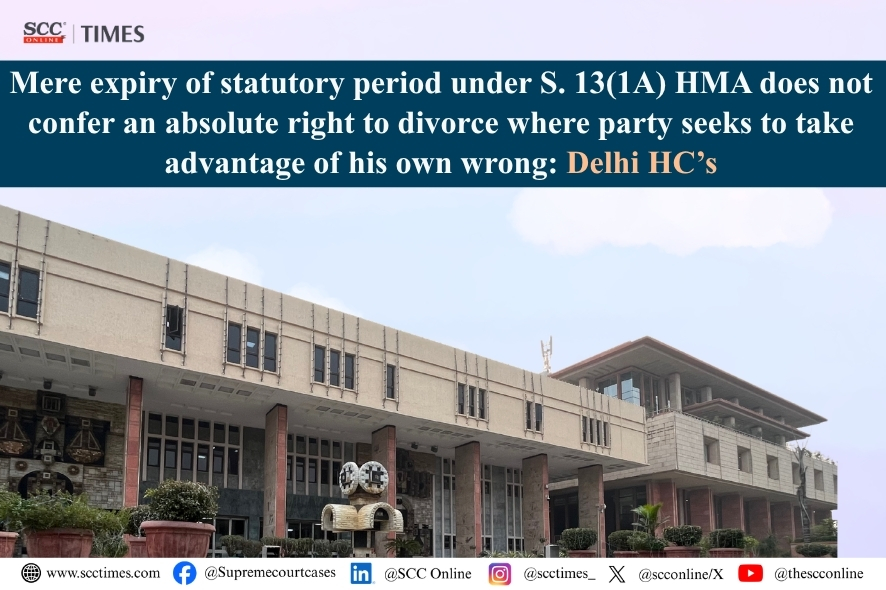
Delhi HC: No 13(1A) HMA Divorce For Taking Advantage Of Own Wrong
Summary
- The Delhi High Court ruled that the mere expiry of the statutory period under Section 13(1A) of the Hindu Marriage Act does not automatically grant a right to divorce.
- The court found that a husband's divorce petition was an attempt to take advantage of his own wrong, as he frustrated reconciliation efforts.
- The husband made no sincere attempts to resume cohabitation and actively hindered his wife's efforts to execute a decree for restitution of conjugal rights.
- His sole objective was to secure a divorce decree without genuinely intending to restore the matrimonial relationship.
- This ruling emphasizes that courts will scrutinize a petitioner's conduct regarding reconciliation efforts, not just the passage of time.
Delhi High Court Rejects Divorce Petition Citing Petitioner's Own Wrong
The court emphasized that merely allowing the statutory period to elapse under Section 13(1A) of the Hindu Marriage Act does not automatically entitle a petitioner to a divorce if their conduct demonstrates an intent to exploit their own wrongdoing.
The Delhi High Court recently delivered a significant ruling, asserting that the mere passage of a statutory period under Section 13(1A) of the Hindu Marriage Act does not automatically grant a right to divorce, particularly when a petitioner's conduct indicates an attempt to benefit from their own wrongdoing. This decision underscores the judiciary's commitment to scrutinizing the sincerity of parties in matrimonial disputes, especially concerning reconciliation efforts.
The case involved a husband who had filed petitions seeking the dissolution of his marriage under Sections 13(1A) and 13(1)(ib) of the Hindu Marriage Act. However, the court observed that throughout the proceedings, the husband demonstrated a clear lack of genuine intent to restore the matrimonial relationship. His actions, or rather inactions, were central to the court's adverse findings against his petition.
Specifically, the Delhi High Court noted that the husband failed to make any sincere efforts to resume cohabitation with his wife. Furthermore, he actively frustrated his wife's attempts to execute a decree for restitution of conjugal rights, which had been previously granted. This pattern of behavior led the court to conclude that his sole objective in pursuing the divorce decree was to secure a dissolution of marriage under the provisions, rather than genuinely seeking to mend the marital bond.
Legal Context: The 'Own Wrong' Principle in Matrimonial Law
This Delhi High Court divorce ruling hinges on a fundamental principle of jurisprudence: no one should be allowed to take advantage of their own wrong. In the context of matrimonial law India Delhi, this principle gains particular significance when parties seek to dissolve a marriage. Section 13(1A) Hindu Marriage Act allows for divorce if, after a decree for judicial separation or restitution of conjugal rights, there has been no resumption of cohabitation for a period of one year or more.
However, the court's interpretation clarifies that this statutory provision is not an absolute right that can be invoked irrespective of a petitioner's conduct. The ruling emphasizes that while the statutory period may have elapsed, the court will delve into the reasons behind the non-resumption of cohabitation. If the petitioner themselves has actively prevented reconciliation or the execution of a divorce decree restitution conjugal rights, they cannot then claim a right to divorce based on the passage of time.
The judgment reinforces that the legislative intent behind Section 13(1A) HMA is not to reward a party who deliberately obstructs the restoration of conjugal rights or cohabitation. Instead, it aims to provide a path to divorce when genuine efforts at reconciliation have failed, or when one party has genuinely moved on after a period of separation mandated by a court order.
Why It Matters: Scrutiny of Petitioner's Conduct in Delhi HC 13(1A) HMA Own Wrong Divorce Cases
This Delhi HC 13(1A) HMA own wrong divorce ruling carries significant implications for matrimonial litigation in India. It serves as a crucial reminder that courts will not merely rubber-stamp divorce petitions based on the expiry of statutory periods if the petitioner's conduct suggests an ulterior motive or a deliberate frustration of reconciliation. Lawyers advising clients on divorce petitions under the Hindu Marriage Act, particularly those invoking Section 13(1A), must now emphasize that courts will scrutinize the petitioner's conduct regarding reconciliation efforts.
Mere expiry of the statutory period is insufficient if the petitioner is found to be frustrating attempts at cohabitation. This impacts strategic advice for both petitioners and respondents in matrimonial disputes, as it places a greater onus on petitioners to demonstrate good faith and genuine efforts towards reconciliation, or at least non-obstruction, following a decree for restitution of conjugal rights. Conversely, respondents can now more effectively argue against divorce if they can prove the petitioner's active role in preventing cohabitation.
The decision sets a precedent against taking advantage of own wrong India, ensuring that the legal process for divorce is not misused by parties who intentionally sabotage marital harmony to achieve a dissolution. It underscores the judiciary's role in upholding equitable principles within the framework of the Hindu Marriage Act 1955 Section 13(1A), ensuring that justice is not only done but also seen to be done, particularly in sensitive family matters.
Practical Implications
Lawyers advising clients on divorce petitions under the Hindu Marriage Act, particularly those invoking Section 13(1A), must now emphasize that courts will scrutinize the petitioner's conduct regarding reconciliation efforts. Mere expiry of the statutory period is insufficient if the petitioner is found to be frustrating attempts at cohabitation, impacting strategic advice for both petitioners and respondents in matrimonial disputes.
Source
Source: Original reporting via SCC Times
How does this affect you?
Get an AI analysis of this article grounded in your jurisdictions, practice areas, and any policy documents you've uploaded to Wansom.
Wansom is AI and can make mistakes.