
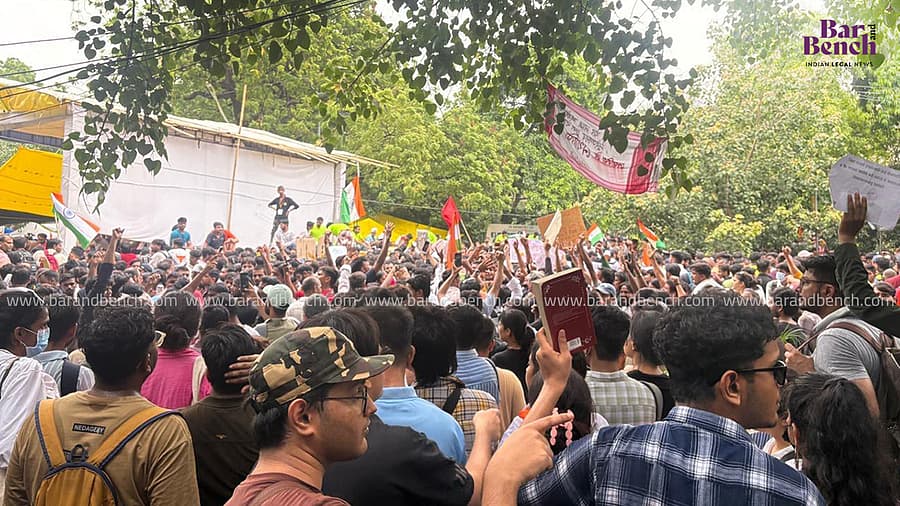
Delhi High Court: IYC Protest Urgent Hearing Declined
Summary
- The Delhi High Court refused an urgent hearing for a petition by the Indian Youth Congress (IYC).
- The IYC challenged the Delhi Police's denial of permission for a protest against CEC Gyanesh Kumar at Jantar Mantar.
- Acting Chief Justice Nitin Sambre stated the matter would be heard on Monday, questioning the urgency.
- The IYC had applied on September 25 for a peaceful demonstration involving 100-150 people, which the police rejected on October 1.
- The IYC argues the police's blanket prohibition violates fundamental rights, including freedom of speech.
Court Declines Urgent Review for IYC Protest
The IYC's legal submission asserts that the police's decision constitutes a direct infringement upon fundamental rights, particularly the freedom of speech, which is a cornerstone of protest rights in India.
The Delhi High Court recently declined to grant an urgent hearing for a petition filed by the Indian Youth Congress (IYC), which sought to challenge the Delhi Police's decision to deny permission for a planned demonstration. The protest, organized by the IYC, was intended to be held at Jantar Mantar and aimed at Chief Election Commissioner (CEC) Gyanesh Kumar. Acting Chief Justice Nitin Sambre, presiding over the matter, questioned the immediate necessity for a swift listing, stating, "What is the urgency? We will hear it on Monday." This procedural stance by the Delhi High Court means the legal challenge to the Delhi Police protest permission refusal will be addressed in due course, rather than expedited.
Background to the Protest Permission Refusal
The legal challenge originated from a petition submitted by Uday Bhanu Chib, the national president of the Indian Youth Congress. Senior Advocate Sanjoy Ghose presented the matter before Acting Chief Justice Sambre, noting that he had previously sought an urgent mention on the preceding day and was granted the liberty to raise it again. The IYC's application for permission to hold a peaceful demonstration, involving an estimated 100 to 150 participants, was initially submitted on September 25. The organization had explicitly committed to adhering to all lawful stipulations concerning security, traffic management, maintaining discipline, and upholding public order during the event.
IYC's Legal Challenge to Police Discretion
Despite repeated follow-ups from the Indian Youth Congress, the Delhi Police only communicated their rejection of the protest application on October 1. This date notably coincided with the first proposed day for the demonstration itself. The petition filed by Uday Bhanu Chib directly contests this refusal, arguing that the Delhi Police’s authority to regulate public assemblies does not extend to imposing a comprehensive prohibition without first conducting a specific and proportionate evaluation of the prevailing circumstances. The IYC's legal submission asserts that the police's decision constitutes a direct infringement upon fundamental rights, particularly the freedom of speech, which is a cornerstone of protest rights in India.
Implications for Public Demonstrations and Judicial Scrutiny
The Delhi High Court's decision regarding the urgent hearing for the IYC protest against CEC Gyanesh Kumar highlights the judicial approach to such matters. While the court did not dismiss the petition, its refusal to expedite the listing underscores a procedural emphasis, suggesting that not all challenges to protest permissions automatically warrant immediate judicial intervention. This case brings into focus the delicate balance between the state's power to maintain public order and citizens' fundamental rights to freedom of speech and peaceful assembly in India. The IYC's argument that police cannot issue blanket prohibitions without individual assessment will be a key point of contention, placing the Delhi Police's discretion under judicial scrutiny and potentially influencing future guidelines for public demonstrations.
Practical Implications
Lawyers advising clients on public demonstrations or fundamental rights in India should note the Delhi High Court's procedural stance on urgent listings for protest permissions, and the ongoing judicial scrutiny of police discretion in regulating assemblies versus imposing blanket prohibitions.
Source
How does this affect you?
Get an AI analysis of this article grounded in your jurisdictions, practice areas, and any policy documents you've uploaded to Wansom.
Finish Reading the Full Story and the Expert Analysis.
Get the latest legal & regulatory intelligence in India
Wansom is AI and can make mistakes.