
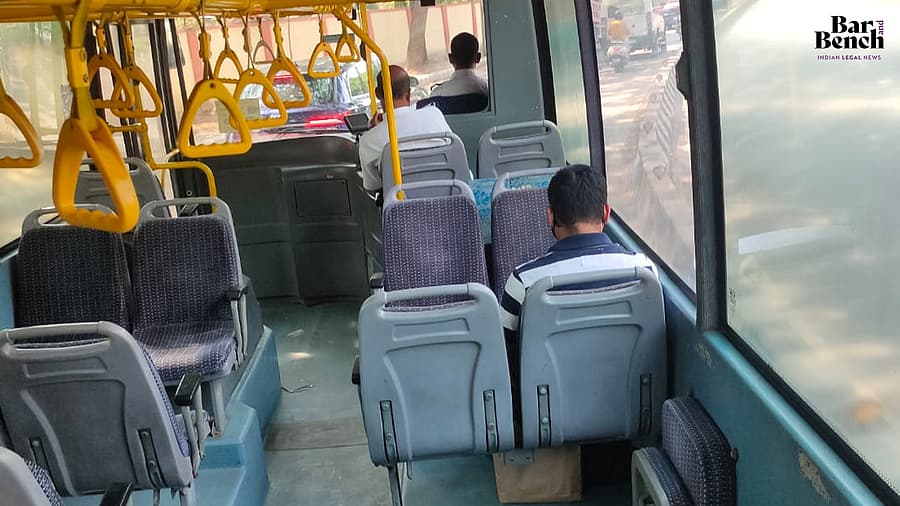
Delhi High Court: Demands Explanation for Not Invoking ESMA on DTC Strike
Summary
- The Delhi High Court questioned the Delhi government and DTC on why the Essential Services Maintenance Act (ESMA) was not invoked against striking bus drivers.
- The court directed the Delhi government to review and make a decision on invoking ESMA as per law.
- DTC's counsel stated there was no formal union, the strike was organized via WhatsApp, and 96% of buses were back in service.
- DTC had previously sent a file to the Delhi government recommending ESMA invocation.
- The High Court allowed the petitioner to approach it again if the situation with DTC bus services did not improve.
Judicial Scrutiny Over Essential Services Strike
The Delhi High Court has placed the onus squarely on the Delhi government to decide on invoking the Essential Services Maintenance Act against striking bus drivers, emphasizing the need to maintain public transport services.
The Delhi High Court recently put the Delhi government and the Delhi Transport Corporation (DTC) on the spot, demanding an explanation for the failure to invoke the Essential Services Maintenance Act (ESMA) against DTC drivers who have been on strike for several days. This pointed inquiry came during the hearing of a Public Interest Litigation (PIL) petition, titled Ami Sisodia vs Government of NCT of Delhi & Ors, which highlighted the significant disruption caused by the ongoing protests. A Division Bench, comprising Chief Justice Devendra Kumar Upadhyaya and Justice Tejas Karia, presided over the proceedings, underscoring the judiciary's concern over the impact on public services.
The court's intervention signals a heightened judicial interest in the executive's discretion when dealing with labor disputes that affect essential public utilities. The questioning of why the Essential Services Maintenance Act Delhi had not been applied to resolve the DTC bus drivers strike PIL indicates a push for accountability from the authorities in maintaining critical public services.
The Delhi Transport Corporation Dispute
During the hearing, Advocate Avneesh Ahlawat, representing the Delhi Transport Corporation, provided insights into the nature of the industrial action. She informed the Bench that, contrary to typical labor disputes, there was no recognized union of DTC drivers involved in the strike. Instead, the protest was being orchestrated through informal channels, specifically via WhatsApp messages, which were being used to mobilize participants. Ahlawat also reported instances of vandalism targeting buses, indicating a more volatile aspect of the strike.
Despite these challenges, the DTC asserted that it had taken various measures to mitigate the impact, successfully restoring nearly 96% of its bus fleet to service. Crucially, the DTC's counsel confirmed that the corporation had already submitted a formal file to the Delhi government, recommending the invocation of ESMA to address the ongoing disruption, highlighting the Delhi government ESMA decision process.
Legal Directives and Potential Recourse
The Delhi High Court has placed the onus squarely on the Delhi government to decide on invoking the Essential Services Maintenance Act against striking bus drivers, emphasizing the need to maintain public transport services. Following the submissions, the High Court decided to dispose of the Public Interest Litigation. However, this disposition came with a clear and firm directive to the Delhi government. The court explicitly ordered the government to "review and take a decision as per law" regarding the invocation of the Essential Services Maintenance Act.
This mandate places the responsibility squarely on the state to assess the situation and act in accordance with legal provisions to ensure the uninterrupted functioning of public transport. The Bench further expressed its expectation that the state would ensure the continued operation of DTC buses on the roads. Importantly, the court also left an avenue open for the petitioner, stating that if the situation concerning bus services does not improve, the petitioner retains the right to approach the High Court again for further intervention. This ruling highlights the court's commitment to upholding essential public services while also ensuring due process in labour law essential services India.
Practical Implications
This development signals increased judicial scrutiny on the government's discretion in invoking ESMA during strikes affecting essential services. Lawyers and compliance officers should note this as a potential precedent for how future labour disputes in India, particularly those impacting public services, might be handled and the pressure on authorities to act.
Source
Source: Based on recent news reports.
How does this affect you?
Get an AI analysis of this article grounded in your jurisdictions, practice areas, and any policy documents you've uploaded to Wansom.
Finish Reading the Full Story and the Expert Analysis.
Get the latest legal & regulatory intelligence in India
Wansom is AI and can make mistakes.