
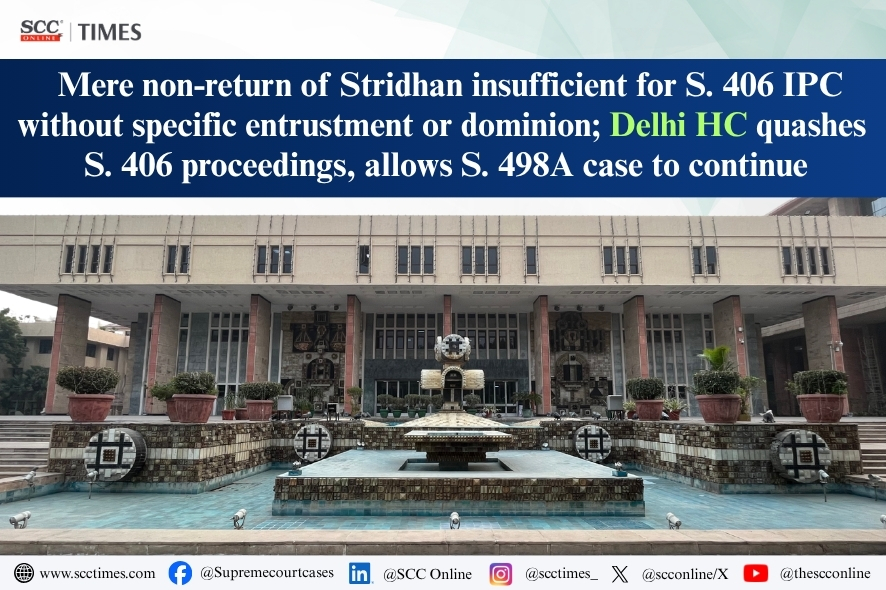
Delhi HC: Stridhan S. 406 IPC Entrustment Needs Proof
Summary
- The Delhi High Court partly quashed criminal proceedings stemming from a matrimonial dispute.
- Proceedings under Section 406 IPC were quashed due to a lack of specific entrustment or dominion over Stridhan.
- The court allowed the case under Section 498A IPC, concerning cruelty, to continue, finding a prima facie case.
- Mere non-return of Stridhan is insufficient for a Section 406 IPC charge without proof of entrustment.
- This ruling clarifies the high evidentiary standard for criminal breach of trust in Stridhan cases.
Court Partially Quashes Criminal Proceedings
Lawyers advising clients in matrimonial disputes involving Stridhan should note that the Delhi High Court has clarified the high bar for Section 406 IPC, requiring specific proof of entrustment or dominion, which impacts how such cases are filed and defended.
The Delhi High Court recently issued a significant ruling in a matrimonial dispute, partially setting aside criminal proceedings that had been initiated. The court determined that while allegations under Section 498A of the Indian Penal Code (IPC) presented a prima facie case of cruelty, the prosecution under Section 406 IPC, pertaining to criminal breach of trust, could not be sustained. This decision underscores the distinct evidentiary requirements for different charges arising from marital discord.
The High Court's order specifically quashed the proceedings related to Section 406 IPC, finding a lack of sufficient evidence regarding entrustment. Conversely, the case concerning Section 498A IPC was permitted to continue, indicating that the initial accusations of cruelty met the threshold for further judicial scrutiny. This bifurcated outcome highlights the court's careful consideration of the specific elements required for each criminal charge.
Legal Framework for Stridhan and Cruelty
Section 406 IPC addresses criminal breach of trust, a charge frequently invoked in matrimonial disputes where a wife's Stridhan is allegedly withheld. For a successful prosecution under Section 406 IPC Stridhan, it is imperative to establish that the property was specifically entrusted to the accused or that they exercised dominion over it. Without concrete proof of such entrustment or dominion, the charge of criminal breach of trust cannot be legally upheld.
In contrast, Section 498A IPC deals with cruelty by a husband or his relatives towards a married woman. This provision aims to protect women from physical or mental harassment in their matrimonial homes. The Delhi High Court's decision to allow the S. 498A IPC cruelty matrimonial case to proceed suggests that the allegations presented were substantial enough to warrant a trial on the merits of the cruelty claims, independent of the Stridhan entrustment issue.
Implications for Stridhan Entrustment Claims
This ruling from the Delhi High Court clarifies the high evidentiary bar for prosecuting criminal breach of trust concerning Stridhan. It firmly establishes that the mere non-return of Stridhan, in itself, is insufficient to sustain a charge under Section 406 IPC without specific evidence demonstrating entrustment or dominion over the property by the accused. The court's emphasis on the necessity of proving Stridhan entrustment dominion sets a crucial precedent.
Lawyers advising clients in matrimonial disputes involving Stridhan should note that the Delhi High Court has clarified the high bar for Section 406 IPC, requiring specific proof of entrustment or dominion, which impacts how such cases are filed and defended. This judgment reinforces that general allegations of property withholding will not suffice for a criminal breach of trust Stridhan charge, necessitating a more detailed and evidence-backed approach when pursuing such claims. The distinction drawn by the Delhi High Court Section 406 IPC ruling will likely influence future litigation strategies in similar cases.
Practical Implications
Lawyers advising clients in matrimonial disputes involving Stridhan should note that the Delhi High Court has clarified the high bar for Section 406 IPC, requiring specific proof of entrustment or dominion, which impacts how such cases are filed and defended.
Source
Source: Original reporting via SCC Times
How does this affect you?
Get an AI analysis of this article grounded in your jurisdictions, practice areas, and any policy documents you've uploaded to Wansom.
Finish Reading the Full Story and the Expert Analysis.
Get the latest legal & regulatory intelligence in India
Wansom is AI and can make mistakes.