
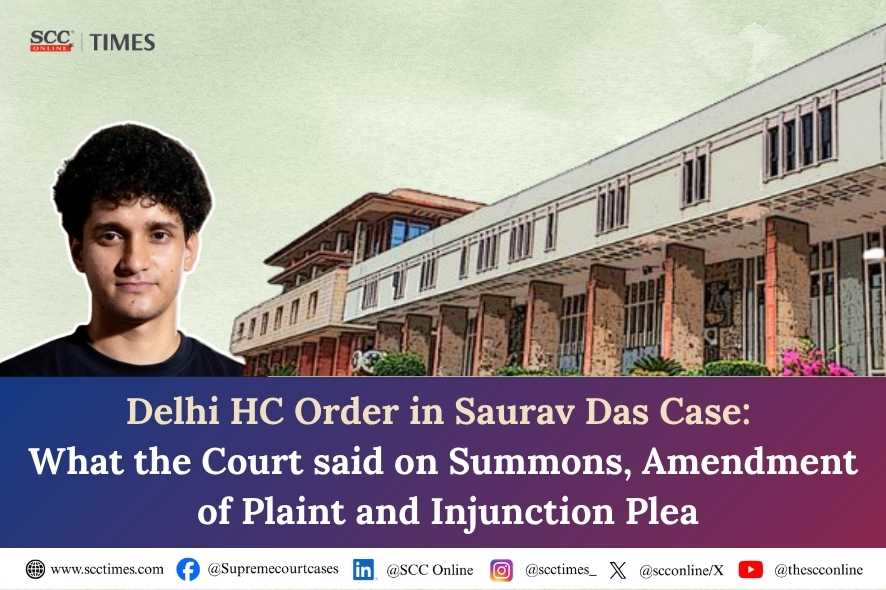
Delhi HC: Saurav Das Summons Plaint Amendment, Interim Reply Due
Summary
- The Delhi High Court issued summons in a suit involving Saurav Das.
- The court allowed an amendment to the plaint, substituting Defendant 4 with Good Morning India (P) Ltd.
- Defendants were directed to file their reply to the interim injunction plea within 10 days.
- The orders illustrate the Delhi High Court's procedural handling of civil suits, including summons, plaint amendments, and interim injunction responses.
Court Issues Key Procedural Directives in Saurav Das Case
The Delhi High Court's handling of the Saurav Das case provides a practical illustration of established civil procedure principles.
The Delhi High Court recently issued a series of significant procedural orders in a suit involving Saurav Das, demonstrating the court's active management of civil litigation. These directives encompassed the formal initiation of proceedings through the issuance of summons, the approval of an amendment to the original plaint, and the establishment of a strict timeline for defendants to respond to an application seeking interim relief.
The court's actions are crucial steps in ensuring the proper progression of the legal dispute. By addressing fundamental aspects such as party identification and the exchange of initial pleadings, the Delhi High Court has laid down the groundwork for the substantive arguments to commence, while also setting an expedited schedule for addressing urgent interlocutory matters.
Specific Orders on Summons, Plaint Amendment, and Injunction Reply
A primary directive from the court was the issuance of summons in the Saurav Das suit. This formal notification serves to inform the named defendants about the legal action initiated against them, compelling their appearance before the court and requiring them to present their defense. The issuance of these summons is a foundational element of civil procedure, ensuring that all parties are duly informed and have an opportunity to be heard.
Further, the Delhi High Court granted permission for an amendment to the plaint. This particular amendment involved the substitution of 'Defendant 4' with 'Good Morning India (P) Ltd.', a critical adjustment to ensure that the correct and necessary parties are formally arrayed in the suit. Such amendments are often permitted by courts to rectify errors, add or remove parties, or clarify pleadings, thereby facilitating a comprehensive and just adjudication of the dispute.
In a related development, the court also mandated that the defendants submit their reply to the interim injunction plea within a stringent period of 10 days. This directive underscores the urgency often associated with applications for interim relief, which seek to maintain the status quo or prevent irreparable harm during the pendency of the suit. The prompt filing of a reply is essential for the court to consider both sides of the argument before deciding on any temporary measures.
Legal Framework for Procedural Management
The Delhi High Court's handling of the Saurav Das case provides a practical illustration of established civil procedure principles. The issuance of summons, for instance, is a mandatory step under the Code of Civil Procedure, ensuring adherence to the principles of natural justice by formally notifying defendants of the proceedings against them. This initial step is vital for the legitimate commencement of any civil action and for the court to acquire jurisdiction over the parties.
The allowance of a plaint amendment, particularly one involving defendant substitution, falls under the court's inherent powers and specific provisions for amending pleadings. The Delhi High Court amendment of plaint process is designed to prevent technicalities from obstructing justice, enabling parties to correct bona fide errors or bring all necessary parties before the court for a complete and effective resolution of the dispute. This flexibility ensures that the litigation accurately reflects the true nature of the controversy and involves all relevant entities.
Moreover, the directive regarding the Saurav Das interim injunction reply highlights the court's proactive approach to managing urgent interlocutory applications. Interim injunctions are powerful tools designed to protect rights during litigation, and courts typically require swift responses from opposing parties to balance competing interests. The setting of a 10-day deadline reflects the court's commitment to expeditious decision-making on matters that could significantly impact the parties before a final judgment is rendered.
Implications for Civil Litigation Practitioners
This procedural order from the Delhi High Court serves as a valuable practical example for legal practitioners navigating civil suits. The court's clear directives on the Delhi HC civil procedure summons, the allowance of a Good Morning India (P) Ltd. defendant substitution, and the timeline for the interim injunction reply collectively demonstrate the court's emphasis on efficient case management and adherence to procedural fairness. Lawyers can observe how the court addresses common procedural hurdles, from ensuring proper party identification to managing urgent applications for temporary relief.
The Saurav Das case procedural order underscores the importance of meticulous attention to procedural details and timely compliance with court directives. For attorneys, understanding the court's approach to these fundamental aspects of litigation — including the flexibility afforded for plaint amendments and the urgency attached to injunction replies — is crucial for strategizing and effectively representing clients within the Delhi High Court's jurisdiction. This case exemplifies the court's balanced approach, facilitating necessary corrections while maintaining a firm hand on the litigation timeline.
Practical Implications
This order provides a practical example of the Delhi High Court's procedural handling of civil suits, specifically regarding the issuance of summons, allowing amendments to pleadings, and setting timelines for responses to interim injunction applications. Lawyers can note the court's approach to these common procedural hurdles when strategizing their own litigation in the Delhi High Court.
Source
Source: Original reporting via SCC Times
How does this affect you?
Get an AI analysis of this article grounded in your jurisdictions, practice areas, and any policy documents you've uploaded to Wansom.
Finish this article free. Just your email for instant unlock.
Wansom is AI and can make mistakes.