
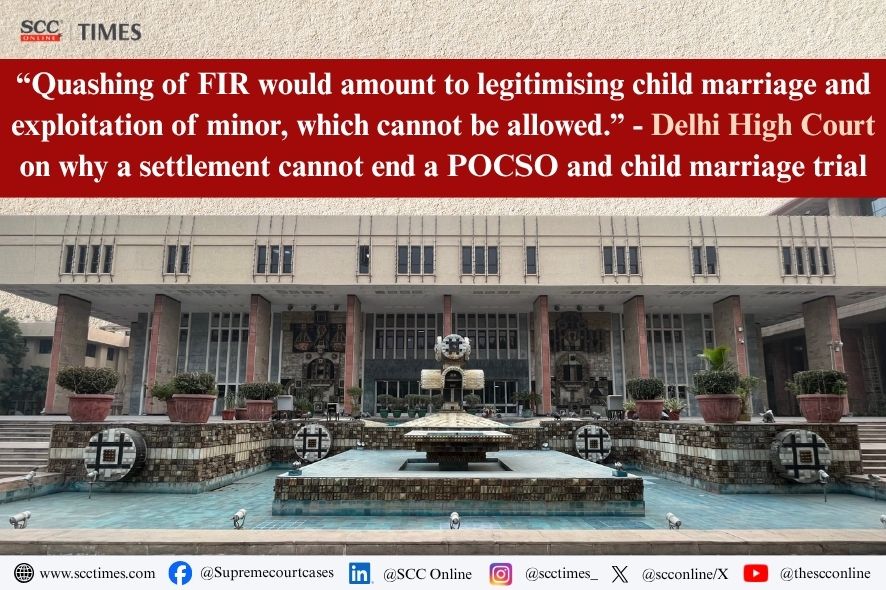
Delhi High Court: No POCSO Quashing for Minor Marriage Settlement
Summary
- The Delhi High Court dismissed a petition to quash an FIR involving charges under the POCSO Act and Prohibition of Child Marriage Act.
- The case concerned the forced marriage of a 17-year-old minor to a 38-year-old man, followed by allegations of forced physical relations.
- The court ruled that forcing a minor into marriage and physical relations is a grave offense with significant societal impact.
- It emphasized that quashing the FIR based on settlement would legitimize child marriage and exploitation, and the trial must continue.
- The decision cited Supreme Court precedents, including Gian Singh v. State of Punjab and Parbatbhai Aahir v. State of Gujarat, against quashing serious offenses through compromise.
What Happened in the Case
The Delhi High Court's decision underscored that allowing the quashing of the FIR in such circumstances would effectively legitimize child marriage and the exploitation of a minor.
A petition was brought before the Delhi High Court seeking to quash an FIR and all subsequent legal proceedings related to a case involving a minor. The petitioner faced serious charges under Sections 363, 366-A, and 376 of the Indian Penal Code, Section 6 of the Protection of Children from Sexual Offences Act, 2012 (POCSO Act), and Sections 9 and 11 of the Prohibition of Child Marriage Act, 2006 (PCM Act). An additional charge under Section 506 IPC was included in the charge-sheet, which was filed on May 10, 2019, before the Additional Sessions Judge at Patiala House Court, New Delhi. The petitioner's primary argument for quashing the FIR was that the initial complaint arose from a "misconception and misunderstanding" and that an "amicable settlement" had been reached between the parties.
The factual background of the case, as presented in court documents, revealed a distressing sequence of events. On March 7, 2019, Respondent 2, who was approximately 17 years old at the time, was informed by her uncle and father that her marriage had been arranged for the following day in Raebareli, Uttar Pradesh. She was subsequently married on March 8, 2019, to the petitioner, a man who was then 38 years old and previously unknown to her. Following the marriage, the petitioner transported her to his brother's residence in Ghaziabad, Uttar Pradesh. During her time there, she was unable to contact law enforcement as she had no access to a telephone. It was alleged that the petitioner forced physical relations upon her on three separate occasions in Ghaziabad. The situation escalated on March 11, 2019, when the petitioner reportedly took her to a farmhouse and again forced her into physical relations. The victim managed to contact the police on March 12, 2019, leading to the registration of the FIR at her instigation. Despite these allegations, the petitioner's counsel contended that the couple was already married and living together harmoniously.
Court's Ruling and Legal Framework
Justice Mini Pushkarna, presiding over a Single Judge Bench of the Delhi High Court, unequivocally dismissed the petition, directing that the trial against the petitioner must proceed. The application for quashing was filed under Section 528 of the Nagarik Suraksha Sanhita, 2023 (BNSS), which corresponds to the erstwhile Section 482 of the Criminal Procedure Code, 1973 (CrPC). The court emphasized that compelling a minor into marriage and subsequently into physical relations constitutes a grave offense with profound societal repercussions. It held that there is an overriding public interest in ensuring the continuation of the trial, irrespective of any purported compromise between the parties.
The Delhi High Court's decision underscored that allowing the quashing of the FIR in such circumstances would effectively legitimize child marriage and the exploitation of a minor. The court was clear that the protective objectives of the Protection of Children from Sexual Offences Act 2012 and the Prohibition of Child Marriage Act 2006 could not be undermined by claims of settlement or the fact that the parties might be living together as husband and wife. This ruling reinforces the judiciary's commitment to upholding the rights and safety of minors, particularly in cases involving child marriage in India and sexual offenses.
Precedential Basis and Societal Impact
While acknowledging its inherent powers under Section 528 BNSS to quash criminal proceedings, even for non-compoundable offenses where a compromise has been reached, the Delhi High Court highlighted crucial limitations. The court referenced established Supreme Court jurisprudence, which cautions against exercising this power in cases involving serious and heinous offenses. Specifically, the judgment cited Gian Singh v. State of Punjab, (2012) 10 SCC 303, which stipulates that settlements between offenders and victims hold no legal sanction in grave crimes such as murder, rape, or offenses demonstrating mental depravity.
Further reinforcing its stance, the High Court also relied on Parbatbhai Aahir v. State of Gujarat, (2017) 9 SCC 641. This precedent mandates that High Courts must carefully consider the nature and gravity of the offense. It clarifies that heinous and serious offenses, particularly those involving mental depravity or crimes like murder and rape, cannot be appropriately quashed even if the victim or their family has settled the dispute, given their significant impact on society.
The court concluded that the forced marriage of a minor, approximately 17 years old, to a man roughly 20 years her senior, followed by forced physical relations, cannot be categorized as a private dispute. Instead, it represents a matter of overriding public interest that necessitates the continuation of the trial.
Practical Implications
Lawyers advising clients in India on criminal matters, particularly those involving the POCSO Act or child marriage, must note that the Delhi High Court has reinforced its stance against quashing FIRs or proceedings based on settlement, even if parties are living together. This decision emphasizes the overriding public interest in prosecuting grave offences against minors, indicating that such cases are unlikely to be resolved through compromise and will proceed to trial.
Source
How does this affect you?
Get an AI analysis of this article grounded in your jurisdictions, practice areas, and any policy documents you've uploaded to Wansom.
Finish Reading the Full Story and the Expert Analysis.
Wansom is AI and can make mistakes.