
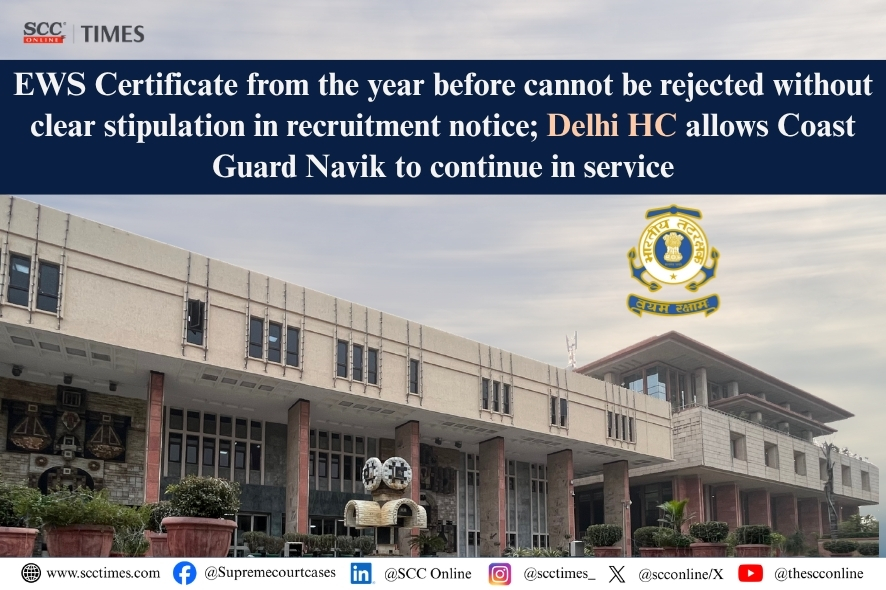
Delhi High Court: EWS Certificate Previous Year Rejection Invalid
Summary
- The Delhi High Court ruled that an EWS certificate from the preceding financial year cannot be rejected if the recruitment notice lacks a clear stipulation against it.
- This decision applies when a candidate otherwise satisfies all eligibility requirements and possesses the necessary certificate.
- The ruling prevented the rejection of an EWS certificate for a Coast Guard Navik, allowing him to continue in service.
- The court emphasized that rejections based purely on technical grounds, without explicit rules, are impermissible.
- This judgment reinforces the need for clear and unambiguous stipulations in recruitment advertisements regarding EWS certificate validity.
What Happened
The court's ruling underscored that such a certificate, presented by a candidate who otherwise met all other eligibility criteria and possessed the required documentation, could not be dismissed solely on a technicality.
The Delhi High Court recently intervened in a matter concerning the validity of an Economically Weaker Section (EWS) certificate, specifically addressing its acceptance when issued for the financial year preceding the application. The court's decision arose from a petition involving a Coast Guard Navik, whose continued service was contingent upon the recognition of his EWS documentation.
The court's ruling underscored that such a certificate, presented by a candidate who otherwise met all other eligibility criteria and possessed the required documentation, could not be dismissed solely on a technicality. This particular Delhi HC EWS certificate previous year rejection was deemed invalid because the relevant recruitment notice lacked any explicit stipulation prohibiting the use of an EWS certificate issued for the prior financial year.
As a direct consequence of this significant Delhi High Court EWS ruling, the Coast Guard Navik involved in the petition was permitted to remain in service. The judgment effectively overturned the earlier decision to reject his EWS certificate, thereby safeguarding his position based on the principle that procedural ambiguities should not unfairly penalize eligible candidates.
Legal Context
This judgment provides crucial clarification regarding EWS certificate validity in recruitment processes, particularly when the recruitment notice EWS stipulation is absent or unclear. The court emphasized that in the absence of a clear directive to the contrary within the recruitment advertisement, an EWS certificate from the preceding financial year should be considered valid. This prevents arbitrary Economically Weaker Section certificate rejection based on unstated requirements.
The core of the court's reasoning revolves around the principle of fairness and transparency in public employment. When a recruitment notice fails to explicitly state that only EWS certificates from the *current* financial year are acceptable, candidates are entitled to rely on the general understanding that a valid certificate, even if issued for the immediate past financial year, fulfills the requirement. Rejecting such a certificate under these circumstances would constitute a technical ground without substantive justification.
The ruling reinforces the idea that candidates who meet all substantive eligibility requirements and possess the necessary documentation should not be disadvantaged by procedural gaps or ambiguities in the recruitment process. It places the onus on recruiting authorities to ensure their advertisements are comprehensive and unambiguous, particularly concerning critical documents like EWS certificates.
Why It Matters
This Delhi High Court EWS ruling sets a significant precedent for future challenges against the rejection of EWS certificates, especially those issued for the financial year preceding the application. It provides a clear legal basis for candidates to contest rejections where the recruitment notice EWS stipulation is not explicitly defined, ensuring that technicalities do not override genuine eligibility. The Coast Guard Navik EWS case serves as a pivotal example of this principle in action.
For public sector employers and recruiting agencies, the judgment serves as a critical directive to review and update their recruitment advertisements. To avoid similar legal challenges and ensure clarity, notices must now explicitly define the acceptable validity period for EWS certificates. This proactive measure will prevent disputes arising from EWS certificate validity recruitment issues and streamline the application process for both parties.
Ultimately, the court's decision upholds the spirit of the Economically Weaker Section reservation policy, ensuring that deserving candidates are not unfairly excluded due to administrative oversight or vague instructions. It reinforces the judiciary's role in safeguarding the rights of applicants against arbitrary decisions, promoting transparency and equity in government recruitment. This ruling will likely influence how Economically Weaker Section certificate rejection cases are handled across various public sector recruitments moving forward.
Practical Implications
This ruling sets a precedent for challenging the rejection of EWS certificates from the preceding financial year in recruitment processes, particularly where the recruitment notice lacks explicit stipulations. Lawyers advising public sector employers should review and update their recruitment advertisements to clearly define EWS certificate validity periods, while those representing candidates can leverage this judgment to contest rejections based on technicalities.
Source
Source: Original reporting via SCC Times
How does this affect you?
Get an AI analysis of this article grounded in your jurisdictions, practice areas, and any policy documents you've uploaded to Wansom.
Finish Reading the Full Story and the Expert Analysis.
Get the latest legal & regulatory intelligence in India
Wansom is AI and can make mistakes.