
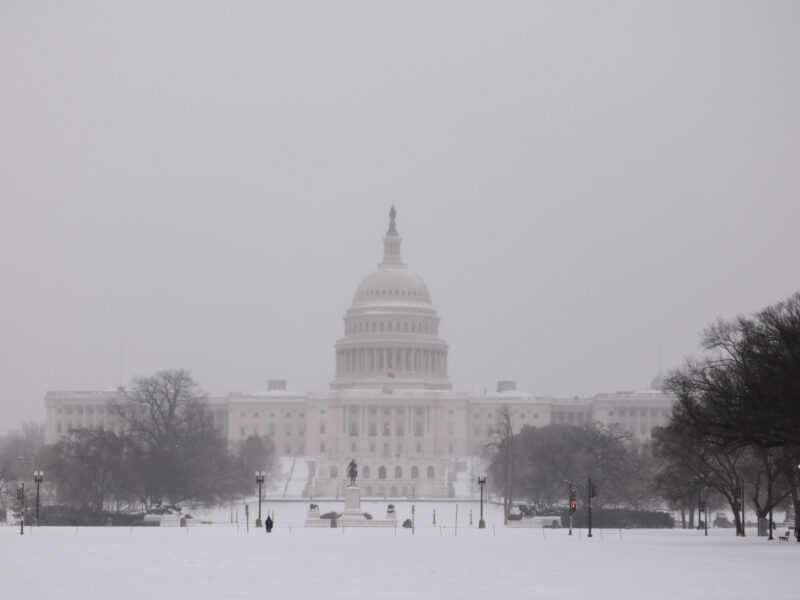
DC Circuit: Capitol Steps Protest Ban Unconstitutional Under First Amendment
Summary
- The D.C. Circuit Court of Appeals ruled that the U.S. Capitol Police cannot ban demonstrations on the Capitol steps solely for lacking congressional sponsorship.
- Judge Neomi Rao, writing for the majority, determined the Eastern Steps are a nonpublic forum but found the sponsorship requirement an unreasonable First Amendment violation.
- Reverend Patrick J. Mahoney successfully challenged the ban after planning a prayer demonstration on the Eastern Steps in September 2021.
- The court affirmed summary judgment for Mahoney but vacated the district court's universal injunction, remanding for a tailored remedy in line with Trump v. CASA.
- Capitol Police regulations, promulgated in February 2025, permit recreational use but restrict demonstration activity, with an exception for protests sponsored by members of Congress.
DC Circuit Strikes Down Capitol Steps Protest Ban
This ruling clarifies the scope of First Amendment protections for demonstrations on federal property, particularly regarding the unreasonableness of requiring congressional sponsorship for protests on nonpublic forums like the Capitol steps.
The D.C. Circuit Court of Appeals recently delivered a significant ruling concerning free speech on federal property, determining that the U.S. Capitol Police cannot prohibit demonstrations on the Capitol steps solely due to a lack of congressional sponsorship. In a 2-1 decision issued on Tuesday, the appellate panel found such a restriction to be an unconstitutional violation of the First Amendment, particularly as it disproportionately impacts issues that may not garner widespread political support. This judgment stemmed from a challenge brought by Reverend Patrick J. Mahoney, a Presbyterian minister who had intended to conduct a prayer demonstration on the Eastern Steps of the U.S. Capitol on September 11, 2021, and initiated legal action pre-emptively against the existing ban.
U.S. Circuit Judge Neomi Rao, a Trump appointee, authored the majority opinion, joined by U.S. Circuit Judge Karen Henderson. Judge Rao clarified that while the Eastern Steps constitute a nonpublic forum, the regulations governing demonstrations there were deemed unreasonable. Her opinion emphasized that an individual's right to demonstrate outside the Capitol should not be contingent upon the discretionary approval of a member of Congress. Consequently, the court affirmed the summary judgment in favor of Reverend Mahoney on his First Amendment claim.
However, the appellate panel also addressed the scope of the lower court's remedy. It vacated the universal injunction previously issued by Chief U.S. District Judge James Boasberg, citing the Supreme Court’s precedent in Trump v. CASA which restricts the issuance of such broad injunctions. The case has now been remanded to the district court to determine a more appropriately tailored scope of relief, ensuring that any future injunction is specific to Reverend Mahoney's circumstances rather than applying universally.
Regulatory Framework and Historical Context
The regulations at the heart of this dispute were promulgated by the Capitol Police Board in February 2025, titled the Traffic Regulations for the U.S. Capitol Grounds. These rules delineate permissible activities on the grounds, allowing for general public use for recreational purposes such as sightseeing, exercising, and dog walking. However, "demonstration activity" is significantly more restricted, permitted only in designated areas. Specifically, three stairways leading to the Capitol’s East Front are largely closed to any form of demonstration.
Historically, the Eastern Steps of the U.S. Capitol were openly accessible to the public, including for demonstration activities, prior to the September 11 terrorist attacks. Following these events, the steps were largely cordoned off, with only the lower section remaining accessible. An exception to these restrictions allows members of Congress and their staff to utilize the steps for entry and exit from the Capitol. Furthermore, these regulations include a specific carve-out enabling members of Congress to sponsor or organize their own demonstrations.
For a congressional member to sponsor a protest, they must do so in their official capacity and be present for the entirety of the demonstration. Judge Rao's opinion highlighted instances of such sponsored events, including an overnight demonstration organized by former Democratic Representative Cori Bush to protest the end of the Covid-19 eviction moratorium, and a 12-hour sit-in hosted by Senator Cory Booker and Representative Hakeem Jeffries concerning a proposed budget. These examples underscored the selective nature of the U.S. Capitol Police demonstration ban, which permits politically connected protests while restricting others.
Judicial Disagreement and First Amendment Implications
A key point of contention between the appellate and district courts revolved around the classification of the Eastern Steps. Chief U.S. District Judge James Boasberg, an Obama appointee, had initially granted summary judgment to Reverend Mahoney, classifying the Eastern Steps as a traditional public forum. Judge Boasberg reasoned that the steps had historically been open for expression and that the existing ban prohibited substantially more speech than was necessary for security purposes. However, Judge Neomi Rao partially disagreed with this assessment, concluding that the steps are a nonpublic forum due to their integration with the Capitol Building itself, distinguishing them from the broader Capitol Grounds.
Despite classifying the area as a nonpublic forum Capitol steps, Judge Rao's majority opinion still found the U.S. Capitol Police demonstration ban to be unreasonable under the First Amendment. The Capitol Police Board had justified its restrictions by asserting their necessity for ensuring the safe passage of members and staff. Yet, Judge Rao pointed out the inconsistency in this rationale: if safety were the paramount concern, the board would not permit large public demonstrations when sponsored by a member of Congress. This selective allowance, based on whether a cause garners political support, undermines the purported safety justification and highlights the arbitrary nature of the restriction on unsponsored protests.
This ruling clarifies the scope of First Amendment protections for demonstrations on federal property, particularly regarding the unreasonableness of requiring congressional sponsorship for protests on nonpublic forums like the Capitol steps. It reinforces free speech principles by limiting arbitrary bans that hinge on political influence. Furthermore, the decision to vacate the universal injunction and remand for tailored relief, in line with Trump v. CASA, serves as an important reminder of the Supreme Court's directives on the appropriate scope of judicial remedies, ensuring that injunctions are narrowly tailored to the specific parties involved.
Practical Implications
This ruling clarifies the scope of First Amendment protections for demonstrations on federal property, particularly regarding the unreasonableness of requiring congressional sponsorship for protests on nonpublic forums like the Capitol steps. Lawyers advising clients on public assembly rights or challenging restrictions on federal land should note this precedent, as it limits arbitrary bans and reinforces free speech principles, while also reiterating the Supreme Court's stance on tailored injunctions.
Source
How does this affect you?
Get an AI analysis of this article grounded in your jurisdictions, practice areas, and any policy documents you've uploaded to Wansom.
Finish Reading the Full Story and the Expert Analysis.
Get the latest legal & regulatory intelligence in United States
Wansom is AI and can make mistakes.