
Cour CEDEAO: Juge la Réforme Constitutionnelle du Togo Invalide
Summary
- The Université de Lomé is hosting a colloquium on October 29-30, 2026, to discuss regional human rights jurisdictions and their control over constitutional changes.
- A central topic is the ECOWAS Court of Justice's January 29, 2026, decision on Togo's March 2024 constitutional reform.
- The ECOWAS Court ruled that Togo's reform violated Article 23 of the African Charter on Democracy, Elections and Governance, deeming it an "unconstitutional change of government."
- Togo's government disputes the ruling, claiming the ECOWAS Court lacks jurisdiction over national constitutional law and that the invoked instrument is state-actionable only.
- The colloquium will feature panels and roundtables exploring the balance between regional judicial oversight, state sovereignty, and the enforcement of community court decisions.
Regional Legal Dialogue on Constitutional Reform
The ECOWAS Court of Justice issued a significant ruling on January 29, 2026, directly addressing the Togolese constitutional reform enacted in March 2024.
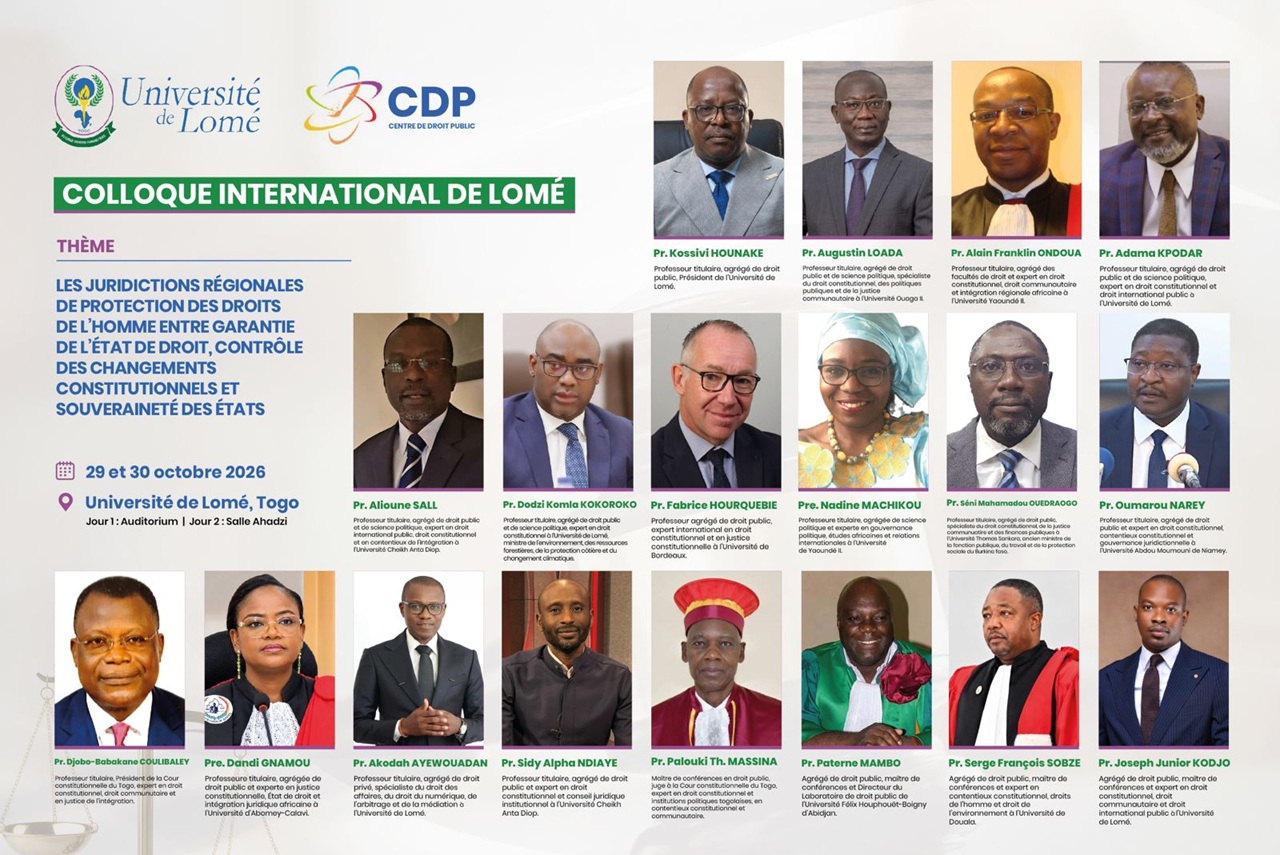
The Université de Lomé is set to host a significant international colloquium on October 29 and 30, 2026, bringing together legal experts from across the sub-region. Organized by the Centre de Droit Public de l'Université de Lomé, the event will take place in the Salle Koffi Ahadzi-Nonou, focusing on the critical role of regional African human rights jurisdictions. The central theme explores the delicate balance between safeguarding the rule of law, overseeing constitutional changes, and respecting state sovereignty.
The timing of this colloquium is particularly pertinent, as it directly addresses a contentious political debate currently unfolding in Togo. A key focus of the discussions will be the January 29, 2026, decision by the ECOWAS Court of Justice concerning the Togolese constitutional reform of March 2024. This specific ruling has ignited widespread discussion regarding the extent of regional judicial oversight over national legislative processes, making the colloquium a crucial forum for legal and political discourse on the matter.
The ECOWAS Court's Stance on Togo's Constitutional Changes
The ECOWAS Court of Justice issued a significant ruling on January 29, 2026, directly addressing the Togolese constitutional reform enacted in March 2024. Following a petition filed by opposition parties and civil society organizations, the Court determined that this reform contravened Article 23 of the African Charter on Democracy, Elections and Governance. Furthermore, the Court characterized the changes as an "unconstitutional change of government," a pronouncement that has been interpreted by the Togolese opposition as a judicial validation of the Lomé government's illegitimacy.
Conversely, the Togolese government has strongly contested this interpretation. It asserts that the ECOWAS Court lacks the authority to review the constitutionality of domestic law and argues that the specific legal instrument invoked by the Court is only applicable to disputes between states. The government also highlighted that the Court's judgment did not mandate the repeal of the constitutional law nor did it impose any financial reparations. A political scientist observing the situation noted the nuanced legal position: while the ECOWAS Court is not a national constitutional court and did not order the law's withdrawal, its decision nonetheless affirmed that a state's constituent power is not above international legal obligations, particularly regarding the Cour CEDEAO décision réforme constitutionnelle Togo.
Navigating Sovereignty and Regional Oversight
The ongoing debate surrounding the ECOWAS Court of Justice's decision on the Togolese constitutional reform underscores a broader tension within the West African region: the extent to which regional courts can legitimately influence national constitutional developments. This legal and political conundrum forms the core of the colloquium's agenda, particularly in panels dedicated to the regional judicial control over constitutional revisions. Experts from Benin, Burkina Faso, Cameroon, France, and Togo, including Dandi Gnamou, Seni Ouedraogo, Fabrice Hourquebie, and Augustin Loada, will contribute to these discussions, with a specific emphasis on the January 29, 2026, ruling.
Further sessions will delve into the practical challenges of enforcing decisions from community courts within sovereign states. Discussions will explore the reception of these rulings in domestic legal systems, the effectiveness of judgments when confronted with national sovereignty, and the concept of a "dialogue of legal orders." These deliberations are crucial for lawyers advising on constitutional law or human rights in ECOWAS member states, as they highlight the evolving jurisprudence of the CEDEAO Cour de Justice Togo and its implications for national constitutional reforms.
Colloquium Agenda and Expert Contributions
The colloquium's program is structured to facilitate in-depth discussions on these complex legal issues. Following opening remarks from the University President, Professor Kossivi Hounake, and Gilbert Bawara, Ministre des Relations avec le Parlement et les Institutions, an inaugural lecture will be moderated by Professor Alioune Sall, a former judge of the ECOWAS Court. The first panel, moderated by Professor Komla Dodzi Kokoroko, Ministre de l'Environnement, des Ressources forestières, de la Protection côtière et du Changement climatique, will specifically examine the regional judicial review of constitutional revisions, with a particular focus on the recent ECOWAS Court decision concerning the Réforme constitutionnelle Togo 2024.
A second panel, moderated by Professor Alain Ondoua, will address the execution of community court decisions, navigating the interplay between state sovereignty and judicial effectiveness. On Friday, October 30, two roundtables are scheduled to explore community protection of human rights, democracy, and the rule of law. These sessions will cover topics such as the dialogue among judges, direct access for citizens and non-governmental organizations to community jurisdictions, the application of democratic clauses, and the independence of the judiciary. The event will conclude with a general report presented by Professor Nadine Machikou from the Université de Yaoundé II.
Practical Implications
Lawyers advising on constitutional law or human rights in ECOWAS member states must monitor the evolving jurisprudence of the ECOWAS Court of Justice, particularly its stance on national constitutional reforms and the enforceability of its decisions against sovereign states, as highlighted by the ongoing debate surrounding the Togolese constitutional reform. This case sets a precedent for the interpretation of regional human rights instruments in relation to national sovereignty.
Source
How does this affect you?
Get an AI analysis of this article grounded in your jurisdictions, practice areas, and any policy documents you've uploaded to Wansom.
Finish Reading the Full Story and the Expert Analysis.
Wansom is AI and can make mistakes.