
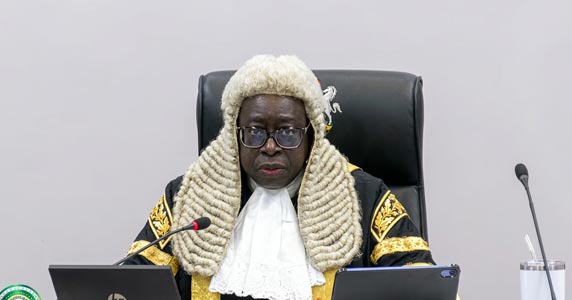
CJN Kekere-Ekun: Supreme Court Makes Urgent Funding Plea
Summary
- Chief Justice Kudirat Kekere-Ekun reported on the Supreme Court's activities for the 2025/2026 legal year.
- During this period, the Nigeria Supreme Court handled 2,456 matters and delivered 411 judgments.
- Among the judgments were 19 political appeals, reflecting a significant aspect of the court's work.
- The Chief Justice emphasized the necessity for financial autonomy to have practical effect.
- She called for timely funding to support the judiciary's operations and efficiency.
Judicial Performance and Funding Appeal
Her declaration that "Financial Autonomy Must Have Practical Effect" goes beyond a mere request for funds; it is a demand for the independence and operational efficiency that true financial self-sufficiency can provide.
The Chief Justice of Nigeria, Hon. Justice Kudirat Motonmori Olatokunbo Kekere-Ekun, GCON, recently provided a comprehensive overview of the Supreme Court's activities during the 2025/2026 legal year. Speaking at a special session convened to mark the commencement of the subsequent 2026/2027 legal year, Chief Justice Kekere-Ekun disclosed that the nation's apex court processed a substantial volume of cases. Her address highlighted both the significant output of the judiciary and an urgent plea for enhanced financial support, underscoring a critical challenge facing the Nigerian legal system.
During her address, Chief Justice Kudirat Kekere-Ekun revealed that the Supreme Court of Nigeria managed a total of 2,456 matters over the specified legal year. This considerable caseload culminated in the delivery of 411 judgments, demonstrating the court's active role in resolving legal disputes across the country. Alongside these performance metrics, the Chief Justice made a pointed appeal for timely funding, asserting that "Financial Autonomy Must Have Practical Effect" to ensure the judiciary can effectively fulfill its constitutional mandate. This statement signals a direct link between operational capacity and the availability of adequate financial resources.
Unpacking the Supreme Court's Workload
The statistics presented by Chief Justice Kekere-Ekun offer a clear insight into the demanding nature of the Supreme Court's responsibilities. The 2,456 matters handled by the court during the 2025/2026 legal year encompass a wide array of legal issues, reflecting the diverse challenges brought before the highest judicial body. The subsequent 411 judgments delivered represent the final determinations made on these complex cases, shaping legal precedents and impacting numerous individuals and entities throughout Nigeria.
A notable component of the Supreme Court caseload statistics Nigeria for the period was the resolution of 19 political appeals. These specific cases often carry significant national implications, requiring meticulous attention and swift resolution, which can place additional strain on judicial resources. The inclusion of such a substantial number of political appeals within the overall judgment count underscores the court's pivotal role in upholding democratic processes and resolving electoral disputes, further emphasizing the need for robust institutional support.
The Imperative of Financial Autonomy
The Chief Justice's impassioned call for timely funding is directly tied to the broader discourse surrounding Nigerian judiciary financial autonomy. Her declaration that "Financial Autonomy Must Have Practical Effect" goes beyond a mere request for funds; it is a demand for the independence and operational efficiency that true financial self-sufficiency can provide. This autonomy is crucial for the judiciary to manage its substantial caseload effectively, including the numerous political appeals, without external financial constraints impeding its functions.
Ensuring that the Supreme Court, and indeed the entire Nigerian judiciary, receives adequate and timely funding is paramount for maintaining the integrity and efficiency of the justice system. The Chief Justice's plea highlights that while legislative provisions for financial autonomy may exist, their practical implementation through consistent and sufficient budgetary allocations remains a challenge. Addressing this issue is vital for improving case processing times and could pave the way for necessary administrative reforms within the judiciary, ultimately benefiting all stakeholders, including legal practitioners and the public.
Practical Implications
Lawyers should be aware of the Supreme Court's substantial caseload and the Chief Justice's call for improved financial autonomy, as these factors may impact case processing times and could lead to future administrative reforms within the Nigerian judiciary.
Source
How does this affect you?
Get an AI analysis of this article grounded in your jurisdictions, practice areas, and any policy documents you've uploaded to Wansom.
Finish Reading the Full Story and the Expert Analysis.
Get the latest legal & regulatory intelligence in Nigeria
Wansom is AI and can make mistakes.