
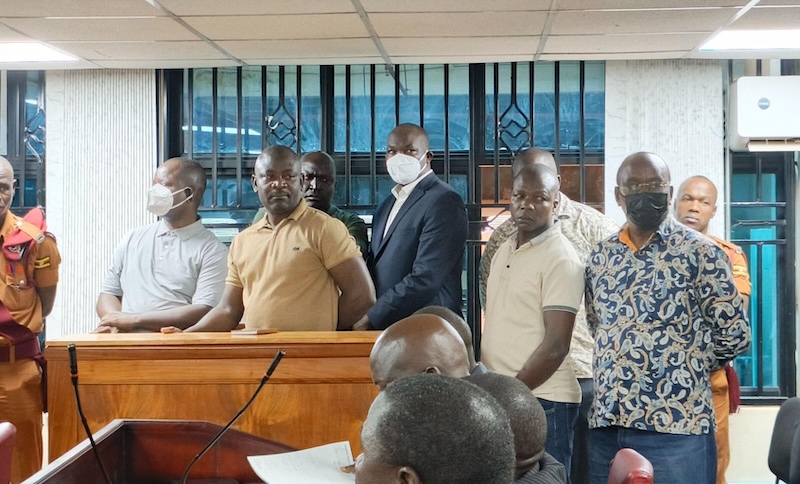
Chris Obore Bail Anti-Corruption Court: Granted To Parliament Official
Summary
- Chris Obore, parliament's interdicted director of communications, and six co-accused were granted bail by the Anti-Corruption Court in Kampala.
- Justice Michael Elubu presided over the decision, which followed two months of pre-trial detention for the accused.
- The charges involve the alleged misappropriation of Shs 27.2 billion within the Ugandan parliament.
- The court considered applications and submissions from the defendants' lawyers before granting bail.
What Happened
The Anti-Corruption Court Kampala's decision to grant Chris Obore Uganda bail, alongside six others facing charges related to the alleged Shs 27.2 billion misappropriation at parliament, carries significant weight for the country's legal framework and public perception of justice.
Chris Obore, who holds the position of interdicted director of communications and public affairs for Uganda's parliament, has recently been granted bail by the Anti-Corruption Court in Kampala. This significant development also extends to six co-accused individuals implicated in the same case. The decision was rendered by Justice Michael Elubu on a recent Wednesday, following a comprehensive review of the bail applications and subsequent legal submissions presented by their respective lawyers.
The charges against Mr. Obore and his six co-accused are serious, revolving around allegations of financial impropriety. Specifically, they face accusations related to the alleged misappropriation of a substantial sum, amounting to Shs 27.2 billion, within the parliamentary institution. This alleged fraud has drawn considerable attention, and the granting of bail allows the seven individuals to await the progression of their trial outside of pre-trial detention, a period that had lasted for two months prior to the court's ruling.
Legal Context
The Anti-Corruption Court in Kampala serves as a specialized judicial body within Uganda's legal system, specifically mandated to handle cases of corruption and economic crimes. Its role is pivotal in the nation's broader efforts to combat graft, particularly when it involves public officials and significant public funds. The process for granting Chris Obore bail, as with any accused person, involves the presiding judge, Justice Michael Elubu, carefully weighing various factors. These typically include assessing the likelihood of the accused absconding, interfering with witnesses, or potentially committing further offenses if released.
Ugandan law generally upholds the fundamental principle of the presumption of innocence, meaning individuals are considered innocent until proven guilty. Consequently, bail is often granted unless the prosecution can present compelling reasons for continued detention. In cases involving substantial amounts, such as the alleged Shs 27.2 billion fraud Uganda is currently investigating, the court's discretion is exercised with particular scrutiny. The decision to grant bail to Chris Obore and his co-accused, after they had spent two months in custody, suggests that Justice Elubu found sufficient assurances that they would comply with any imposed conditions and attend all future court proceedings.
Why It Matters
The Anti-Corruption Court Kampala's decision to grant Chris Obore Uganda bail, alongside six others facing charges related to the alleged Shs 27.2 billion misappropriation at parliament, carries significant weight for the country's legal framework and public perception of justice. High-profile cases, especially those involving public officials and substantial financial allegations, are closely monitored. The outcomes of such bail applications are often seen as indicators of the judiciary's commitment to combating corruption and upholding the rule of law.
For legal professionals and compliance officers, the specific conditions and the underlying judicial reasoning behind Justice Michael Elubu bail decision provide crucial insights. This ruling could establish a precedent for how similar charges against public officials are handled in the future, thereby influencing litigation strategies and risk assessments for clients facing allegations of economic crimes. The fact that bail was granted after a two-month period of detention underscores a careful balance between the gravity of the Uganda parliament misappropriation charges and the fundamental rights of the accused, reinforcing the principle that pre-trial detention should not be punitive.
Practical Implications
Lawyers and compliance officers should observe the conditions and judicial reasoning for bail grants in high-profile corruption cases before Uganda's Anti-Corruption Court, as this sets a precedent for how similar charges against public officials may be handled, influencing litigation strategy and risk assessment for clients.
Source
How does this affect you?
Get an AI analysis of this article grounded in your jurisdictions, practice areas, and any policy documents you've uploaded to Wansom.
Finish Reading the Full Story and the Expert Analysis.
Wansom is AI and can make mistakes.