
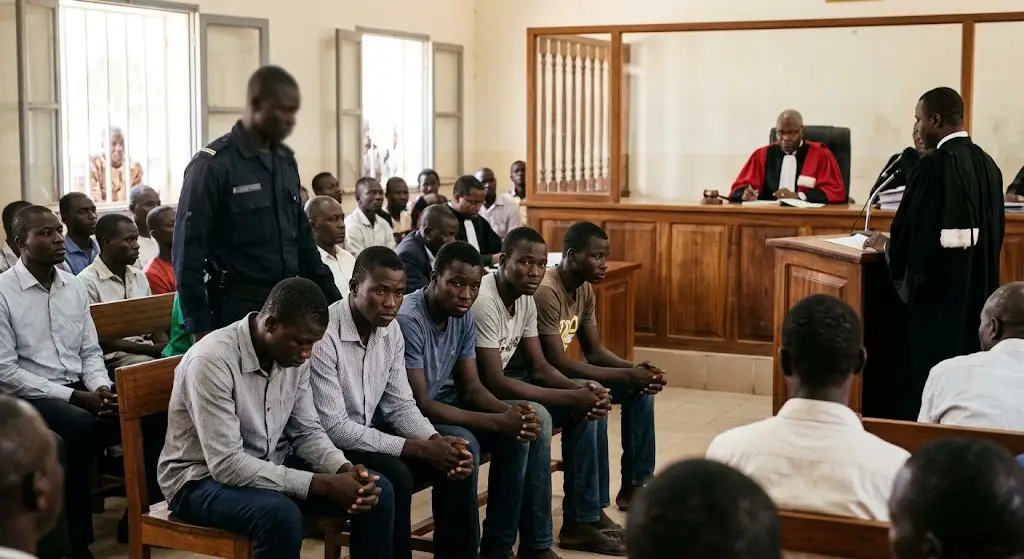
Tambacounda Prosecutors: Cheikh Tidiane Diouf Réquisitions For 7-Year Sentence
Summary
- Senegalese prosecutors in Tambacounda sought seven years in prison for Cheikh Tidiane Diouf and five years for four co-defendants on charges of "unnatural acts."
- The case began after Diouf and Mamadou Diop were found leaving high school premises at night, with a medical exam suggesting recent sexual activity for Diop.
- Investigators used evidence from Cheikh Tidiane Diouf's phone, including the Grindr application, to identify the additional defendants.
- Defense lawyers contested the charges, citing lack of material evidence and, for one defendant, minority status at the time of alleged acts.
- This trial is part of a broader series of prosecutions in Tambacounda, including a separate incident where 14 out of 21 arrested individuals were remanded for similar offenses.
Prosecution in Tambacounda for "Unnatural Acts"
This case, alongside other ongoing judicial proceedings, underscores the aggressive prosecution and severe potential penalties for 'actes contre-nature' in Senegal, particularly within the Tambacounda region.
Senegalese prosecutors in Tambacounda have requested a seven-year prison sentence for Cheikh Tidiane Diouf, alongside five-year sentences for four co-defendants, in a high-profile trial concerning charges of "actes contre-nature." The court has scheduled its deliberation for October 21, following extensive arguments from both the prosecution and defense teams.
The proceedings originated from an incident at the Mame Cheikh Mbaye high school, where a night watchman discovered Mamadou Diop and Cheikh Tidiane Diouf emerging from technical facilities late at night. The watchman promptly alerted the censor, who then contacted law enforcement. During the investigation, a medical examination of Mamadou Diop reportedly revealed indicators consistent with recent sexual activity.
Both men were apprehended after allegedly scaling the school wall to access the toilets. In court, Mamadou Diop denied any sexual relations with Cheikh Tidiane Diouf, asserting that he was merely accompanying his friend who needed to use the restroom. This initial encounter and subsequent denials form a central part of the Mamadou Diop procès Tambacounda.
Digital Evidence and Co-Defendants' Accounts
A significant turning point in the investigation involved the exploitation of Cheikh Tidiane Diouf's mobile phone. This digital evidence led investigators to identify four additional men, whose connections to Diouf were reportedly established through the Grindr application, highlighting the increasing role of Grindr preuve Sénégal in such cases.
Among the co-defendants, Cheikh Sy admitted to exchanging messages and photographs with Cheikh Tidiane Diouf on the platform but maintained that they had never met in person. Youssouf Fall acknowledged a past sexual relationship with another man in Dakar, expressing regret over the encounter. René Dacosta also spoke of previous relationships with men in the capital, claiming that Cheikh Tidiane Diouf had arranged a meeting near the high school, luring him to the location.
The prosecution contended that the collected evidence strongly implicated Cheikh Tidiane Diouf, citing messages found on his device that allegedly contained propositions for meetings directed at the other defendants. These messages were presented as crucial in establishing the nature of the alleged offenses.
Judicial Arguments and Requested Penalties
During the trial, the public ministry formally presented its réquisitions, seeking a substantial seven-year term of imprisonment for Cheikh Tidiane Diouf and five years for each of the four other individuals implicated in the case. The defense lawyers, however, vigorously contested the charges, uniformly requesting the acquittal of their clients.
René Dacosta's legal counsel argued that there was no material evidence to substantiate the specific offense attributed to his client, further asserting that any alleged past acts could not form the basis for a current conviction. Similarly, Youssouf Fall's lawyer contended that the alleged acts dated back to 2024, a period when his client was a minor, and therefore, the matter should fall under the jurisdiction of a juvenile court. Another defendant, Youssouf Sall, explicitly denied having responded to any sexual invitation from Cheikh Tidiane Diouf.
These arguments underscore the legal complexities and the varying defenses employed in response to the severe délit contre-nature peine Sénégal.
Broader Context of Anti-Homosexuality Prosecutions in Senegal
This particular case involving Cheikh Tidiane Diouf Tambacounda réquisitions is not an isolated incident but rather unfolds within a broader context of heightened judicial activity in Tambacounda concerning alleged homosexuality and lesbianism. The region has seen a notable increase in Tambacounda homosexualité poursuites, reflecting a stringent application of laws against "unnatural acts."
In a separate but related development, 21 individuals were recently arrested and presented before an investigating judge on similar charges. Of these, 14 were subsequently placed under remand, while seven were released. This larger dossier, significantly more extensive than the current trial, highlights the considerable number of people potentially affected by these prosecutions across the region, underscoring the aggressive stance taken in Sénégal actes contre-nature procès.
Practical Implications
This case highlights the aggressive prosecution and severe potential penalties for 'actes contre-nature' in Senegal, particularly in Tambacounda. Lawyers should note the use of digital evidence (Grindr) in investigations and the judicial stance on these offenses, advising clients on heightened compliance risks and potential exposure under Senegalese law.
Source
Source: Original reporting via Senego
How does this affect you?
Get an AI analysis of this article grounded in your jurisdictions, practice areas, and any policy documents you've uploaded to Wansom.
Finish Reading the Full Story and the Expert Analysis.
Get the latest legal & regulatory intelligence in Senegal
Wansom is AI and can make mistakes.