
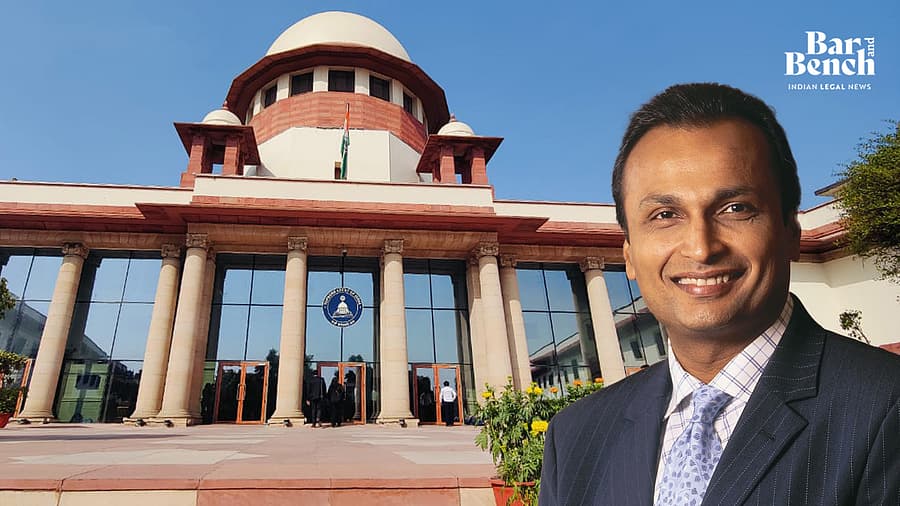
Supreme Court: Anil Ambani Black Money Act Petitions Transfer Sought
Summary
- The Union government and Income Tax department have petitioned the Supreme Court to consolidate and transfer Anil Ambani's challenges against the Black Money Act to the Delhi High Court.
- These petitions contest the Black Money (Undisclosed Foreign Income and Assets) and Imposition of Tax Act, 2015.
- A Supreme Court bench, including CJI Surya Kant, adjourned the matter for two weeks to allow the government to provide detailed information on pending cases.
- The government, represented by Senior Advocate Zoheb Hossain, argued for consolidation under Article 139A(2) to prevent a multiplicity of proceedings.
- CJI Kant suggested the Delhi High Court could decide the cases first, with its ruling potentially serving as a precedent for matters in other courts.
Supreme Court Considers Transfer of Anil Ambani's Black Money Act Challenges
Lawyers advising clients on similar challenges to the Black Money Act should closely monitor the Supreme Court's decision on consolidating Anil Ambani's petitions.
The Union government, alongside the Income Tax department, has formally approached the Supreme Court of India with a request to consolidate and transfer several legal challenges initiated by Reliance Communications Chairman Anil Ambani. These petitions, currently dispersed across various High Courts, specifically contest the constitutional validity and application of the Black Money (Undisclosed Foreign Income and Assets) and Imposition of Tax Act, 2015. The case, officially titled `Union of India v Anil Dhirajlal Ambani`, underscores a significant legal battle over India's foreign asset disclosure laws.
A Supreme Court bench, comprising Chief Justice of India Surya Kant, Justice Joymalya Bagchi, and Justice V Mohana, recently heard the matter. However, the proceedings were adjourned today, following a request from the government for an additional two weeks. This extension is intended to allow the government sufficient time to compile and submit comprehensive information regarding all similar cases that are currently pending before different High Courts, thereby providing the apex court with a complete picture of the ongoing litigation.
Arguments for Consolidation and Judicial Perspective
During the hearing, Senior Advocate Zoheb Hossain, representing the Income Tax authorities, emphasized the existence of numerous parallel legal challenges. He informed the bench that similar matters are actively being heard in both the Delhi High Court and the Bombay High Court, creating a situation of potential judicial inefficiency. Hossain strongly argued against allowing these proceedings to continue independently, asserting that such a fragmented approach would inevitably lead to a "multiplicity of proceedings" across various judicial forums, consuming valuable court resources and potentially resulting in conflicting judgments. To support the government's plea for consolidation, he specifically invoked Article 139A(2) of the Indian Constitution, which empowers the Supreme Court to transfer cases from one High Court to another if it deems it necessary for the ends of justice.
Chief Justice Kant, however, presented an alternative viewpoint on how to manage the dispersed litigation. He suggested that the Delhi High Court could be tasked with adjudicating these cases first, noting that there is "no delay" in its proceedings. The Chief Justice proposed that once a verdict is obtained from the Delhi High Court, that decision could then be cited and potentially guide the resolution of similar matters pending before the Bombay High Court. This approach, he implied, could still achieve a degree of judicial consistency without necessarily requiring an immediate, blanket transfer of all petitions.
Broader Implications for Tax Law and Precedent
The Supreme Court's ultimate decision regarding the transfer of `Anil Ambani Black Money Act petitions transfer` holds substantial implications for the broader legal interpretation and enforcement of the Black Money (Undisclosed Foreign Income and Assets) and Imposition of Tax Act, 2015. A unified ruling, particularly from a high-profile court like the Delhi High Court, could establish a critical precedent for how challenges to this Act are handled nationwide. This is especially pertinent given the ongoing `Black Money Act 2015 challenge consolidation` efforts.
Lawyers advising clients on similar challenges to the Black Money Act should closely monitor the Supreme Court's decision on consolidating Anil Ambani's petitions. A unified judgment from a single high court could significantly influence future litigation strategies concerning the Act's validity and interpretation, potentially streamlining the judicial process for what are effectively `Anil Ambani tax evasion cases` and other challenges to the Act. Such a development would offer a definitive legal framework, potentially shaping the landscape for tax compliance and enforcement in India.
Practical Implications
Lawyers advising clients on challenges to the Black Money Act should closely monitor the Supreme Court's decision on consolidating Anil Ambani's petitions, as a unified ruling from the Delhi High Court could establish a significant precedent for similar cases and influence future litigation strategies concerning the Act's validity.
Source
How does this affect you?
Get an AI analysis of this article grounded in your jurisdictions, practice areas, and any policy documents you've uploaded to Wansom.
Finish Reading the Full Story and the Expert Analysis.
Wansom is AI and can make mistakes.