
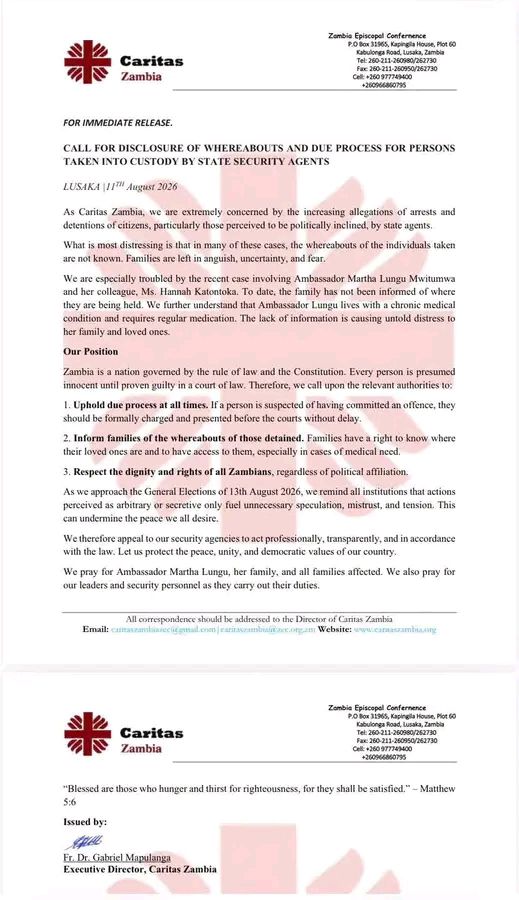
Caritas Zambia: Demands Disclosure of Political Detainees' Whereabouts
Summary
- Caritas Zambia has expressed alarm over increasing allegations of arrests and detentions of citizens.
- These detentions are reportedly carried out by state security agents and target individuals perceived to be politically inclined.
- The organization is demanding that authorities immediately disclose the whereabouts of all people taken into custody.
- This call highlights concerns about due process and human rights in Zambia.
Mounting Concerns Over Detentions
Ensuring that authorities are transparent about arrests and detentions is not merely a procedural requirement; it is fundamental to maintaining public trust in state institutions and upholding the integrity of the justice system.
Caritas Zambia, a prominent civil society organization, has issued a public statement expressing significant alarm regarding what it characterizes as a growing pattern of arrests and detentions targeting citizens within the country. The organization specifically highlighted that these actions appear to disproportionately affect individuals perceived to hold political inclinations, suggesting a potential targeting based on political affiliation. These alleged detentions are reportedly being carried out by state security agents, raising questions about the procedures and legal frameworks governing such actions.
The core of Caritas Zambia's concern centers on the lack of transparency surrounding these incidents. In response to these escalating allegations, the organization has made an unequivocal demand for immediate action from the authorities. Specifically, Caritas Zambia is calling for the prompt disclosure of the whereabouts of all individuals who have been taken into custody. This demand underscores a fundamental right to information regarding the status and location of detainees, particularly in cases where Zambia state security arrests are involved and the reasons for detention remain opaque. The call for transparency aims to address the uncertainty and distress caused to families and the wider public by the undisclosed nature of these detentions.
Safeguarding Due Process and Human Rights
The allegations brought forth by Caritas Zambia touch upon critical aspects of human rights and the rule of law, particularly concerning Zambian unlawful detentions. International human rights standards and domestic legal frameworks typically mandate that any individual arrested or detained must have their whereabouts known to their family and legal counsel, and that they be brought before a court within a reasonable timeframe. When state security agents conduct arrests without immediately disclosing the location of those taken into custody, it creates an environment ripe for potential abuses and undermines fundamental due process protections.
Such undisclosed detentions can severely impede a detainee's ability to access legal representation, communicate with their family, or challenge the legality of their arrest. This lack of transparency is a significant concern for human rights Zambia detentions, as it can lead to situations where individuals are held incommunicado, increasing their vulnerability. Civil society organizations, like Caritas Zambia, play a vital role in monitoring state compliance with human rights obligations and advocating for accountability when these principles are challenged. Their intervention highlights the importance of upholding constitutional guarantees even in matters involving national security or political sensitivities.
The Imperative of Transparency and Accountability
The repeated calls from Caritas Zambia for clarity on the Caritas Zambia political detainees whereabouts underscore a broader concern about governance and the protection of civil liberties in Zambia. When allegations of politically motivated arrests by state security agents surface, and the locations of those detained are not immediately disclosed, it can have a chilling effect on freedom of expression and political participation. Citizens may become hesitant to voice dissenting opinions or engage in political activities if they fear arbitrary detention and a lack of transparency regarding their fate.
Ensuring that authorities are transparent about arrests and detentions is not merely a procedural requirement; it is fundamental to maintaining public trust in state institutions and upholding the integrity of the justice system. The demand for Caritas Zambia demands disclosure is therefore a call for accountability, urging the government to adhere to its own laws and international commitments regarding human rights. Addressing these concerns promptly and openly is crucial for demonstrating a commitment to democratic principles and safeguarding the rights of all citizens, irrespective of their perceived political leanings. The ongoing monitoring by organizations like Caritas Zambia serves as a critical check on state power, advocating for adherence to legal norms and preventing potential abuses that can arise from opaque detention practices.
Practical Implications
Lawyers should monitor increasing allegations of arbitrary arrests and undisclosed detentions by Zambian state security, advising clients on their rights during custody and preparing to challenge potential due process violations or human rights abuses.
Source
How does this affect you?
Get an AI analysis of this article grounded in your jurisdictions, practice areas, and any policy documents you've uploaded to Wansom.
Wansom is AI and can make mistakes.