
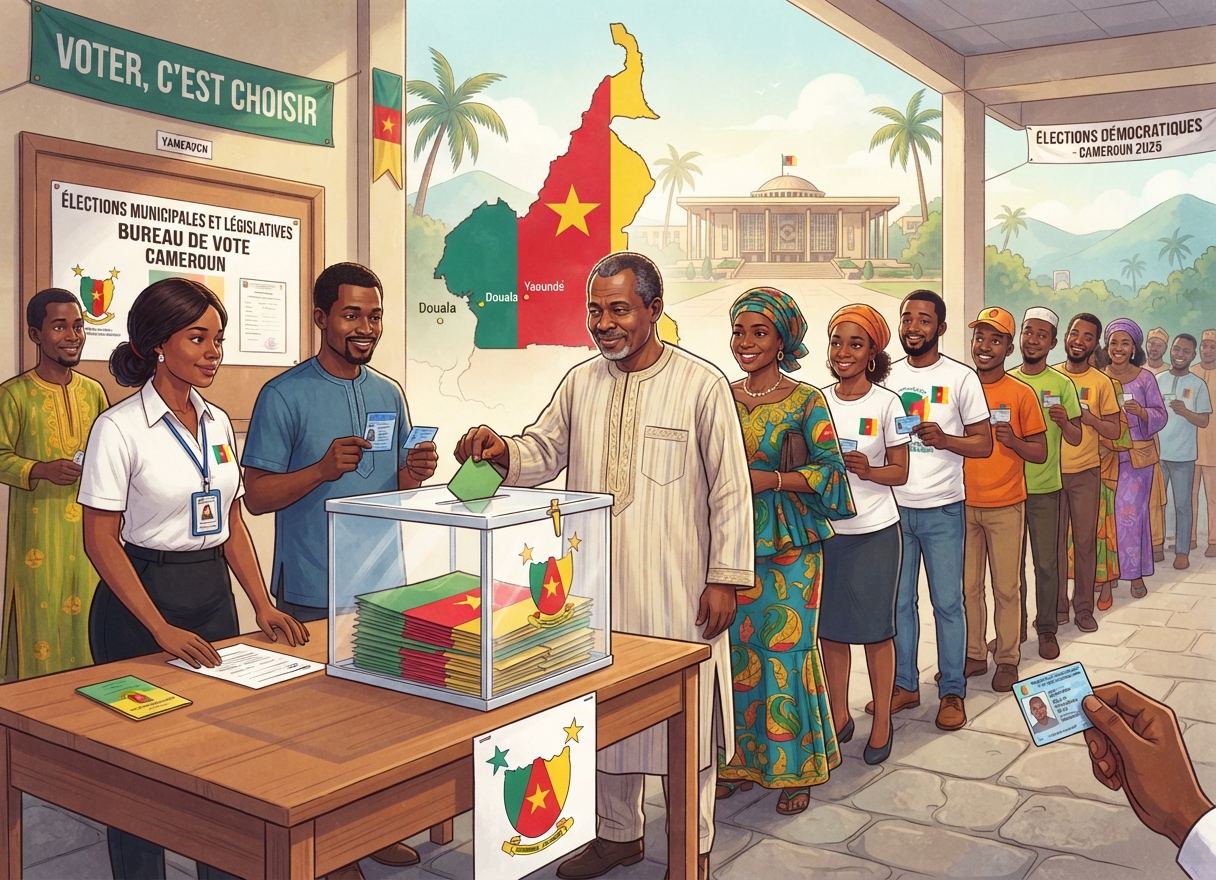
Cameroon Legislative Municipal Elections 2027: President Biya Sets Date
Summary
- President Paul Biya officially scheduled the legislative and municipal elections for February 7, 2027, via a decree signed on November 9, 2026.
- This decision follows a two-year extension of mandates for current deputies and municipal councilors, ending a period of political uncertainty regarding the Cameroon electoral calendar 2027.
- The upcoming Cameroon legislative municipal elections 2027 will be the first electoral test since the highly contested 2025 presidential election, which saw President Biya declared winner amidst opposition protests.
- A major opposition party, the Front pour le salut national du Cameroun (FSNC), was suspended for three months in late October 2026, impacting its participation in the crucial pre-election period.
- The elections are seen as a critical barometer for political stability and will significantly influence the country's future leadership, particularly concerning the potential for a Cameroon political transition at the highest level.
Official Election Announcement
The forthcoming electoral campaign, balancing the government's stated desire for stability with voter demands for transparency, is poised to be one of the most pivotal for Cameroon's institutional future this decade.
President Paul Biya officially set the date for the upcoming legislative and municipal elections for Sunday, February 7, 2027. This decision was formalized through a decree signed on November 9, 2026, effectively ending a prolonged period of political uncertainty regarding the nation's electoral calendar. The announcement follows a two-year extension of the mandates for both parliamentary deputies and municipal councilors, confirming that these crucial polls will not take place in 2026 as some had anticipated.
These Cameroon legislative municipal elections 2027 represent the first significant political test for the country since the highly contested presidential election of 2025. The dual ballot will see Cameroonians return to the polls to elect representatives for the 180 seats in the National Assembly and members for the 360 municipal councils, marking a pivotal moment in the nation's political trajectory.
Post-Election Political Climate
The upcoming elections unfold against a backdrop of a deeply polarized political environment, stemming from the October 2025 presidential election. During that contest, President Paul Biya, then 93 years old, was declared the winner with 53% of the votes. However, opposition parties, which collectively garnered over 45% of the ballots, vehemently disputed these results, leading to widespread demonstrations that were met with severe repression.
In this tense atmosphere, the February 2027 elections are far from a mere administrative exercise. They are widely viewed as a critical barometer to assess the territorial influence of various political forces and to gauge the resilience of the ruling Rassemblement démocratique du peuple camerounais (RDPC). The RDPC currently holds a dominant position, controlling 152 out of the 180 seats in the lower house of parliament, in addition to governing the vast majority of the country's major cities.
Key Stakes and Opposition Challenges
The Cameroon legislative municipal elections 2027 carry three primary stakes. Firstly, they highlight the ongoing battle for representativeness and renewal within the political class. Issues surrounding the inclusion of youth and women in decision-making bodies remain prominent, with previous regional elections underscoring the difficulties these groups face in accessing positions of power. Generational renewal is therefore a significant challenge for all political parties.
Secondly, the elections will shape the recomposition and potential marginalization of the opposition. The political landscape is currently experiencing considerable turbulence. Notably, the Front pour le salut national du Cameroun (FSNC), led by Issa Tchiroma Bakary, who placed second in the presidential election, faced a three-month suspension in late October 2026 by the Ministry of Territorial Administration. This sanction, imposed for alleged 'incitement to insurrection,' severely hampers the party during the crucial period for candidate investments. Meanwhile, other prominent opposition formations, including the MRC, whose former leader Maurice Kamto resigned in September 2026, the PCRN, and the SDF, are actively seeking to leverage public discontent to challenge the RDPC's long-standing hegemony.
Finally, the shadow of a potential Cameroon political transition at the highest echelons of government looms large. These legislative elections hold immense institutional importance due to ongoing discussions about the nonagenarian president's health and recurring debates concerning a potential power vacuum. A constitutional reform previously reintroduced the position of vice-president, designated to succeed the head of state in the event of incapacity. Consequently, securing a majority in the National Assembly is paramount for various political factions aiming to influence the mechanisms of any future power transition.
Electoral Preparations and Administration
The electoral management body, Elections Cameroon (ELECAM), is confronting substantial organizational challenges in preparing for the 2027 polls. As of August 31, 2026, the provisional electoral roll had been updated to include over 8.2 million registered voters, a figure that incorporates 252,830 new registrants. Managing such a large and dynamic voter base requires considerable logistical effort.
In a move aimed at ensuring institutional stability ahead of the ELECAM 2027 elections, President Paul Biya concurrently renewed the mandate of Enow Abrams Egbe, the president of ELECAM's electoral council. The forthcoming electoral campaign, balancing the government's stated desire for stability with voter demands for transparency, is poised to be one of the most pivotal for Cameroon's institutional future this decade.
Practical Implications
Lawyers and compliance officers in Cameroon should note the official setting of legislative and municipal elections for February 7, 2027, as this clarifies the political calendar and ends a period of uncertainty. This development signals a critical period for political stability and potential legal challenges, particularly given the contested 2025 presidential election and the suspension of a major opposition party. Legal professionals should monitor electoral regulations, potential for civil unrest, and any constitutional implications related to the presidential succession, which could impact business operations and legal risk assessments.
Source
How does this affect you?
Get an AI analysis of this article grounded in your jurisdictions, practice areas, and any policy documents you've uploaded to Wansom.
Finish Reading the Full Story and the Expert Analysis.
Get the latest legal & regulatory intelligence in Cameroon
Wansom is AI and can make mistakes.