
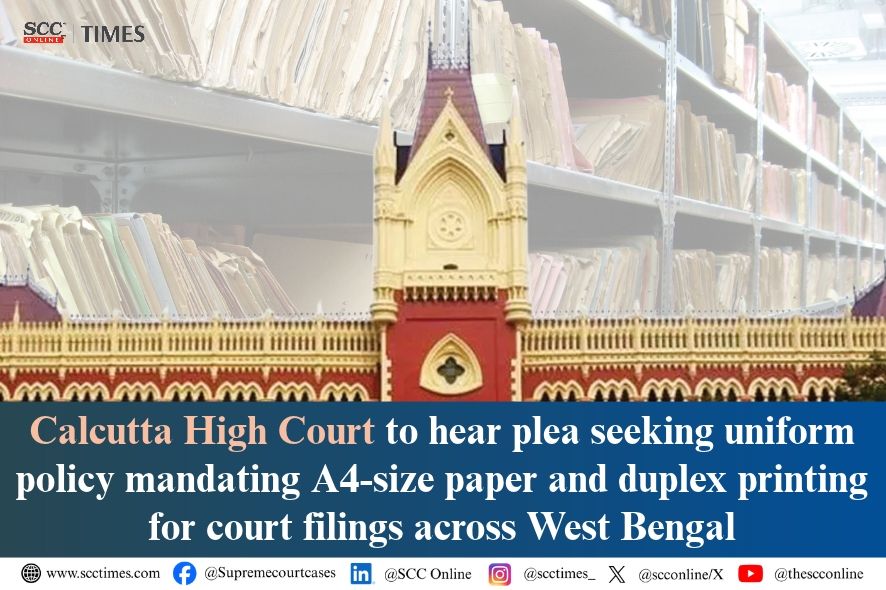
Calcutta High Court: A4 Paper Policy Plea for Uniform Filings
Summary
- The Calcutta High Court considered proposals for standardizing court filings on February 22, 2021.
- The case, Nikunj Berlia v. High Court at Calcutta (WPA 4575 of 2020), addressed paper quality and size.
- A uniform policy mandating A4-size paper and duplex printing for all West Bengal court filings is under consideration.
- This initiative aims to streamline administrative processes and promote environmental sustainability.
What Happened
The outcome of the Calcutta High Court A4 paper policy plea holds considerable importance for legal professionals, court administrators, and the broader legal ecosystem in West Bengal.
On February 22, 2021, a Division Bench of the Calcutta High Court addressed significant proposals concerning the standardization of materials used for court submissions. The court, in the matter of Nikunj Berlia v. High Court at Calcutta, identified by the case number WPA 4575 of 2020, specifically considered establishing a uniform policy. This policy aims to mandate the use of A4-size paper and duplex printing for all court filings across the state of West Bengal. The deliberation focused on ensuring consistency in the physical presentation of legal documents submitted to the courts.
The initiative seeks to introduce a clear directive that would govern both the dimensions and the printing method for all official papers filed within the Calcutta High Court's jurisdiction and potentially other courts in West Bengal. This move signals a potential shift towards more regulated and standardized document submission practices, aiming to bring uniformity to a process that may currently lack it. The court's consideration of these proposals underscores a commitment to refining administrative aspects of judicial proceedings.
Legal and Administrative Context
The consideration of a uniform policy for court filings, particularly regarding paper size and printing methods, reflects a broader administrative effort to enhance efficiency within the judicial system. Currently, the absence of a universal standard for court document printing rules in India, or specifically within West Bengal courts, can lead to inconsistencies in document handling and storage. Implementing a standard paper size, such as A4, which is widely used internationally, could significantly streamline administrative processes and improve the accessibility and manageability of court records.
The specific proposal for duplex printing, which involves printing on both sides of a sheet of paper, also carries important implications for resource management and environmental sustainability. Such a mandate would not only standardize the physical format of submissions but also potentially contribute to reducing paper consumption and associated costs. This initiative by the Calcutta High Court could set a precedent for other judicial bodies in India to adopt similar modern practices for court filings, aligning with global best practices for document management. The move is part of an ongoing effort to modernize the legal infrastructure.
Why It Matters
The outcome of the Calcutta High Court A4 paper policy plea holds considerable importance for legal professionals, court administrators, and the broader legal ecosystem in West Bengal. A mandated shift to A4-size paper and duplex printing would necessitate immediate and significant adjustments in document preparation and submission protocols for all legal practitioners. Law firms and individual lawyers operating within West Bengal would need to update their printing equipment, paper procurement strategies, and internal guidelines to ensure full compliance with the new requirements.
Beyond the immediate operational changes, this standardization could lead to substantial long-term benefits for the judicial system. These include improved archival efficiency, reduced physical storage space requirements for court records, and potentially lower costs associated with paper consumption for the courts themselves. The decision in Nikunj Berlia v. High Court at Calcutta, WPA 4575 of 2020, therefore represents a pivotal moment for modernizing court document management in the region, impacting how legal information is processed, stored, and preserved for years to come, ultimately aiming for greater consistency and environmental responsibility.
Practical Implications
Lawyers and compliance officers practicing in West Bengal should closely monitor the outcome of this plea, as a mandated shift to A4-size paper and duplex printing for court filings would necessitate an immediate change in document preparation and submission protocols, impacting operational costs and efficiency.
Source
How does this affect you?
Get an AI analysis of this article grounded in your jurisdictions, practice areas, and any policy documents you've uploaded to Wansom.
Finish Reading the Full Story and the Expert Analysis.
Wansom is AI and can make mistakes.