
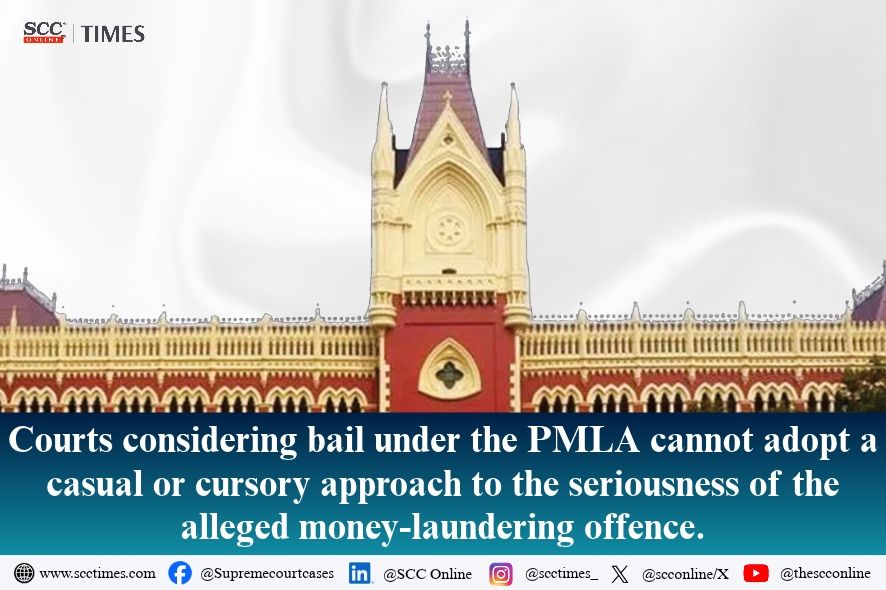
Calcutta High Court: Denies Bail to Sujit Bose in Recruitment Scam, Cites PMLA Section 45
The Calcutta High Court, in West Bengal, recently denied bail to Sujit Bose, a former Minister and Vice-Chairman of South Dum Dum Municipality, in a matter concerning an alleged municipal recruitment scam, with the decision touching upon Section 45 of the Prevention of Money Laundering Act (PMLA).
This decision is profoundly significant for legal practitioners, particularly those involved in economic offense cases, as it underscores the stringent bail conditions under Section 45 of the PMLA. The ruling reinforces the judiciary's cautious approach to granting bail in cases involving allegations of money laundering, especially when the accused holds or has held public office. It signals a continued judicial emphasis on combating corruption and financial irregularities, which can have far-reaching implications for public trust and governance.
The core legal context of this matter revolves around Section 45 of the Prevention of Money Laundering Act, 2002 (PMLA), which imposes strict 'twin conditions' for granting bail. These conditions require the court to be satisfied that there are reasonable grounds for believing that the accused is not guilty of such offense and is not likely to commit any offense while on bail. The Calcutta High Court, operating within the Indian judicial hierarchy, interprets and applies these statutory provisions, setting a precedent within its jurisdiction for similar bail applications. The alleged municipal recruitment scam falls under the broader ambit of corruption and economic offenses, often investigated by specialized agencies like the Enforcement Directorate (ED) in India.
The key parties involved include Sujit Bose, the petitioner and former public official, and the Calcutta High Court, which adjudicated the bail application. Implicitly, the investigating agency responsible for the PMLA proceedings (likely the Enforcement Directorate) and the State of West Bengal are also central to the context of the alleged scam. The outcome of this specific bail application is reported as a denial, highlighting the rigorous application of PMLA provisions.
Attorneys representing clients accused under the PMLA, especially those in public life or implicated in alleged scams, must be acutely aware of the high threshold for bail under Section 45. They should meticulously prepare arguments addressing the
How does this affect you?
Get an AI analysis of this article grounded in your jurisdictions, practice areas, and any policy documents you've uploaded to Wansom.
Finish Reading the Full Story and the Expert Analysis.
Get the latest legal & regulatory intelligence in India
Wansom is AI and can make mistakes.